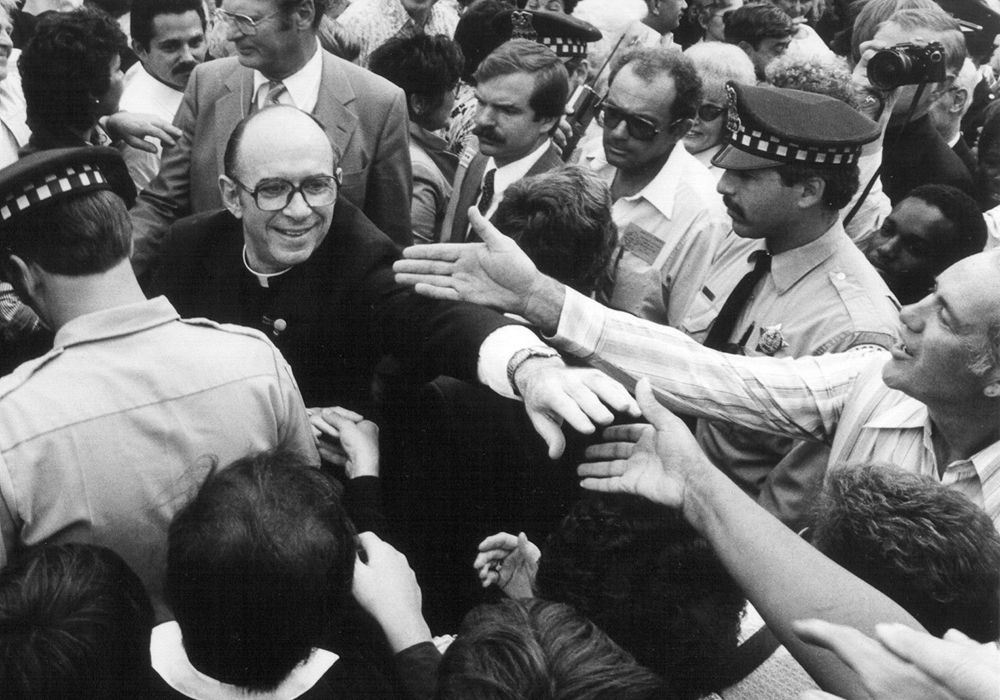
Joseph Bernardin, then the newly installed archbishop of Chicago, reaches out to admirers in a crowd in this 1982 photo. Then-Archbishop Bernardin became head of one of the nation's largest Catholic dioceses. Bernardin died Nov. 14, 1996. (CNS file photo)

by Enzo Del Brocco
Join the Conversation
Send your thoughts to Letters to the Editor. Learn more
Thirty years after his death on Nov. 14, 1996, Cardinal Joseph Bernardin continues to teach, and like every prophet, to unsettle. I read The Gift of Peace in 1998 during a retreat a few months after it was published. I was a young priest then. Now as president of Catholic Theological Union, the home of the Bernardin Center, I remember how I was struck by the words he used to express the lifelong spiritual process of letting go: "By letting go, I mean the ability to release from our grasp those things that inhibit us from developing an intimate relationship with the Lord Jesus." Those are unsettling words in a world where control and possession seem to determine a successful life.
I also remember the breathless tears I shed after reading about his encounter with a former seminarian who had publicly accused the cardinal of sexual abuse in November 1993. The accusation was withdrawn in early 1994, and Bernardin could have let the matter close with his name cleared. Instead, on Dec. 30, 1994, he went looking for the man who had nearly destroyed his reputation, not for revenge but for peace. He brought a Bible and a hundred-year-old chalice that a stranger had given him for the purpose of saying Mass for him. That day the accused and his accuser, Steven Cook, stood at the same altar and celebrated Mass with that chalice. "He was the sheep who had been lost, and, as a shepherd, I knew that I had to seek him out," Bernardin wrote.
Seeking out the lost was not just a pastoral instinct; it was the root of his moral vision. His profound conviction that every human being bears the image of God gave birth to a great moral teaching known as the consistent ethic of life. It is a teaching that unsettles every side. The day he celebrated Mass with Steven, he gave flesh to that consistent ethic of life. It was that same refusal to see anyone as an enemy that prompted him to commit himself deeply to ecumenical and interreligious dialogue, to build lasting bonds of trust with the Jewish community, and to speak as a peacemaker during the nuclear age.
Faithful to Gaudium et Spes, which calls the church to read the signs of the times in the light of the Gospel, Bernardin recognized that addressing threats to human life in isolation risked obscuring their deeper connection. He believed that grounding our responses in the dignity of every human person would strengthen each commitment and reveal the moral responsibility they shared. The Second Vatican Council itself had already joined them, condemning in one breath: "Whatever is opposed to life itself, such as any type of murder, genocide, abortion, euthanasia or willful self-destruction, whatever violates the integrity of the human person … all these things and others of their like are infamies indeed." (GS, 27). In Bernardin's words: "The viability of the principle depends upon the consistency of its application."
During a lecture at Fordham University in December 1983, he presented the consistent ethic of life by using the Gospel image of the seamless garment (John 19:23-24) to show that the defense of human life is one fabric. He proposed an ethic — without equating — that held together abortion, nuclear war, capital punishment, poverty and care for the dying. Bernardin's consistent ethic was not to erase the moral differences among these issues, but to insist that the dignity of the human person must inform our response to each of them.
That teaching was picked up 40 years later by then-Cardinal Robert Prevost, now Pope Leo XIV, when he returned to Chiclayo, Peru, to receive an honorary doctorate from the university that had been under his jurisdiction while he was bishop there. During his speech he said: "A Catholic cannot declare himself pro-life only by holding a position against abortion but then saying he is in favor of the death penalty. That would not be consistent with the Church's social doctrine. … Today we need once again Cardinal Bernardin's proposal and perhaps more than ever." And last year, as Pope Leo XIV, he reiterated: "Someone who says, 'I'm against abortion' but says, 'I'm in favor of the death penalty,' is not really pro-life." He continued, "So someone who says that, 'I'm against abortion but I'm in agreement with the inhuman treatment of immigrants who are in the United States,' I don't know if that's pro-life."
Since I became president of Catholic Theological Union, I have found myself confronting questions of life at every turn: in the news each morning, in conversations with students and colleagues. I think of the inhumane treatment of migrants, the killing of both non-citizens and citizens by federal agents, laws permitting the ending of life at its beginning and at its end, the world war in pieces, antisemitism and anti-Muslim bigotry, the number of victims of fentanyl and gun violence, the violations of international law, the arms race and lack of access to healthcare, and the ones I encounter every day with no home.
Behind these issues are real people with an inherent dignity, and yet many of us quickly pick which lives to see or ignore. We decide which lives count and stop listening to the other and in the end we all miss the depth of human dignity at every stage, condition, age, origin, faith or economic status.
In contrast, Bernardin knew that a consistent ethic of life could not be lived by people who only advocate their point of view without seeing the seeds of truth in the other. For this reason, in August 1996, three months before his death, he launched the Catholic Common Ground Initiative, convinced that a divided Church could rediscover its unity only by listening across its divisions. Cardinal Bernardin insisted that the initiative be "centered on faith in Jesus, marked by accountability to the living Catholic tradition, and ruled by a renewed spirit of civility, dialogue, generosity, and broad and serious consultation." He never intended it as a way to avoid conflict, nor as a strategy to manage disagreements.
In Bernardin's view, Common Ground was a spiritual path to help us become disciples of Christ and to help the church grow as a community of spiritual mature believers. The consistent ethic of life asks us to recognize the dignity of every human being. Common Ground asks us to recognize that dignity even in persons whose convictions we found profoundly mistaken. In other words, Common Ground is the ecclesial expression of the consistent ethic of life.
In line with Bernardin, Pope Francis invited us to expand our vision. In Laudato Si' he emphasized that "everything is connected," and later, in Fratelli Tutti, he reminded us that we are all brothers and sisters. This is Bernardin's seamless garment in the language of our time. If everything is connected, no life can be ignored, and we cannot defend one life while discarding another. In Gaudete et Exsultate he wrote, "Our defense of the innocent unborn, for example, needs to be clear, firm and passionate, for at stake is the dignity of a human life, which is always sacred and demands love for each person, regardless of his or her stage of development. Equally sacred, however, are the lives of the poor, those already born, the destitute, the abandoned and the underprivileged, the vulnerable infirm and elderly exposed to covert euthanasia, the victims of human trafficking, new forms of slavery, and every form of rejection." (GE, 101). If we are all brothers and sisters, then, as Pope Francis said: "No one is useless and no one is expendable" (Fratelli Tutti, 215).
What Bernardin began as an initiative is now finding its natural evolution in synodality: a way of walking together, listening before judging, discerning together what the Spirit is asking. Today Pope Leo XIV proposes synodality beyond the church, asking all of us to search for answers together rather than in opposition to one another (cf. Magnifica Humanitas, 10). In Magnifica Humanitas he writes, "Let us not be afraid to get our hands dirty on the 'construction site' of our time. … The task that stands before us is that of being builders of communion, rather than architects of Babel" (MH, 16). Such work is rarely easy.
Thirty years on, I see more clearly that Bernardin's legacy still continues. The Gift of Peace mentions Bernardin going out to Steven Cook with a Bible and a chalice. When James and John asked for places of honor, Jesus asked them, "Can you drink the cup that I drink?" (Mark 10:38). Bernardin drank from it not only while celebrating Mass, but he also drank from it when he was falsely accused and again when his cancer returned. In what he described as letting go, he learned what every disciple must learn: The chalice hardest to drink is the one most full of life. That is his gift to us. Not the absence of conflict, but the peace of a man who refused to make an enemy of anyone, including death.
Advertisement