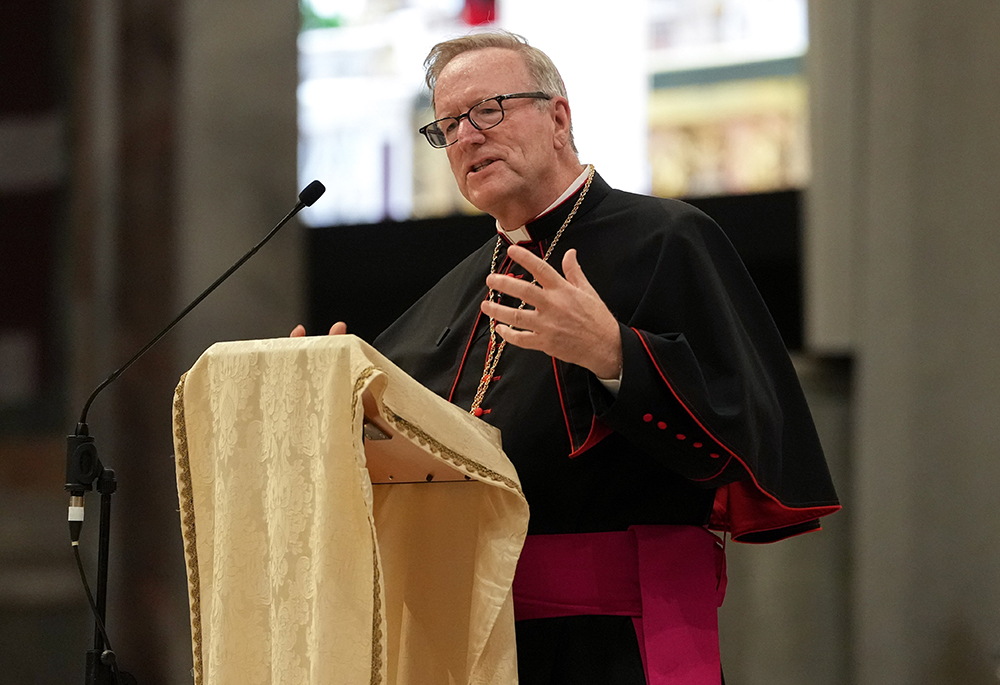
Bishop Robert E. Barron of Winona-Rochester, Minnesota, gives the keynote address during the USA National Jubilee Pilgrim Gathering at the Basilica of St. Paul Outside the Walls in Rome, July 30, 2025. (CNS/Lola Gomez)

Join the Conversation
Send your thoughts to Letters to the Editor. Learn more
Bishop Robert Barron of Winona-Rochester, Minnesota, appeared on EWTN's "The World Over with Raymond Arroyo" last week. It was unfortunate.
Arroyo started by asking about a recent document from the Holy See that reflected on the 60 years since the promulgation of Nostra Aetate, the Second Vatican Council's Declaration on the Relation of the Church to Non-Christian Religions. This document was among the most consequential issued by Vatican II, revolutionizing the church's understanding of and relationship with non-Christian religions, especially with Judaism.
In the course of the discussion, Arroyo noted that Cardinal Walter Brandmüller has long noted that Nostra Aetate is a "declaration not a dogmatic constitution, in other words, not binding doctrinally" and asked Barron how much doctrinal weight Catholics should accord it.
Barron had an easy answer: Nostra Aetate is a decree of an ecumenical council, and it was signed by a now-canonized pope. It is doctrinally binding. Unfortunately, Barron limped. "I think there are elements in it that really belong to the doctrine of the church." Why parse this? Are there elements in it that do not belong to the doctrine of the church? Isn't it the case that conciliar decrees are the very essence of church doctrine? To be fair, Barron went on to commend the document on many points, but he should have used the occasion to instruct Arroyo on the weight of conciliar decrees, all conciliar decrees.
The real trouble began when Arroyo asked Barron about a recent interview published here at NCR with Bishop Daniel Flores of Brownsville, Texas, who is the current vice president of the U.S. bishops' conference. Flores called for "self-restraint" on the part of bishops in the highly charged political atmosphere in which the nation finds itself. Arroyo also noted that, when asked about Barron's advising the Trump administration, combined with his frequent, outspoken attacks on prominent Democrats, Flores replied, "I think the church is robust enough to be able to handle when somebody speaks in that way."
To be fair, Barron is right to insist that he is not a "member of the Trump administration" and that many clerics have served advisory roles to presidents in the past, citing Fr. Theodore Hesburgh who served on 16 presidential commissions from the Eisenhower through Nixon administration during his tenure as president of the University of Notre Dame. But it should be obvious even to Barron that Donald Trump is no Dwight Eisenhower and even Nixon had the decency to resign when he was caught trampling on the Constitution.
Advertisement
Then Arroyo noted that Chicago Cardinal Blase Cupich had called the deportation policy of the Trump administration "profoundly disturbing" and Washington Cardinal Robert McElroy said mass removals of people is "contrary to human dignity." "None of that, I will note, has drawn a public call for restraint," Arroyo added. Is there a double standard? Arroyo asked.
Barron said that, in regard to the cardinals, he would distinguish between moral principles and prudential judgment. As a citizen, a member of the clergy is entitled to form their own opinions on particular policies but that "as a churchman, that's not my prerogative, it seems to me. Mine is to articulate the great principles. When it comes to, what's precisely the right way to formulate immigration policy, or what's exactly the right way to frame tax legislation, that's not my prerogative. I have no competence in that regard."
Competence? Does the bishop not have eyes and ears? "The poor man called, and the Lord heard him," the psalmist tells us. Should not the Lord's ministers also hear the cries of the poor?
Barron, like many who navigate the estuary where politics and religion intersect, wishes to turn prudential judgment into a get-out-of-jail-free card. Are religious leaders really to allow an inhumane policy to go unnoticed, one that clearly violates moral principles, simply because it is a policy?
At one point in the interview, Barron recalls his mentor, the late Cardinal Francis George. I admired George greatly, but I thought he made a terrible mistake when he led the bishops' conference to oppose the Affordable Care Act because of the possibility it would make abortion more accessible. On Barron's reading, George was not wrong to reach the conclusion he did because it miscalculated the relative merits and problems with the legislation. He was wrong to have any opinion on it at all.
Later in the interview, when the issue turns to religious liberty and Barron's recent appointment to the United States Commission on International Religious Liberty, Barron was not so concerned about distinguishing between articulating moral principles and applying moral analysis to policy decisions. He called for the release of Catholic dissident Jimmy Lai from prison in China, as well he should. But that is a concrete policy decision, is it not?
And, by the way, Dignitatis Humanae, the Vatican II Declaration on Religious Freedom, is, like Nostra Aetate, a declaration, not a dogmatic constitution. I wonder why Arroyo was not agitated about its doctrinal status?
Perhaps Barron should look ahead to next week's Gospel reading in which Jesus says to the chief priests and the elders:
A man had two sons.
He came to the first and said,
"Son, go out and work in the vineyard today."
He said in reply, "I will not,"
but afterwards changed his mind and went.
The man came to the other son and gave the same order.
He said in reply, "Yes, sir," but did not go.
Which of the two did his father's will?"
We all have biases and blinders, but it is the better part of mature judgment to call them out no matter where we find them. His advocacy for the unborn is damaged by his failure to defend the undocumented. Inconsistency is the enemy of moral leadership. Barron is correct to insist he is not a "member of the Trump administration" but his selective treatment of the Church's teachings convicts him as an apologist for the president.
Editor's note: You are reading a selection from Michael Sean Winters' weekly newsletter. To get the full edition — including the "In the News" link roundup — delivered 24 hours before it appears online, sign up here!