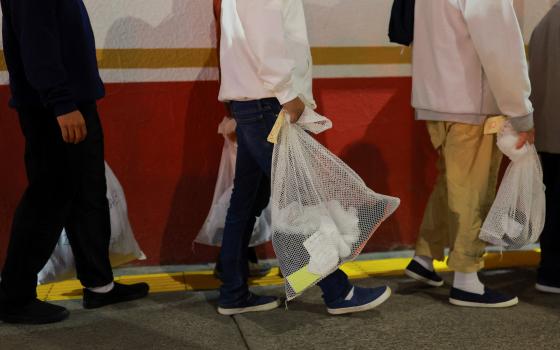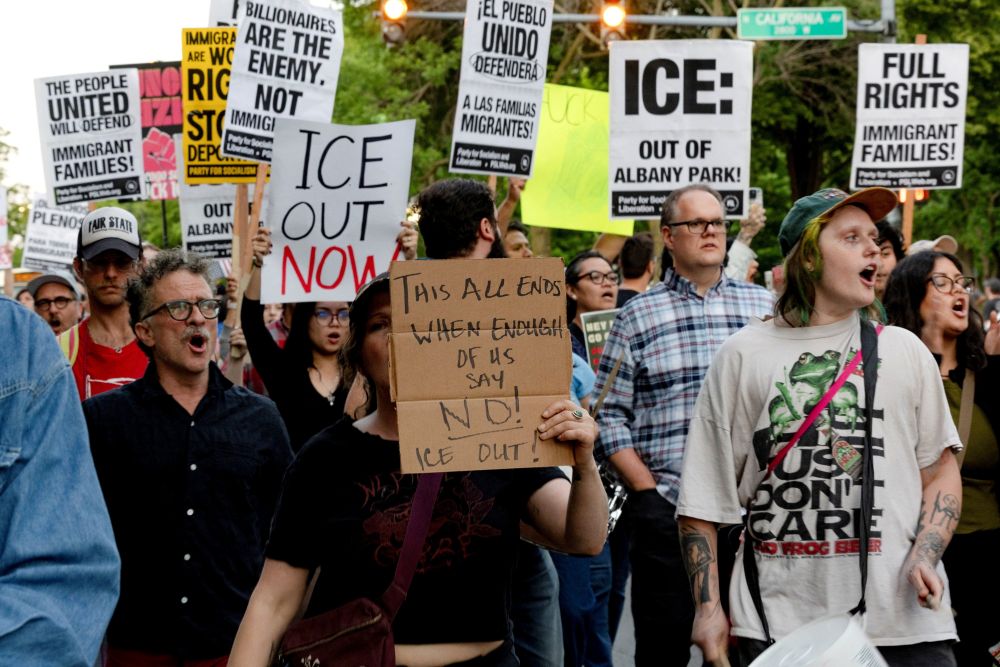
Demonstrators opposed to U.S. Immigration and Customs Enforcement, or ICE, march through the streets during a protest in the Albany Park neighborhood of Chicago June 3, 2026, against immigration enforcement operations by federal agents. (OSV News/Reuters/Jim Vondruska)
by Sr. Christine Schenk
Join the Conversation
Send your thoughts to Letters to the Editor. Learn more
I am sickened by actions from the Trump administration that violate the human and legal rights of migrants. I am also disgusted by the administration's apparent determination to undermine the integrity of the U.S. election process.
So when I learned about an Aug. 25 online campaign call working to protect our elections and advocate for migrants, I signed up.
Sponsored by Catholics in Communion, the call was one of several virtual opportunities designed to educate, share strategies across faith-based networks and shore up hope during these dismal times. CIC is a collaboration of Catholic social ministry groups, religious orders and academic and parish leaders.
The virtual session did not disappoint.
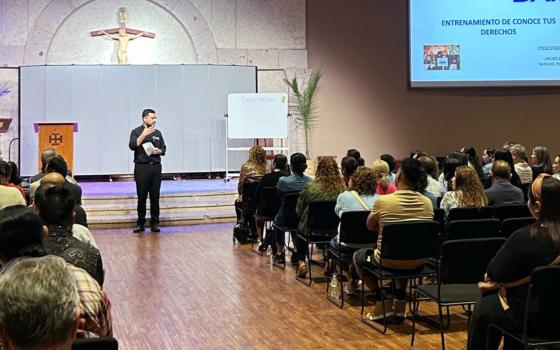
Nearly 200 Catholic activists, parish leaders and organizers from various religious orders, migrant ministries and justice organizations heard Zoom presentations from Sr. Norma Pimentel and Megan Toppe Goodwin before joining breakout groups to share advocacy efforts and learn from one another.
Prayer first
A beloved Catholic "shero," Sister Norma is a Missionary of Jesus who knows well the sufferings of migrant families whom she accompanies daily in her capacity as the executive director of Catholic Charities of the Rio Grande Valley. Pimentel spoke movingly about the need for Catholic change-seekers to root themselves in prayer if we are to find courage to speak out.
"We cannot start without God," she said. "God in our life is key in directing us and feeding us with the fire and the force that we need to be who he is calling us to be. We see the pain and the suffering. It's not easy. Our hearts hurt when we see them [migrant families] hurting."
And so, Pimentel advised:
You must not stay quiet. Even though you're afraid, don't let that hold you back from actually living out that presence of God within you that is calling you forward. And we can only experience that if we spend time with God every day. And you don't have to say anything. We just simply have to be there with him.
Pimentel may have been reflecting her own experience when she described what happens when we spend time with God.
"Because God within us will fill us with his presence and will pull us forward to know what to say, what to do, to be able to not let our fear and whatever holds us back from really acting the way we need to," Pimentel said.
A history of Catholics defending elections worldwide
Goodwin, the founder and executive director of the St. Catherine of Siena Forum for Democracy, outlined the theological basis for Catholic engagement in democracy and then shared case studies from the Philippines, the Democratic Republic of the Congo and Malawi. In all three countries, the Catholic Church had engaged in defending elections, with impressive results.
Advertisement
In 1986, the church in the Philippines organized a parallel system for counting votes and exposed a massive election fraud conducted by the Marcos regime. Cardinal Jaime Sin spoke out on Catholic Radio Veritas. Two million citizens took to the streets and eventually brought about a nonviolent end to the Marcos dictatorship.
In 1992, Malawi's eight Catholic bishops wrote a pastoral letter that publicly exposed government corruption, nepotism, inequality and the regime's refusal to permit any opposition voices. It was read in every single parish during Lent, sparking national resistance, strikes and protests. Three months later a national referendum ended the country's one-party state.
In 2016 in the DRC, the nation's bishops brokered an election date and deployed 40,000 election observers ensuring the first peaceful transfer of power in that country in 59 years.
Goodwin identified the pattern that led to success in all three countries: First, "Bodies at the ballot box. In the Philippines and in Congo, they deployed a protective presence for the people against violence." Second, she noted the presence of "an honest number [of election results] said aloud, speaking the truth in the face of opposition, and retaining their voice." Last, "a [media] channel that couldn't be captured … Radio Veritas or a pastoral letter read through the parishes."
After Pimentel and Goodwin spoke, online attendees joined one of four breakout sessions: protecting participation in civic life through the elections; protecting migrant families; Catholic social teaching and leadership formation; and a special Spanish-speaking option.
Each breakout shared strategies and experiences from their local areas.
The protecting elections breakout reported that their conversation included ways to engage local election officials as well as parish staff and parish priests. A social justice minister in New York city said her parish already has a voter registration drive in place.
The protecting migrant families breakout prioritized a need to work for pastoral care access in all detention facilities and to push for accounting for children whose parents are detained. They observed that "immigration work encompasses lots of different expressions" and noted the link between election work and immigration. A number of naturalized citizens will have a deep fear of going to the polls given concerns over racial profiling by law enforcement.
On Sept. 27, the World Day of Migrants and Refugees, special Masses are planned in many dioceses.
The Catholic social teaching and leadership formation breakout prioritized a need to engage parish staff and noted that training programs by the JustFaith Network are helpful.
What you can do
Consider signing up for the Sept. 22 Catholics in Communion campaign call.
Download CIC's toolkit Protecting Participation in Civic Life Workbook, designed to help Catholics organize to accompany voters, contest misinformation, and ensure safe and meaningful elections for all. It includes a helpful timeline of virtual events leading to election day.
Attend a Virtual Theological Conference on the evenings of Sept. 16 and 17 for input from two archbishops and theologians from over eight universities.
Consider online training as a poll chaplain sponsored by Faiths United to Save Democracy on the afternoon and evening of Sept. 28 and Oct. 15.
Check out the Coalition for Spiritual and Public Leadership, which merges liberation theology and community organizing and works to bring pastoral care to immigrant detainees.
The Federation of the Sisters of St. Joseph is sponsoring a protect election integrity project and the Franciscan Action Network has developed a special Election Official Outreach Toolkit
And a special virtual Interfaith Immigration Summit will be held Oct. 29 and 30, sponsored by the Catholic Legal Immigration Network.
In these heart-rending times we must ask ourselves, what is ours to do?
I give the last word to Sister Norma:
God wants us to be prophets, to be able to be there. ... The most important thing we do is simply to love, to care, to have compassion, to be present ... No matter what it is that we have to face, we don't face it alone, and that gives us strength. Because together we make the presence of God even stronger ... It is that that will transform the world, transform this country.