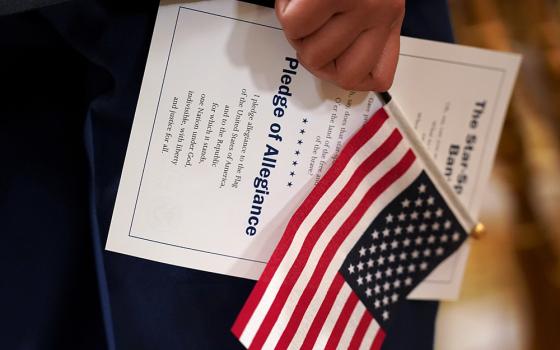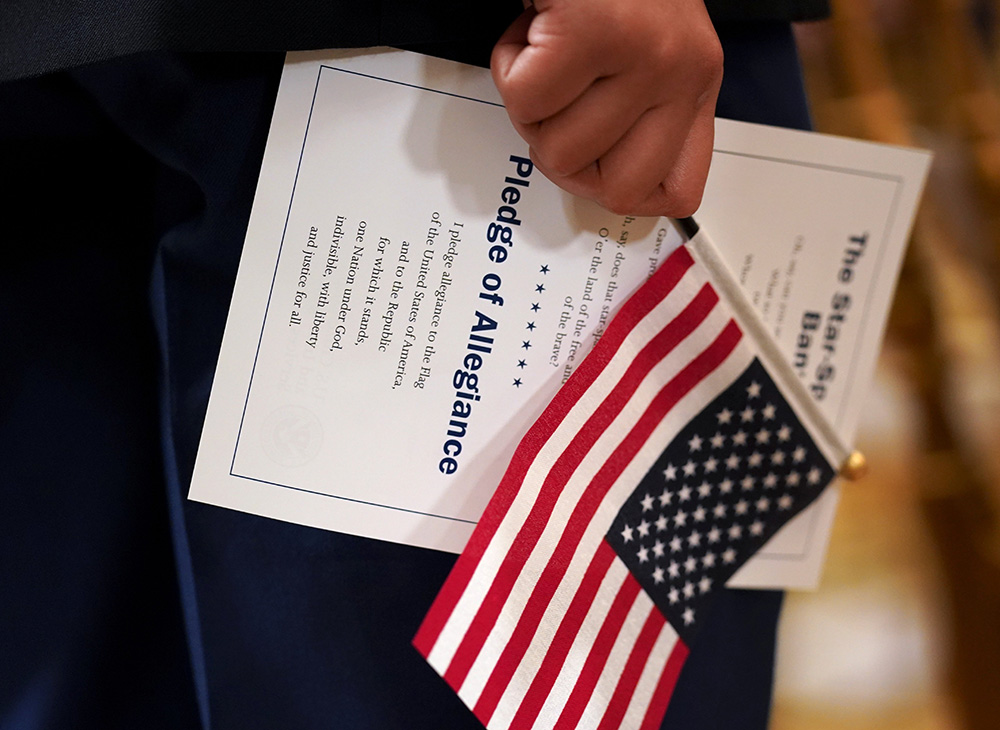
A U.S. flag and a copy of the Pledge of Allegiance are held during a naturalization ceremony in a 2021 file photo. (OSV News/Reuters/Kevin Lamarque)

by Leo Fiascone
Join the Conversation
Send your thoughts to Letters to the Editor. Learn more
Before the sun comes up on Chicago's West Side, Juanita finishes her second shift of the day at a warehouse. As a mom, she packs lunches while checking her hectic work schedule. She's exhausted, but she opens her citizenship materials, consisting of a crude 250-page PDF, to prepare for her exam, which is 59 days away.
At the same time, a father rides the Blue Line toward his shift at O'Hare Airport. He is taking his time on the L to study and trying to remember which amendment ended slavery.
These are not hypothetical stories. They are real-world examples of how legal immigrants go about a marathon-like process to become citizens of the USA, while working multiple jobs, paying taxes, raising kids and dealing with language barriers. Often, their support structure and family are still in their home country.
They juggle vast responsibilities that by themselves are a real challenge. Add a country with the volume turned up about the immigration debate, and the stress gets higher. Whatever we believe about enforcement and sanctuary cities, the people studying for the naturalization test should not be part of that chaos. They are following the law and working hard. They are waiting their turn. They are taking the path that tens of millions of us took to get here.
In Chicago, many of these families can be found at Erie Neighborhood House, a nonprofit that has been helping to integrate immigrants since 1870. If you go to Erie House in West Town, you will find a functional and simple place with folding chairs, tutors at folding tables, and kids doing homework in the next room while a parent tries to master the multiple-choice questions, the branches of government and the speaking portion of the exam. The American dream is alive at Erie House. They chase it with tutors, on the L, in pickup lines and on break after a late shift.
Their test prep process seemed ripe for improvement. Students were studying from document links or, even worse, 250-page printed packets. Many longtime citizens would find this test a challenge. Doing it from a PDF after work, with a family that needs them at home, is not effective. I call it a "digital wall."
When high school students take a U.S. history test, they would never use a 250-page PDF. They use tools that make studying effective. Why should people taking a life-changing citizenship test use anything less?
Advertisement
I am a high school senior who went to elementary and middle school at Old St. Patrick's Church and Holy Name Cathedral, where faith and intentional inclusion were part of our day. We were taught that belief is best served by taking action.
Test prep is part of my life, along with stocking shelves at Jewel-Osco, but I have no children, no language barrier and no citizenship test hanging over me. I have digital tools to help with Advanced Placement exams. They had 250 pages of cumbersome text while their stakes were much higher.
That reality inspired me to try to do something positive, even if it was small.
In May 2025, Pope Leo XIV stated that artificial intelligence posed new challenges for human dignity, justice and labor. In May 2026, in the encyclical Magnifica Humanitas, he warned that AI must be "disarmed" so it serves human dignity rather than dominating it.
I use my faith as a basis for my decisions, so I took those words as an opportunity. If powerful new technology is going to change work and opportunities, it should be aimed at the people who often get left behind. The Gospels tell us to love our neighbor and serve the least among us.
So I sat at the desk in my room and mapped out a mobile-first, bilingual training platform for Erie House. Parts of it were features I had never built before. I put in $400 of my savings from Jewel-Osco and raised the rest from 22 people in $50 increments until we had $1,500.
My platform turned the 250-page "digital wall" into the tools high school students use. I included flashcards, mock tests, timelines, fun facts, a reading and speaking module, and an AI tutor the students named Benji, after Benjamin Franklin.
Benji never sleeps. He is a 24/7 bilingual tutor who knows the civics material, the citizenship test, and small tricks that make the hard parts of the exam far easier to remember. For students who had never used AI before, an explanation at 2 a.m., in English or Spanish, no longer had to wait for the next class.
The platform tracks weak spots so students can return to areas where they are struggling during their next sporadic session. It does not replace the tutor. Instead, it handles the repetitive content so that when students are at Erie House, they can practice the interview and overcome their anxiety. The goal is simple: the confidence to pass the test so they can call this country their home.
On June 11, 2026, the new training platform was presented at an Erie House celebration for new citizens. Tutors and candidates now use it together and on their own. Erie House recently decided to share the platform with other community groups across Chicago so more immigrants preparing for the same test can use it.
The point was never the AI. AI provided a tool that could meet people where they needed assistance, not vice versa.
The Gospels and Proverbs are outstanding principles for guidance, and guidance for AI is not an exception. They are far older and more time-tested than any algorithm. "Love your neighbor as yourself" is not a slogan. It is a calling from Jesus to notice and care for the person in front of you. Proverbs 11:1 warns that a false balance is an abomination. A 250-page PDF for a citizenship test, while a weekly quiz in high school gets better tools, is a false balance.
The Gospels also remind us that the Sabbath was made for man, not man for the Sabbath. Tools exist for people. People do not exist to serve the tools.
AI can advance our society and prioritize the people technology is meant to serve, but it requires guardrails and a commitment that exceeds profit margins and stock prices. Our faith teaches that it is our job to make sure this is the case.
I support AI. I have studied it and worked with it. I respect the opportunity it brings, but I also know what can happen if no one pays attention to those who can be left behind, especially the least among us.
Students my age are anxious because school treats AI as cheating while the job market treats it as a prerequisite. The answer is not to ban technology; it is to integrate it with care and thoughtful intent. That isn't easy, but it is necessary.
Legal immigrants studying for citizenship are not a side issue in the AI debate. They are a good example of whether we mean what we say about work, family and our faith. Places like Erie House have been keeping that promise for more than 150 years.
As part of Gen Z, we cannot settle a border argument, but we can do a lot more than we think if each of us does a little.
A high schooler with a laptop can't rewrite laws. But we can tear down one small digital wall.