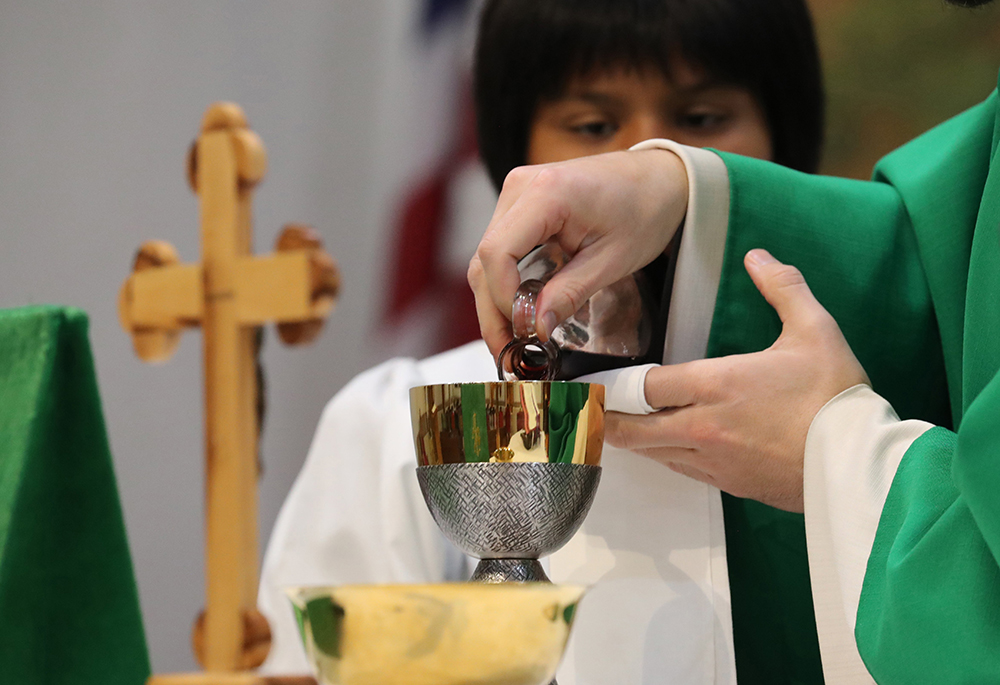
A priest is seen in a file photo pouring wine into the chalice during the offertory of the liturgy of the Eucharist as he celebrates morning Mass. (OSV News/Bob Roller)

by Karen E. Park
Join the Conversation
Send your thoughts to Letters to the Editor. Learn more
Ever since my first Communion, many decades ago, I have received the Eucharist under both kinds. Every Sunday, in churches from Massachusetts to Minnesota, and from New York City to Chicago, I received the consecrated host and then drank from the chalice. Along with millions of American Catholics, I understood this as the normal reception of the Eucharist.
Then came Covid, and for a time, the chalice was no longer offered at Mass as a health precaution. Many parishes also advised offering a wave or a nod at the sign of peace, instead of a handshake, just as many pews featured a bottle of hand sanitizer next to the hymnal. But gradually, as pandemic fears and restrictions lifted, the chalice eventually returned.
And then, in my diocese of Green Bay, Wisconsin, it suddenly disappeared again.
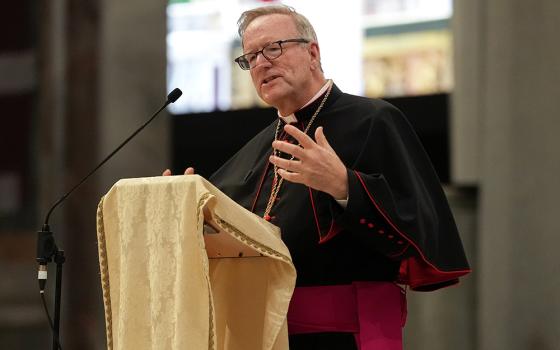
This time, there was no public health emergency. On Holy Thursday 2024, Bishop David Ricken issued a pastoral letter entitled "Pastoral Instruction for the Diocesan Practice of Holy Communion Under Both Kinds" in which he begins by conceding that reception under both kinds is "a wonderful gift" and "the fuller sign of the Eucharist," as well as something that is genuinely desired by his flock. Yet in the same document he goes on to state unequivocally that he "cannot mandate the practice [of routine reception of the precious blood] in the Diocese." Instead, Ricken restricts the reception of the Eucharist under both kinds to only a handful of occasions each year: Holy Thursday, the Easter Vigil, Christmas — but only the Midnight Mass — and five other occasions: Pentecost, Corpus Christi, Christ the King, Trinity Sunday and Divine Mercy Sunday. Pastors may choose to offer it to first communicants, but not their parents or the congregations. Pastors may also offer it to the bride and groom, but never to their wedding guests.
It turns out that Green Bay is part of a very small, but growing number of U.S. dioceses where the pandemic appears to have become the occasion for an emerging post-Covid liturgical movement led by a handful of conservative bishops who are sharply restricting the post-Vatican II practice of routinely offering the precious blood. The question is why?
In his pastoral letter, Ricken invokes the "Principle of Progressive Solemnity" claiming that "by their very nature, Masses of the greatest solemnity within the liturgical year demand a higher and fuller ritual." The implication is that he is allowing the Eucharist in both kinds only on the most solemn days. Yet a closer look at the tiny number of Masses at which he now allows the reception of the Eucharist under both kinds reveals that they are not a list of the most solemn days of the Catholic liturgical year. The church's official order of precedence places Christmas, Epiphany, Ascension and Pentecost immediately below the Paschal Triduum. Ricken does include the chalice at Christmas but only during the Midnight Mass, and not at the other, more popular Masses. And while his list does include Pentecost, it omits the Epiphany and Ascension. Also, he adds another feast, Divine Mercy Sunday, thereby essentially creating his own special Eucharistic ritual calendar.
Other reasons given for the restriction in Ricken's document include the supposedly greater risk involved in spilling the precious blood as opposed to dropping the host, as well as "unity" that is "continued by the uniformity of distribution of Holy Communion" in the Diocese. According to Ricken, if some parishes in the Green Bay Diocese offer Communion under both kinds and some do not, this uneven practice "could set up the possibility of parishioners traveling to churches to find where Holy Communion is offered from the Cup." It is notable that this desire for unity does not seem to apply when considering unity among neighboring dioceses, such as the Diocese of Superior, Wisconsin, whose website makes clear that "In the Diocese of Superior, Communion under both kinds, the Body and Blood of Christ, is normative on Sundays and holy days — as well as at weekday Masses."
Does Ricken's approach square with that of the United States Conference of Catholic Bishops, or USCCB? Yes and no. The General Instruction of the Roman Missal affirms both that the whole Christ is received under either species and that Communion "has a fuller form as a sign when it takes place under both kinds." The conference's Norms for the Distribution and Reception of Holy Communion under Both Kinds in the Dioceses of the United States of America likewise outlines the doctrine of concomitance; that is that Christ's presence is "wholly and permanently real under each of the consecrated species of bread and wine." This doctrine was also cited by the Diocese of Green Bay when I asked them for clarification about rationale. However, immediately after affirming concomitance, the bishops' conference goes on to say:
Since, however, by reason of the sign value, sharing in both eucharistic species reflects more fully the sacred realities that the Liturgy signifies, the Church in her wisdom has made provisions in recent years so that more frequent eucharistic participation from both the sacred host and the chalice of salvation might be made possible for the laity in the Latin Church.
To be clear, Ricken is acting within his authority as diocesan bishop to establish norms for the reception of the Eucharist. The issue is not whether he has the authority to restrict reception from the chalice in almost all cases, but why he has chosen to exercise his authority in this way. If the U.S. bishops' conference encourages more frequent eucharistic participation from both the host and the chalice, why would Ricken restrict it so drastically? And are there other U.S. bishops who are also removing the chalice from their flock?
When I asked the Diocese of Green Bay about the rationale for the bishop's policy, its communications director reiterated concomitance, progressive solemnity, and preservation of unity as the three principles underlying it, but would not address my questions about the simultaneous encouragement by the U.S. bishops' conference of more frequent reception under both kinds.
Advertisement
Interestingly, Ricken's instruction tracks closely with a pastoral letter and policy on Communion under both species issued just about five months before by Bishop Peter Muhich of Rapid City, South Dakota, who passed away shortly after issuing his letter. Muhich was succeeded by Bishop Scott Bullock who has so far kept the restrictions in place. The two bishops' instructions are remarkably similar, both in language and rationale. Whole sentences, paragraphs, and numerous distinctive phrases occur in both documents, making it clear that Ricken's instruction was borrowed from Muhich's. This passage regarding concomitance is repeated nearly word for word in both documents:
While a deficiency in catechesis about Eucharistic theology is primarily the cause of this error, it is not difficult to see how insisting that the Precious Blood be offered to everyone at every Mass could also foster this misunderstanding. Rather than giving the communicant "more Jesus," reception from the Cup [Muhich's document says "Chalice"] offers another or a different opportunity to receive the same Eucharistic Lord who was already fully received within the Consecrated Host.
In addition to numerous examples of identical language, both documents invoke similar arguments about the risk of spilling the precious blood, and both refer to the concept of "progressive solemnity," although Green Bay's policy is more restrictive about the number of permitted occasions for reception of the Eucharist. Green Bay's is also the only document which mentions the need for the "Preservation of Unity" in the diocese.
But perhaps the most telling argument in both documents is the idea that routine reception of the precious blood is, as Ricken puts it, an example of "liberties taken in recent years" which "go beyond what was called for by the Church’s documents promulgated during and after the Second Vatican Council." Ricken does not argue that Vatican II itself was wrong to restore reception under both kinds. Rather, he presents the routine offering of the chalice as a postconciliar excess that went beyond what the Council actually intended. The Diocese of Rapid City makes essentially the same argument. And since Holy Thursday 2024, when Ricken issued his decree, there have been at least two more dioceses — Portland, Oregon and Orange, California — which have also restricted the precious blood while invoking very similar concerns: inadequate catechesis about concomitance, reverence and the risk of profanation, the use of extraordinary ministers of Holy Communion and the proper scope of Vatican II's restoration of Communion under both kinds.
In Portland, the connection between restriction and ordained authority is explicit. Its norms argue that Communion under both kinds "unnecessarily multiplies the need for extraordinary ministers of Holy Communion" and that this multiplication "diminishes the unique sacred ministry of the ordained minister." Orange — citing the USCCB norms — likewise voices a similar fear that extraordinary ministers could obscure the distinctive role of priests and deacons.
Paul Wadell, an emeritus professor of theology at St. Norbert College, who is also a member of the Diocese of Green Bay, has written on the theology of sacramental access. He sees deep theological problems in this movement toward restriction of Communion. Drawing on Thomas Aquinas' understanding of charity as friendship with God, Wadell argues that the sacraments reveal not a God who must be protected from human touch and access, but one who continually makes himself available to human beings.
"That God lives to love us is manifest in the sacraments" Wadell writes in an essay in Developmental Disability and Sacramental Access, adding that "the principal duty of the church is to facilitate, not frustrate, God's intention." Wadell goes on to marvel that "What is almost blasphemous about the sacraments is that they make God so easy to approach. Through them God is exposed and handed over."
For Wadell, that makes contemporary efforts like those in Wisconsin, South Dakota, Oregon and Southern California to surround the Eucharist with ever greater restrictions troubling.
"What I fear taking place is a mystification of the Eucharist to create such an aura about it that the focus shifts to the 'untouchability' of God," he told me. "An overly clerical view of the sacraments frustrates and obscures God's desire."
What is taking place in these dioceses is also part of a familiar story about who gets to define "tradition." Communion under both kinds is not a liberal post-conciliar innovation. It was the practice of the ancient church and remained normative for centuries. Vatican II authorized its restoration to the laity in specified circumstances and subsequent liturgical legislation progressively expanded the occasions on which it was offered. Ricken's Eucharistic policy reflects a growing strain of contemporary American Catholicism that yearns to present itself as recovering tradition while in reality it is innovating. Promoting a narrow interpretation in which restriction itself becomes a sign of reverence, and greater clerical control can be presented as authentically traditional, is a direct rebuke to the spirit of Vatican II.
Covid created an unusual opportunity for those church leaders who think this way. The pandemic accomplished overnight what otherwise would have required a lengthy period of discernment and adjustment. The virus abruptly removed the chalice from Catholic worship. But once the public health rationale disappeared, bishops had to decide whether and how to return it. In Green Bay, and in a small number of other dioceses, that terrible interruption instead became the occasion to enact something they had perhaps been hoping to do all along.
To be clear, what is being "recovered" in Green Bay and elsewhere is not an older or more authentic Catholic tradition, much less one that is inherently more reverent, but rather a newer vision of Catholicism in which restriction of the fuller sign of the Eucharist has come to signify holiness.