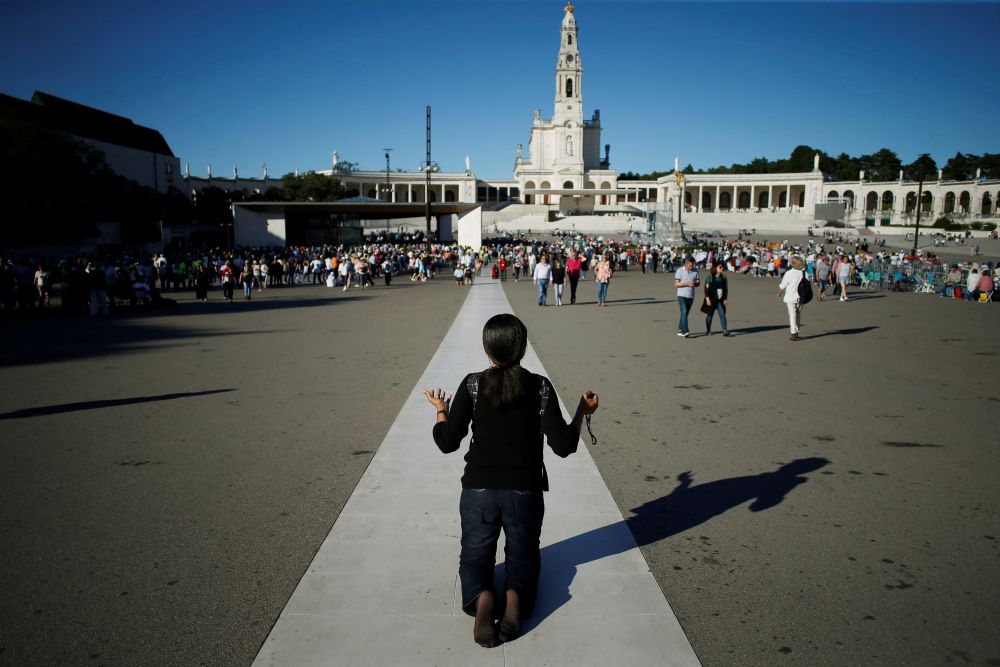
A pilgrim prays near the Marian shrine of Fátima in central Portugal May 12, 2019. In 1917, three shepherd children reported apparitions of the Virgin Mary in the fields of the Cova da Iria quarter in Fátima. (OSV News/Reuters/Pedro Nunes)

by George Cassidy Payne
Join the Conversation
Send your thoughts to Letters to the Editor. Learn more
There are places in the Catholic imagination where the veil between the physical and spiritual feels unusually thin. A hillside in Portugal; a grotto in southern France; a former Aztec shrine outside Mexico City. Again and again, ordinary people — often children or peasants — claim to have encountered the Virgin Mary in moments that would reshape devotional life for generations.
The Catholic Church has never fully resolved the tension these stories create. Marian apparitions are reported supernatural appearances of the Mother of God, usually understood as messages of prayer or consolation. But they behave less like isolated miracles and more like openings in perception, moments where ordinary life becomes newly legible under pressure. Many unfolded amid political instability and revolutionary upheaval.
The church approaches such claims cautiously; the devotion that grows around them, however, often moves faster. Though hundreds of apparitions have been reported throughout history, only a small number have been formally recognized by the Vatican as "worthy of belief" and Catholics are never required to accept them. And yet, millions of people continue to travel to these sites each year, not only to witness miracles, but to search for meaning within suffering.
Marian apparitions occupy an uneasy space between mysticism and institution, private revelation and public devotion, skepticism and belief. That is why these stories persist: not because they settle belief, but because they keep attention open.
Our Lady of Fátima
Three shepherd children reported apparitions of the Virgin Mary in the fields of the Cova da Iria quarter in Fátima, Portugal, in what the sanctuary there calls "an eruption of God's light amid the shadows of human history." It was 1917, and Europe was engaged in World War I.
But before Mary, the children were first visited by the Angel of Peace, who told them not to be scared and taught them a simple prayer: "My God, I believe, I adore, I hope and I love you."

Luis Dinnella-Borrego organizes European pilgrimage for students at Belen Jesuit Preparatory School in Miami. (Courtesy of Belen Jesuit Preparatory School)
Luis Dinnella-Borrego reads the encounter as faith formation, not spectacle.
Dinnella-Borrego teaches at Belen Jesuit Preparatory School in Miami, where he organizes European pilgrimage for students to help them understand the connection between spirituality and the study of history. The students seem to connect particularly deeply with Fátima.
At first glance, the Sanctuary of Fátima in Portugal feels almost unfinished. There is no overwhelming grandeur competing for attention, no devotional excess pulling pilgrims into spectacle. The place is spare in a way that unsettles modern expectations of sacred architecture. In Fátima, students who had moved quickly through other sacred sites slowed down. Some even chose, of their own accord, to walk the path on their knees as an act of personal reflection.
The site's austerity, Dinnella-Borrego suggests, is significant.
"Don't get me wrong, I love Lourdes. But it is like the Marian equivalent of Disneyland," he says. "Fátima is what that would look like if the desert fathers planned it."
Marian apparitions are controversial in their very nature, and interpretations associated with Fátima have been read through apocalyptic, geopolitical and devotional frameworks. Still, Dinnella-Borrego returns less to interpretation than to posture. "These were children receiving something heavy," he says. "The innocence of the children mattered."
Our Lady of Guadalupe
At Tepeyac Hill near Mexico City in 1531, the Virgin is said to have appeared to a peasant man named Juan Diego, an Indigenous convert to Christianity, and asked him to have a shrine built in her honor. According to tradition, Juan Diego carried her request to the local bishop, who demanded a sign that could confirm the vision. The Virgin then appeared again, providing roses that Juan Diego gathered in his tilma (cloak); when he opened it before the bishop, an image of the Virgin was said to have appeared miraculously on the cloth.
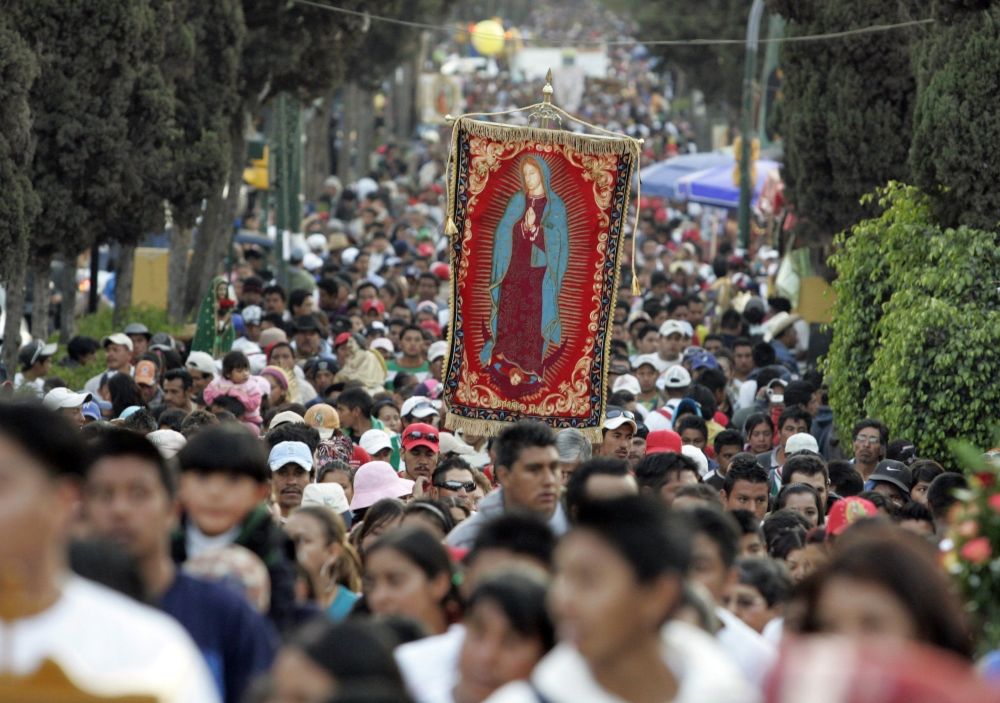
Pilgrims make their way to the Basilica of Our Lady of Guadalupe in Mexico City in this undated photo. (OSV News/Reuters/Felipe Courzo)
For Claire Lavarreda, a world history doctoral candidate at Northeastern University in Boston, the Mexican apparition of Guadalupe must be understood within the layered historical entanglement of colonization, Indigenous continuity and cultural adaptation.
"From the perspective of Mexico and Guatemala, colonization brought profound disruption," she explains. "But Marian devotion also became a site of Indigenous agency."
For these Indigenous communities, Marian devotion was naturally positioned to offer comfort in distress because their cosmologies already included feminine sacred figures who shaped the peoples' spiritual life.

Claire Lavarreda is a world history doctoral candidate at Northeastern University. (Courtesy of Northeastern University)
"Maya conceptual worlds of transformation, fertility, life and death intersected with Marian imagery," Lavarreda told me. "These are not equivalents, but they help explain resonance. Devotion to Mary allowed Indigenous communities to re-express existing frameworks within a new structure."
The tension between the church's authority and the way ordinary people have embraced Guadalupe is part of what makes her story so complex. Indigenous and mestizo communities made her their own, finding in her a figure of guardianship and maternal care. Over time, she has come to mean different things to different people, from a personal expression of faith to an emblem of Mexican identity and resistance. In other words, her story cannot be removed from the colonial world in which it emerged — but neither can it be fully explained by that history.
Our Lady of Knock
For Michael Rogers, director of mission and archdiocesan initiatives at the Archdiocese of Hartford, Connecticut, Marian apparitions belong not at the edges of Christianity but within its deepest grammar. In fact, he places them within the cycle of the Christian narrative itself: Annunciation, Resurrection and divine encounter.
"People think of apparitions as the ephemera of Catholic life, but the Incarnation begins with an apparition," he said. "In a world that wants to explain everything, there is a real need for transcendence."
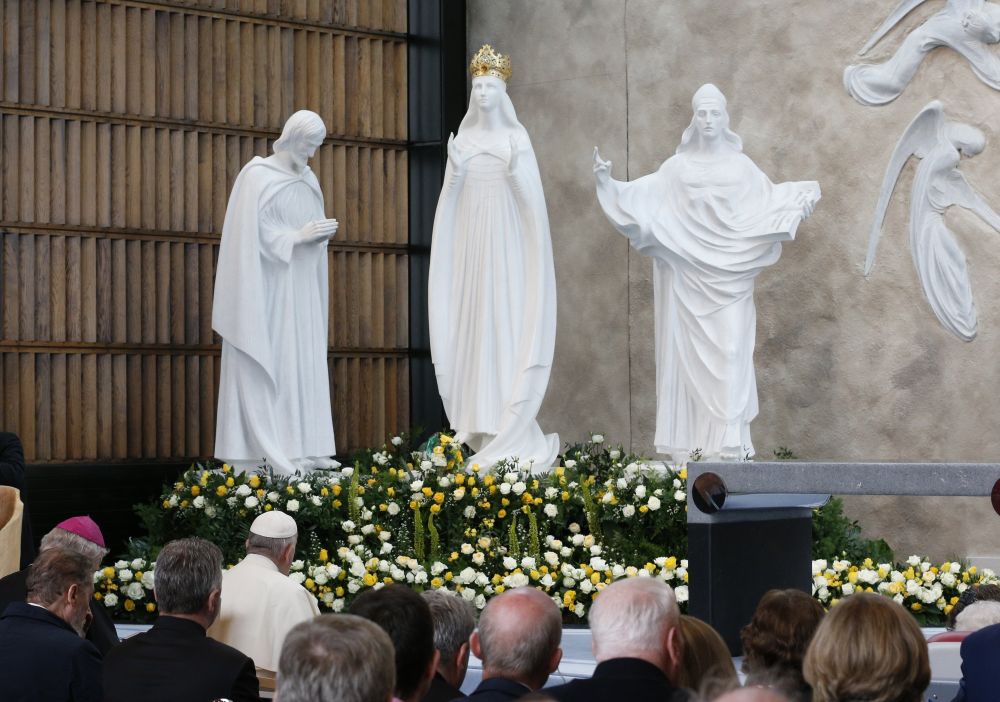
Pope Francis prays during a visit to the Chapel of the Apparitions at Ireland's Knock Shrine Aug. 26, 2018. (CNS/Paul Haring)
Yet he is equally careful about limits.
"The church says you can believe it or not," he points out. "Devout Catholics are not required to believe it." Rogers himself is cautious about Fátima in particular; but the way he sees it, even uncertainty belongs to the tradition.
Rogers is particularly drawn to the story of Knock. In this small village in County Mayo, Ireland, a group of local residents on Aug. 21, 1879, reported seeing an apparition of the Virgin Mary, St. Joseph and St. John the Evangelist beside an altar bearing a lamb. The witnesses were ordinary people from the village, including farm workers and children, whose accounts became the foundation of what would eventually become the Knock shrine and pilgrimage tradition. Unlike many reported Marian apparitions, the figures at Knock did not speak or deliver any message.
That silence has carried social and political significance of its own. In a predominantly Catholic Ireland still living under British rule, religious identity was intertwined with resistance to outside authority. Knock offered no political manifesto, yet its story became part of a broader Irish Catholic tradition in which faith could provide a sense of belonging. For Rogers, the absence of words is precisely what makes the story powerful: The apparition does not command or instruct. Its meaning is found in the act of appearing, and in the community's decision to remember.
"She wanted them to know they are loved," says Rogers
Our Lady of Medjugorje
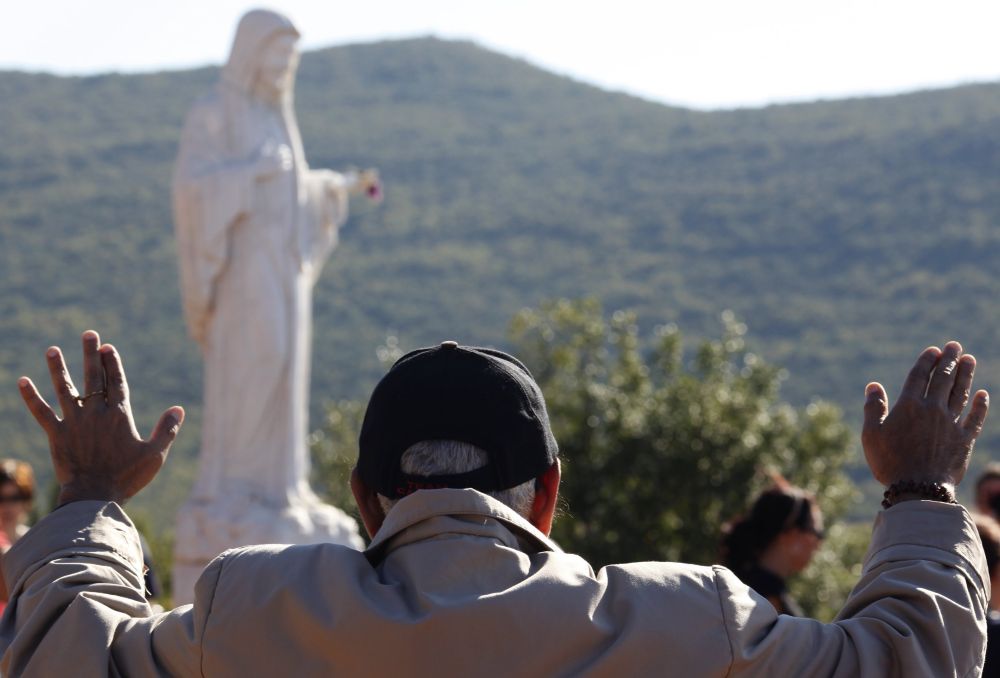
In 1981, six young people in the village of Medjugorje in Bosnia-Herzegovina reported seeing the Virgin Mary and receiving messages from her about repentance. The apparitions began more than a decade before the Bosnian War, but in retrospect many interpret the messages associated with Medjugorje against the backdrop of a conflict that left more than 100,000 people dead and millions displaced.
Pope Francis prays during a visit to the Chapel of the Apparitions at Ireland's Knock Shrine Aug. 26, 2018. (CNS/Paul Haring)
The Vatican's Dicastery for the Doctrine of the Faith in 2024 recognized "the abundant and widespread fruits, which are so beautiful and positive," associated with devotion to Mary and with pilgrimages to Medjugorje. However, even as it authorized "public acts of devotion" at Medjugorje, the Vatican made clear that it did not "imply a declaration of the supernatural character of the phenomenon in question." Still, about 1 million people have visited Medjugorje each year since the reported apparitions began.
This is the tension aroused by apparitions. But for layperson Karen Bunker, faith is not an argument to be won but something defined by suffering and persistence in prayer. A retired scientist and active member of her parish, Bunker has long been drawn to the localized Mary of Medjugorje.
"I always remember my grandparents with rosaries in their hands," she says. Her grandmother prayed constantly; her grandfather was blind. When Bunker eventually traveled to Medjugorje on a pilgrimage, the experience deepened her faith. She returned determined to make the rosary part of her own daily life.
For more than three decades, Bunker has helped lead a rosary group at St. Lawrence Catholic Church in Greece, New York. Her understanding of Medjugorje is less about proving what happened there than about comfort and direction during and after trauma.
"I do not know how people get through the day without prayer," she says.
Whether miracle, mystery or myth, that is why these stories endure. In places marked by oppression and suffering, Mary becomes a language for longing and peace, giving people a way to name their yearnings when the world around them offers little reason to hope.
Advertisement