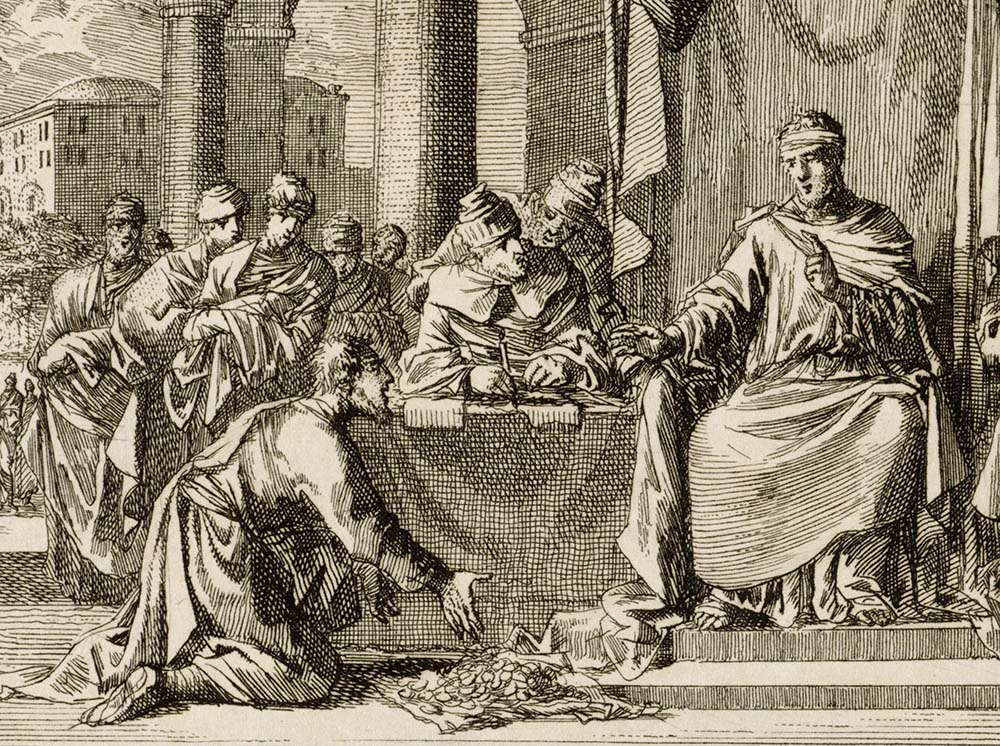
The Parable of the Talents, illustrated in a 1712 print by Jan Luyken (Wikimedia Commons/Rijksmuseum)

by Sr. Mary M. McGlone
Join the Conversation
Send your thoughts to Letters to the Editor. Learn more
"A worthy wife." The Book of Proverbs enumerates the good works that win her that title. The author praises her as a talented worker who brings her husband good and gives to the poor. Most of all, her husband can entrust his heart to her. For all of that she deserves to be honored. The church chose this reading as one to help interpret today's Gospel.
Today's Gospel comments on both work and relationships. A wealthy man goes on a journey, entrusting his estate to servants, giving "to each according to his ability." He gave each of them an enormous amount. (A talent was equal to 20 years' worth of an ordinary worker's earnings.) With no further instructions, he simply left them in charge. Apparently, he assumed that knowing him and his methods, they would carry out business as he would.
Two of the servants had great success with their master's wealth, doubling what they had been given. Considering the enormous sums they managed and the master's example, it seems unlikely that they could earn so much in a more honorable way than he had. When these two delivered the fruits of their labor to the master, he called them "good and faithful." He appreciated their industry, they were following in his footsteps. He could trust them to develop his wealth according to his methods.
The third servant, the one who gets the most attention in the story, carefully kept his portion safe. His reason? It could have been personalities or priorities. Most of all, this servant had little esteem for the master or his mode of operation. He brazenly described his master not only as demanding but also willing to appropriate what wasn't his. In the light of that, this servant played it as safe as he could because he feared the master.
For his part, instead of denying his greed, dishonesty and severity, the master used the servant's assessment of him as the very reason for penalizing him. According to the master, servant number three was lazy and worthless because he did not at least invest the money with moneylenders.
Three of these characters apparently had chosen ever-increasing wealth as their ultimate goal. Servant number three cared most for his own safety. None of them were people fathers would want as a son-in-law, and it's quite unlikely that Jesus told this parable to direct his listeners toward a corrupt or affluent life.
For the past few weeks, Matthew has been preparing us for the second coming of Christ. The parable of the vineyard presented a vignette of salvation history: God's attempts to bring people's faith to fruition and humanity's poor response. Then we heard about the wedding feast open to anyone humble enough to accept an invitation to join a celebration with the king's guest list. After that, Matthew gave us the story about wise and foolish virgins and now the master and three servants.
This part of the liturgical year focuses our attention on the fact that our time is limited and thus we need to spend it in the best way possible.
Advertisement
Jesus used today's parable to illustrate the demands of discipleship. There's no time to waste or hide away like the third servant, perhaps assuming that the master would handle everything when he returned. The other two servants, like the master who had become so wealthy, worked with all they had been given. They followed the master's example, most likely reaping and harvesting wherever they wished. That demonstrated their loyalty and increased their master's fortune.
Material gain was the most important value in the life of the master in this parable. Accepting his priorities, his faithful servants did all they could to increase his and their fortunes.
Today, we still suffer from the problems caused by people who prioritize gain, no matter the human cost. Added to that, technology's growth is rushing at us like Niagara Falls. In Magnifica Humanitas, Pope Leo XIV warns, "If technology becomes the ultimate criterion, the human person risks being reduced to data, a cog in a machine or a commodity."
For the master, all three servants were essentially cogs or commodities — the means to an end. In turn, using people demeaned his humanity as well.
In contrast, the worthy wife, a symbol of true disciples, dedicates herself to good because she and her husband share one heart. They anticipated Leo's teaching that "human persons are called to communion with God and can fully discover their true selves only in sincere self-giving."
Our lifetimes are limited. Jesus, Matthew and Leo each remind us that our time is limited and discipleship is an all or nothing proposition.
We have only this finite time to learn to share the master's heart and do as he would do.