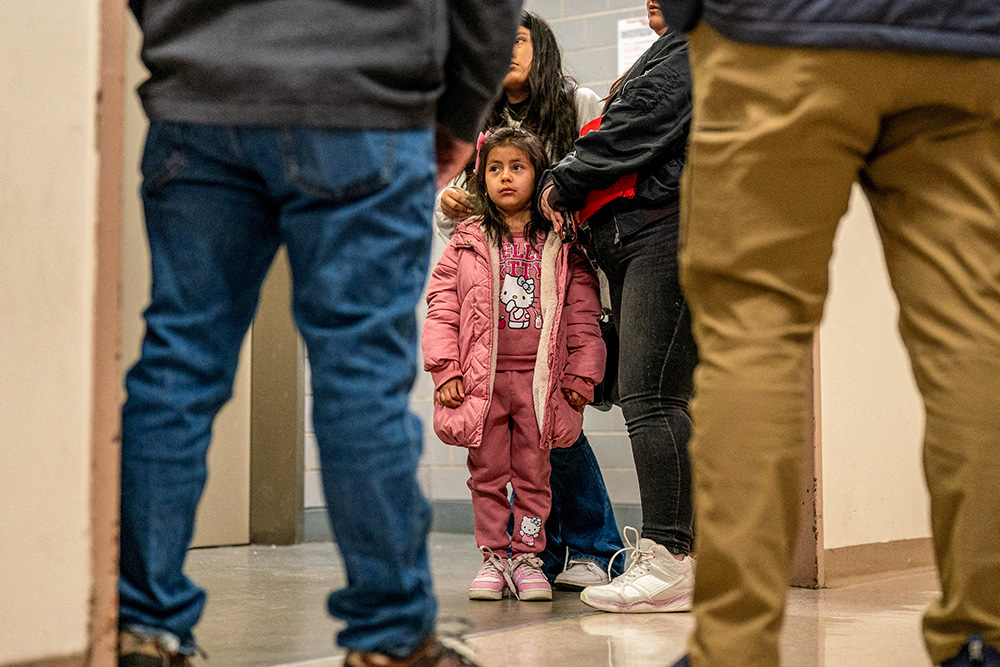
The family of a detained migrant speaks to immigration officers in an attempt to gain information at a U.S. immigration court in the Manhattan borough of New York City Jan. 16, 2026. (OSV News/Reuters/David 'Dee' Delgado)

by Sr. Mary M. McGlone
Join the Conversation
Send your thoughts to Letters to the Editor. Learn more
Years ago, I taught a course on the history of Christianity in the U.S. At the beginning of the semester, I would ask the students where their ancestors were from. Most said something like Kansas, Nebraska or Illinois. A few proudly claimed some portion of Native American lineage. Very few named the country from which their predecessors had immigrated. The students felt that they belonged to their present-day place and gave little thought to why their ancestors left distant homelands.
They were missing out by not being aware of one of the greatest influences on our U.S. culture. A majority of our population has ancestral roots in Europe, mostly from the British Isles, Germany and Italy, with every other European country represented as well. Approximately 40 million immigrants came to our country from Europe and Asia between 1820 and the 1950s. Our population of Mexican Americans jumped when the U.S. took over about half of the territory of Mexico in 1848.
Our earliest migrants came as colonizers, presuming ownership of "the new world." After that, the motives for immigration included religious freedom, free land and avoiding military service. Most of all, masses of poor people came to escape death from the effects of dire poverty. Most of our immigrants shared a similar hope: to be part of creating a better world.
We have a lot in common with the Israelites whom God addresses in today's excerpt from Exodus. God commands them to care for widows and orphans and to treat foreigners well because they, too, had been aliens.
We might ask if some divine wit or wisdom brings us these readings when we are 10 days away from our midterm elections.
We've heard the message of today's Gospel so often that it hardly sounds radical. It was probably the same for Jesus' Jewish audience. Twice each day, faithful Jews repeated the Shema, a Scripture-based prayer that proclaims that the God of Israel is the one true God and goes on to repeat Deuteronomy 6:5: "You shall love the Lord your God with all your heart and with all your soul and with all your might."
In today's Gospel, Jesus put that command together with Leviticus 19:18: "You shall love your neighbor as yourself."
In Matthew's Gospel, Jesus said this to a lawyer trying to trip him up. Why did he give this two-pronged response to the question about the commandments? It seems that he wanted the two commands to interpret one another.
According to Scripture scholar Douglas Hare, "Biblical love is not affection, but commitment," and to love our neighbors "is to imitate God by taking their needs seriously." Love of God necessarily implies prayerful attention to others and active care for anyone in need.
Advertisement
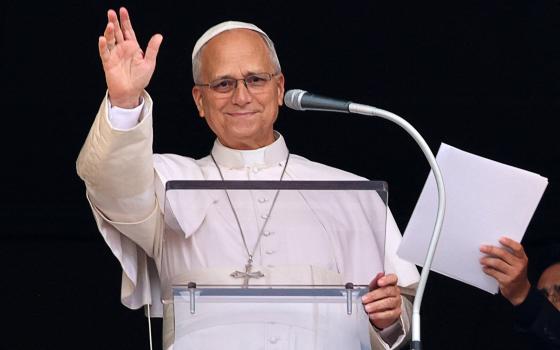
Pope Leo XIV spells this out in Magnifica Humanitas, by citing the Second Vatican Council and Pope Francis, reminding us that Christian faith "calls for a Church capable of listening to the cry of the poor, migrants and victims of new forms of slavery." Leo challenges us to build a world in which all can flourish.
Closer to home, this past July, Texas Bishops Daniel Garcia and Brendan Cahill published a pastoral reflection that decreed, "Acts that diminish or disregard the dignity of any person or group of people should never be normalized in our society. The dehumanization of immigrants, regardless of their legal status, is one such example of this; the vilification of law enforcement officers is yet another."
Leo tells us that the pursuit of the common good gives life to a people as they "learn to recognize that they themselves are interconnected and jointly responsible." He reminds us that we are capable of building forms of cooperation that make it possible for all people to live a full and just life.
Church teaching on both the universal and local levels gives us a very clear commentary on today's Liturgy of the Word. If we are to be faithful Christians, we will take our neighbors' needs seriously. Indeed, we are called to take others' needs as seriously as does the God who hears the cries of the poor and responds with compassion.
As a people of God, we are called to love God and neighbor — especially the poor — with all our heart, mind and soul, and never fail to act on that love.
Like Israel, we are a pilgrim people with immigrant ancestors. In Magnifica Humanitas, Leo teaches that we share the vocation to shape our own era by carrying out the Gospel mission of transforming the structures of society from within and forging paths toward a greater humanity.
Love of God and neighbor demand the commitment to act with justice.