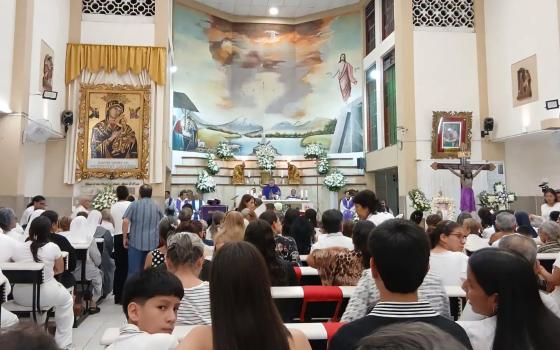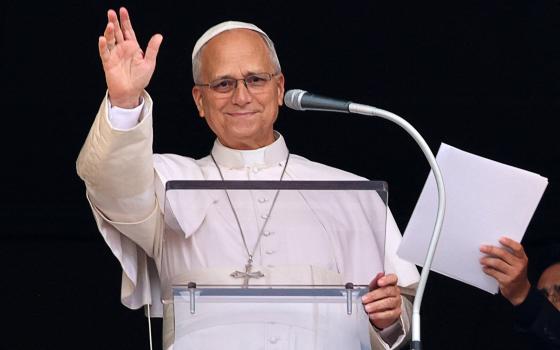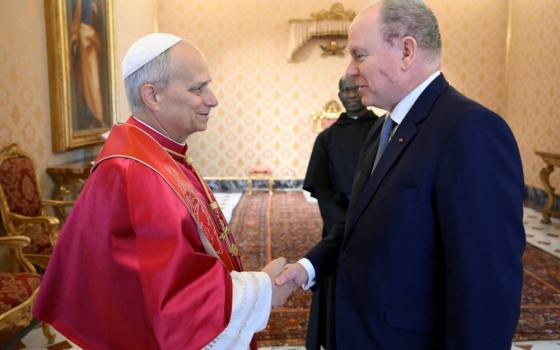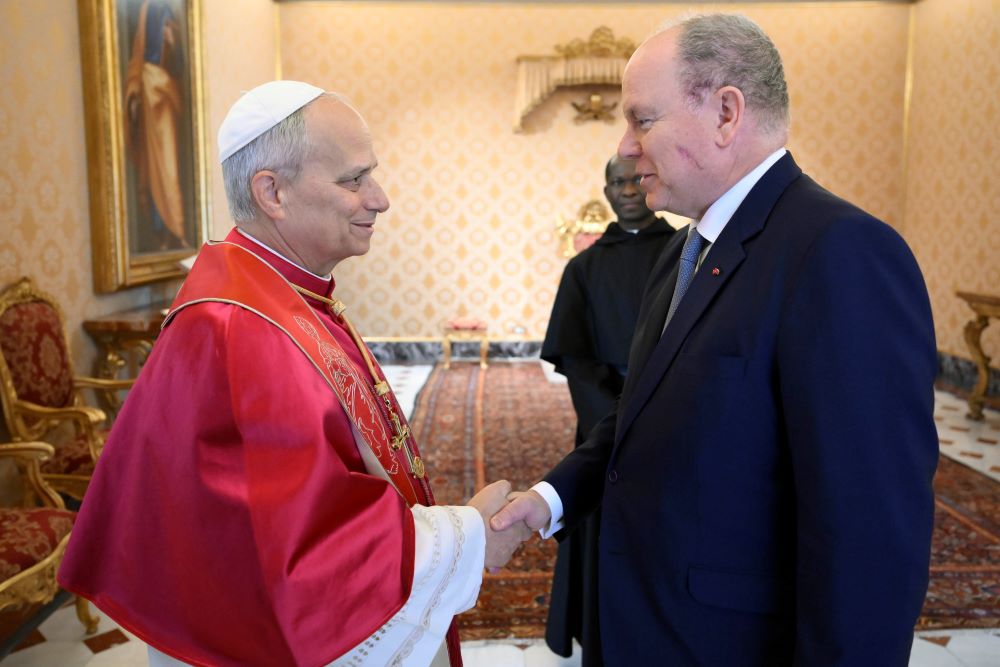
Pope Leo XIV greets Prince Albert II of Monaco at the Vatican Jan. 17, 2026. Pope Leo will visit Monaco March 28 for a historic one-day apostolic journey. (OSV News/Vatican Media)

Join the Conversation
Send your thoughts to Letters to the Editor. Learn more
Monaco is one of the few countries that enshrines Catholicism as the state religion, yet no pope has ever paid it a dedicated visit.
Pope Leo XIV will change that with his nine-hour visit to the principality nestled along the French Riviera on March 28, where he will meet with Prince Albert II, the local Catholic community and celebrate Mass in a sports arena. In doing so, he will make good on an invitation to visit Monaco that has remained pending since the pontificate of Pope Benedict XVI.
Leo's choice to visit Monaco so soon in his pontificate "shows an interior freedom of this pope," said Fr. Christian Venard, communications director for the Archdiocese of Monaco. "He is a pope who will not let himself be dictated to by anything external; he makes personal choices, and they are the choices of a free man."
Venard told the National Catholic Reporter that the impetus for the trip is born out of the personal relationship the pope has developed with Monaco's prince, who visited the Vatican in January. The two share a strong relationship to the United States: Leo is the first U.S.-born pope, and Albert is the son of Philadelphia-native actress Grace Kelly and a graduate of Amherst College in Massachusetts.
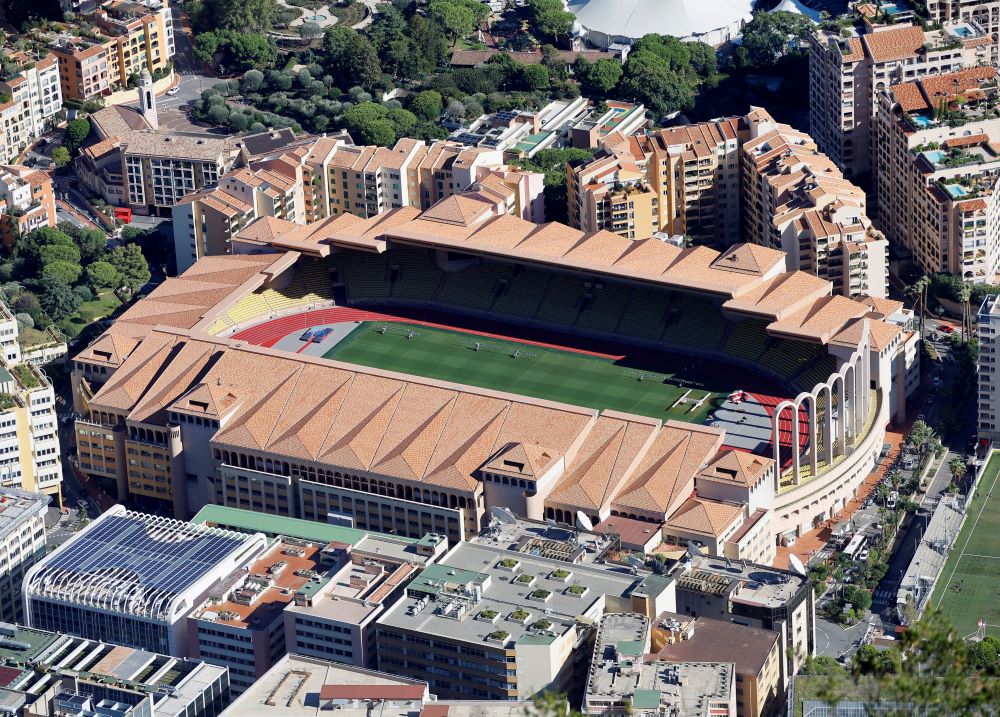
Pope Leo XIV will celebrate Mass at Louis II stadium in Monaco during his March 28 visit to the microstate in the French Riviera. (OSV News/Reuters/Eric Gaillard)
Yet their relationship is also rooted in a broader alignment in how both men understand the role of faith in public life.
The prince in 2025 refused to sign into law a bill legalizing elective abortions in Monaco, citing the role of religion in the country as the reason for withholding his support. Albert has also been a fierce advocate of environmental protections on the global stage and he has a charity in his name dedicated to environmental causes.
Leo has made known his concern for the environment and he has issued strong language against abortion, calling the use of state funds for abortion "deplorable."
For Monaco's ambassador to the Holy See, Philippe Orengo, that convergence extends beyond the relationship between the pope and the prince and into the way both Monaco and the Vatican understand their role on the global stage.
"Precisely because we are not very powerful and are not driven by a desire for conquest or domination, we are able to look beyond our national interests to convey messages that are both timeless and universal in nature," he said.
That shared emphasis on the common good is particularly evident in Monaco's longstanding focus on peace, which Orengo pointed to as a defining feature of the principality's international posture.
"The principality has long been committed to the defense of peace," he said, noting that as early as 1903, Monaco's sovereign founded an international institute dedicated to peace. "We have never been at war with anyone."
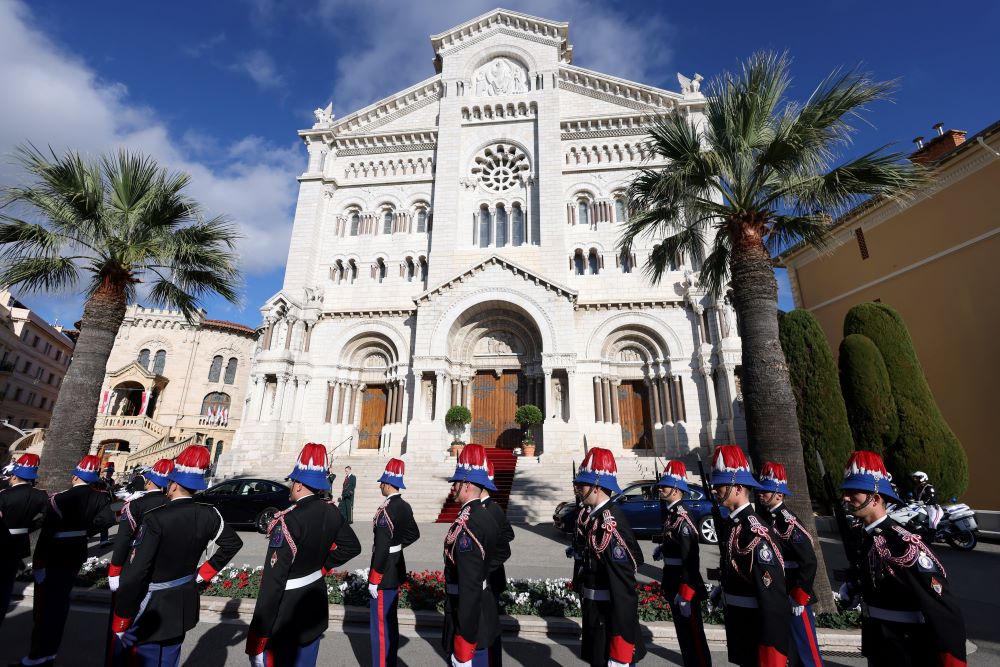
Carabiniers of Prince Albert II of Monaco stand in front of the Cathedral of Our Lady Immaculate Nov. 19, 2023, during the celebrations marking Monaco's National Day. (OSV News/Reuters/Claudia Greco)
For a pope who has decried a "diplomacy based on force" supplanting international dialogue, highlighting the principality's commitment to peace on the global stage underscores his repeated messages on peace and multilateralism.
The first dedicated papal visit to Monaco will be unusual in both its logistics and its focus.
Because Monaco lacks an airport, Leo will travel directly from the Vatican by helicopter, while the papal entourage and accompanying journalists will fly into nearby Nice, France, before being transported across the border.
The arrangement allows the pope to avoid the diplomatic protocol required when a foreign head of state lands on French territory and the complications that could arise in planning the trip from involving French authorities.
More striking than the logistics, however, is the focus of the trip itself. The pope's one-day visit to the principality will be entirely dedicated to the country's Catholic community.
Whereas Pope Francis made a point of visiting marginalized groups and non-Catholics during his international travels, Leo's trip will engage exclusively with Monaco's Catholics — an estimated 80% of the microstate's 39,000 residents.
On his only other international trip so far to Turkey and Lebanon, Leo visited a nursing home and hospital for people with mental disabilities, but he will not be seeking out marginalized groups in a nation where 1 in 3 residents is a millionaire.
Advertisement
Despite its reputation as a playground for the ultrawealthy, that Monaco retains its historic relationship with Catholicism offers a rare example of religion exerting a visible influence in civic society.
During a visit to Monaco in 2021, Cardinal Pietro Parolin, Vatican secretary of state, said the microstate's unique relationship with religion presents an opportunity in an increasingly secularized world which "claims to exclude religion from the sphere of public life, relegating it to a purely personal matter."
Five years later, if the pope wants to make the case for the role of religion in shaping public life, Monaco might just be the perfect backdrop.
The National Catholic Reporter's Rome Bureau is made possible in part by the generosity of Joan and Bob McGrath.