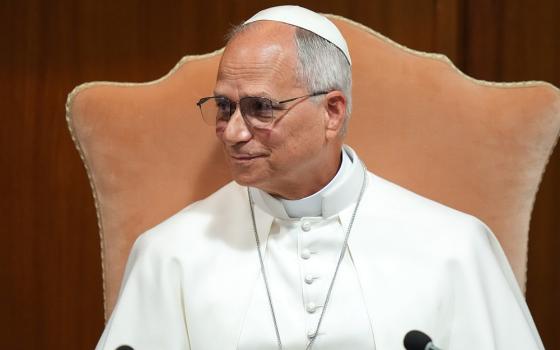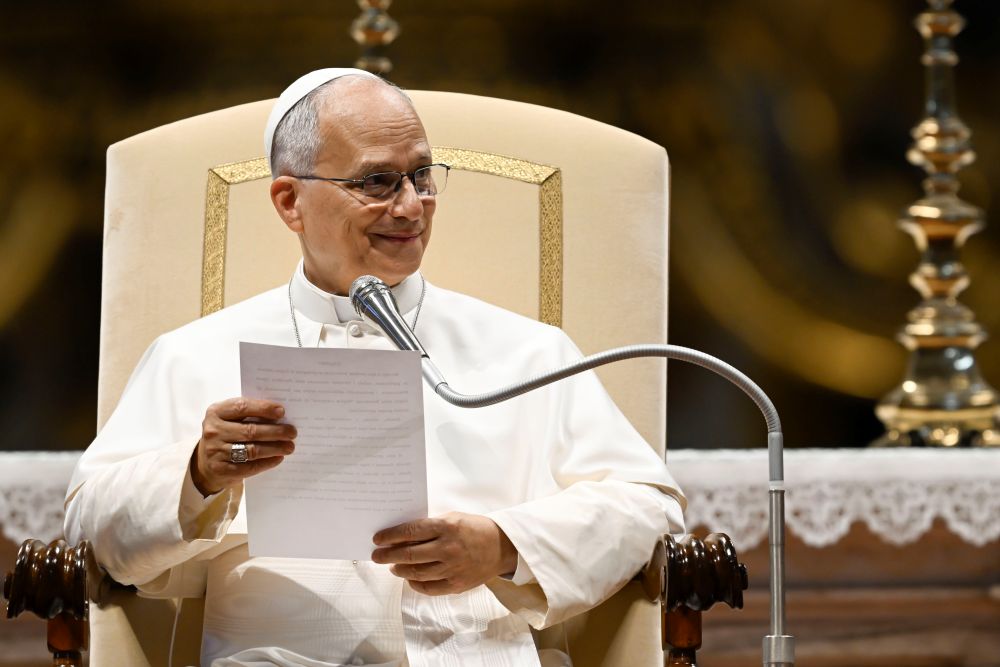
Pope Leo XIV addresses visitors and pilgrims during his weekly general audience at St. Peter's Basilica on Aug. 26, 2026. (CNS/Vatican Media)

Join the Conversation
Send your thoughts to Letters to the Editor. Learn more
After months of poring through the major documents of the Second Vatican Council, Pope Leo XIV said the council's reform of the liturgy — one of its most polemical legacies — was "necessary" for the faithful to more fully participate in the celebration of Mass.
Addressing the attendees of his weekly general audience hosted inside St. Peter's Basilica Aug. 26, Leo expounded on the motivations for the liturgical reform issued in Sancrosanctum Concilium, the council's constitution on the liturgy that opened the way for the Mass to be celebrated in the vernacular and to alter elements of the Latin-rite liturgy.
Drawing from the council's teaching on the liturgy and the writings of Pope Paul VI when he was archbishop of Milan, Leo recalled that the council's concern for the faithful attending Mass as "silent spectators" expressed a "renewed awareness of the value of the liturgy."
"The participation of the faithful cannot be passive," he said. "From this conviction arose the need to make the richness of the biblical texts and prayers more accessible to all the faithful, and to streamline the order of the celebration compared with that set out in the liturgical books then in use."
The council's liturgical reform has remained a source of debate in the church since its promulgation in 1963 and it reached a fever pitch in 2021, when Pope Francis tightened restrictions on celebrating the pre-Vatican II Latin Mass. His predecessor, Pope Benedict XVI, had previously loosened the restrictions.
The issue was thrust back into the public spotlight this summer when the clergy of the ultraconservative Society of St. Pius X, which has called the reformed liturgy "evil" and lacking in the spiritual value necessary for the faithful, were excommunicated in the Catholic Church's most significant schism in recent memory.
Several prominent prelates capitalized on that moment to call for greater access to celebrate the pre-Vatican Latin Mass.
Despite those appeals, the head of the Vatican's liturgy office has stated that the pope will not repeal Francis' 2021 restrictions and wrote in a document to cardinals that the reformed liturgy ought to be the sole form of the Mass in the Latin rite.
In his Wednesday audience, Leo did touch on the liturgical abuses that traditionalist Catholics cite to push back against the reform of the Mass. He said that correct understanding of the council's teaching on the liturgy "also makes it possible to reject the abuses that occurred in certain sectors of the church during the post-conciliar period, and which unfortunately still occur at times even today, by taking some of the principles underlying the reform itself to extremes or misunderstanding them."
Yet the pope also maintained that the council's liturgical reform is "firmly rooted in the living tradition of the church."
"Indeed, since the liturgy is a living entity, throughout the centuries it has always been subject to developments and changes," he said. "The magisterium adapted its forms to the needs of different eras. It is therefore not surprising that the Second Vatican Council too, with the utmost respect for the heritage of tradition, and precisely in order to make it more accessible, considered it necessary to revise the liturgical books."
In January, Leo chose the documents of the Second Vatican Council as the theme for his first catechesis series as pope, stating that the faithful had to familiarize themselves with the council's teaching to "continue to seek ways and means to implement its insights."
Starting next week, the pope will turn his attention to the church's pastoral constitution issued by the council, Gaudium et Spes.
The National Catholic Reporter's Rome Bureau is made possible in part by the generosity of Joan and Bob McGrath.
Advertisement