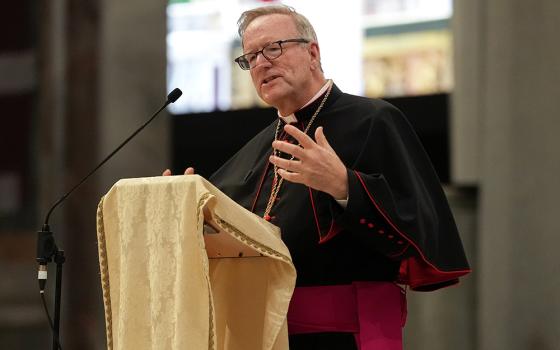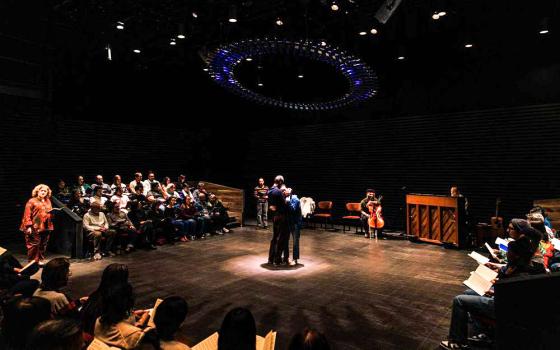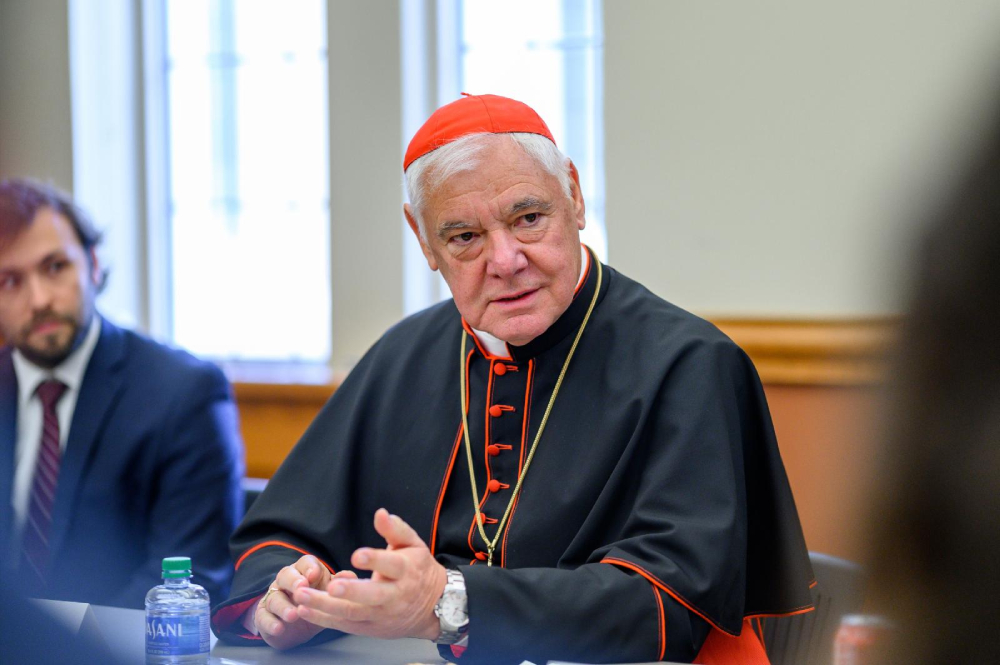
Cardinal Gerhard Müller speaks with students and faculty at the University of Notre Dame in Indiana Oct. 27, 2021. (CNS/University of Notre Dame/Matt Cashore/Courtesy of Today's Catholic)

Join the Conversation
Send your thoughts to Letters to the Editor. Learn more
With much of the Vatican curia in summer mode and Pope Leo XIV having just returned to Rome from vacation, conservative cardinals and bishops are taking advantage of the news lull to call for greater access to the Latin Mass and to cast doubt on the ongoing synodal process.
These voices, including three influential cardinals, have turned to friendly media to give support to goals that are often discordant with the pope's own messaging.
Leo's July 5-27 respite at Castel Gandolfo created a news vacuum in Catholic media just as the wider church absorbed two major developments: the late-June gathering of the world's cardinals to discuss church governance and its most consequential formal rupture in recent memory, the excommunication of adherents of the ultraconservative Society of St. Pius X.
Those events gave conservative voices abundant material to shape the summer's Catholic news cycle.
The SSPX schism is not as simple as a debate over the liturgy. But that such a widespread group so devoted to the pre-Vatican II Latin Mass severed itself from the church sparked renewed conversation over how the Vatican should handle its balancing act of accommodating devotees to the old form of the Mass while insisting on liturgical unity in the reformed rite.
Several prominent prelates seized on the moment to publicly enter that debate, amplifying growing tensions within a church led by a pope who has made unity his refrain.
Cardinal Robert Sarah, former head of the Vatican's liturgy office, called for a return to the more permissive treatment of celebrating the old form of the Mass under Pope Benedict XVI, and downplayed the divisive elements of celebrating Mass in the old rite in the wake of a church schism where debates over the liturgy were front and center.
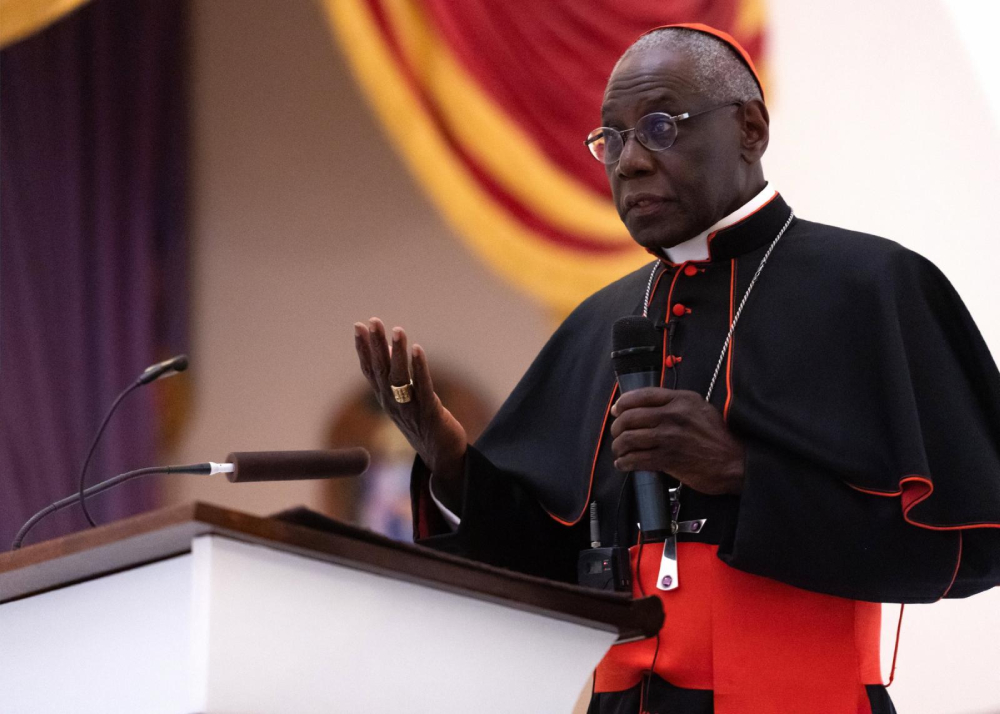
Guinean Cardinal Robert Sarah answers questions in Baltimore May 15, 2022. (OSV News/Catholic Review/Kevin J. Parks)
"Some of the excesses of those attached to the extraordinary form are, in part, justified by the dramatic and widespread abuses of the ordinary form of the liturgy, which, to this day, is often not celebrated as the council would have intended and as the liturgical reform itself suggests," he said in an interview published in the Italian newspaper Il Foglio on Aug. 3.
And in a separate July interview with writer Diane Montagna, Sarah said Leo should expand a message sent to French bishops on his behalf, in which the pope, speaking about the "old order" of the Mass, called for the "the generous inclusion of those sincerely attached to the Vetus Ordo, in accordance with the guidelines established by the Second Vatican Council regarding the Liturgy."
However the cardinal removed any Vatican II reference in his characterization of the pope's message, saying that Leo had encouraged the bishops "to be more open to the [old] rite, to the traditional Mass."
Sarah went on to say that today, the liturgy "has become a kind of entertainment, in the way of inculturating the liturgy and the Christian message."
That voice was only one in a chorus of calls nostalgic for Benedict-era leniency toward the celebration of the pre-Vatican Latin Mass.
Cardinal Gerhard Müller, the Vatican's former doctrine chief, praised Benedict's "wise decision" to expand access to the old form of the Mass and U.S. Cardinal Raymond Burke criticized the Francis-era restrictions on the pre-Vatican II Latin Mass in a July interview with The College of Cardinals Report, a conservative blog which sought to sway the conclave that elected Leo. The cardinal went so far as to call for a Vatican dicastery to be created to attend to Catholics devoted to the old form of the Mass.
Messaging sympathetic to Catholics who desire the Latin Mass emerged from beyond Rome, with Benedict's longtime personal secretary and now nuncio to the Baltic States, Archbishop Georg Gänswein, telling Il Giornale that now is the time to "lift those bans" on celebrating the old form of the Mass. The interview from Gänswein, who emerged as a source of dissent during the Francis era, was a rare public intervention from a Vatican diplomat on an internal church issue.
In the United States, San Francisco Archbishop Salvatore Cordileone, a champion of traditional liturgy who was recently appointed by Leo to the Vatican's high court, also called for "easier access to the Traditional form of the Mass."
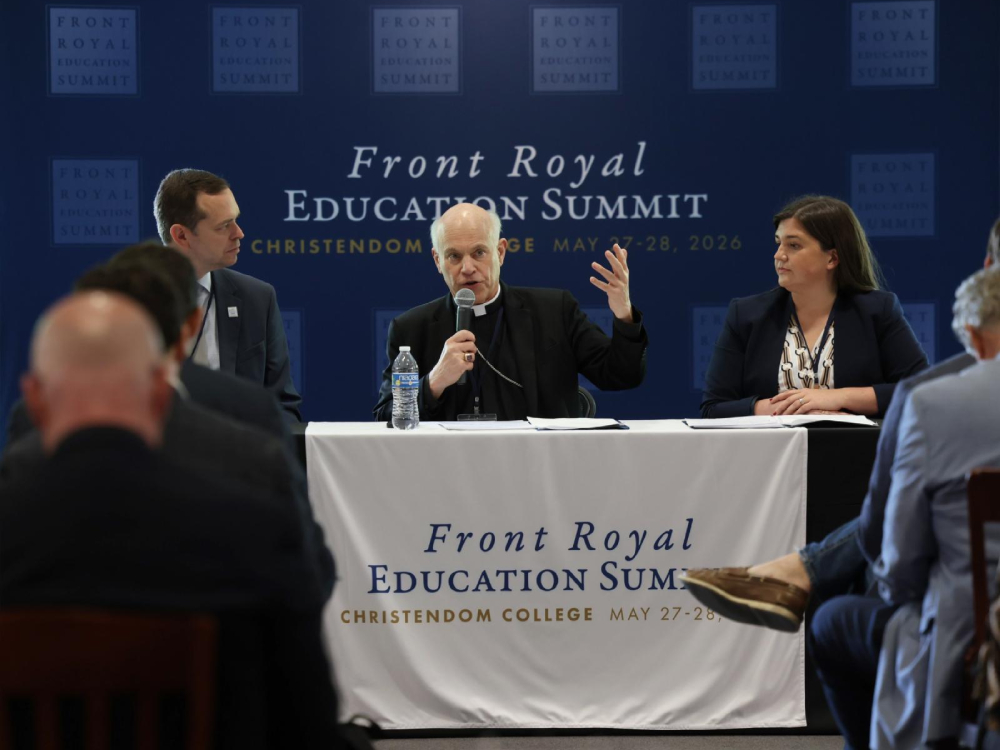
San Francisco Archbishop Salvatore J. Cordileone speaks at Christendom College in Front Royal, Va., May 27, 2026. (OSV News/Seton Hall Prep)
The three cardinals calling for more accessibility to the Latin Mass also used the summer lull to call into question the effectiveness of using a synodal method to discuss church governance and teaching.
Before leaving for vacation, the pope summoned the world's cardinals to Rome to discuss his newly published encyclical, avenues for promoting peace, and synodality. He also put the latter into practice by having cardinals deliberate in small groups.
Müller criticized that format in an interview with The Catholic Herald, arguing that the consistory's agenda, largely centered on Leo's encyclical Magnifica Humanitas, had not been adequately developed.
"It was more a brainstorm than a reflected conversation," he said.
The cardinal also voiced frustration with the consistory's emphasis on listening, arguing that the church's responsibility was instead to speak unequivocally to the world, invoking familiar culture war issues even though they were not on the agenda during the June meeting.
The church needed, he said, to make "some very clear statements to say that it's absolutely impossible for bishops or cardinals to celebrate Masses with rainbow flags, these symbols of atheistic ideology, and not to make these so-called pastoral compromises."
Sarah meanwhile criticized the cardinals' discussions for engaging too heavily on the issues afflicting the world, saying that the church's internal matters such as the liturgy and the administration of the sacraments "should be the primary concern of the consistory."
In his July interview, Burke also criticized the nature of the consistory as well as the concept of synodality, stating that there is "no history of it in the church."
"We have to insist that this whole synodality business stop, and there be a very serious study done of the whole matter," he said.
The swell of support for the Latin Mass from a group of conservative bishops appeared to have caught the attention of Vatican authorities, and Leo's previous remarks, plus his plans for the years ahead, suggest he's not backing away from his commitment to Vatican II liturgical reforms or synodality.
Advertisement
Cardinal Arthur Roche, head of the Vatican's liturgy office, told The Tablet in a July interview that "Pope Leo is not going to change Traditionis Custodes" — Francis' 2021 decree placing greater restrictions on the celebration of the old form of the Mass.
Leo returned to the Vatican on July 27 and his voice is once again coming to dominate the Catholic news cycle. His first general audience after his break on Aug. 5 marked a return to his public catechesis series on Vatican II, featuring an analysis of Sacrosanctum Concilium, the Vatican II document on the reform of the liturgy.
Leo previously said in that series that with the reform of the liturgy, which most notably shifted the Mass from exclusive celebration in Latin to the local vernacular, "The church's worship has thus been 'embodied' in the cultural forms of each age and has been able to influence them and even transform them."
And despite the cardinal's appeal, Leo shows no signs of slowing down the church's synodal process.
The Vatican released guidelines for local churches to carry forth their synodal process throughout 2027 ahead of a summit to discuss synodality in Rome the following year. In October, Leo will convene the heads of the world's bishops' conferences to the Vatican to discuss the legacy of Francis' apostolic exhortation on the family, Amoris Laetitia, for "a synodal discernment on the steps to be taken in order to proclaim the Gospel to families today."
The slow evolution of Leo's pontificate largely spared him direct criticism during his first year. But as the pope increasingly shows his hand, revealing a vision of the church rooted in Vatican II and synodality, he is also giving those who oppose that vision something more concrete to resist.
The summer lull may have briefly lowered the volume of Leo's papacy, and in doing so revealed which voices are prepared to push back against it, but with Leo back in Rome the pope once again will likely set the terms of the conversation.
The National Catholic Reporter's Rome Bureau is made possible in part by the generosity of Joan and Bob McGrath.