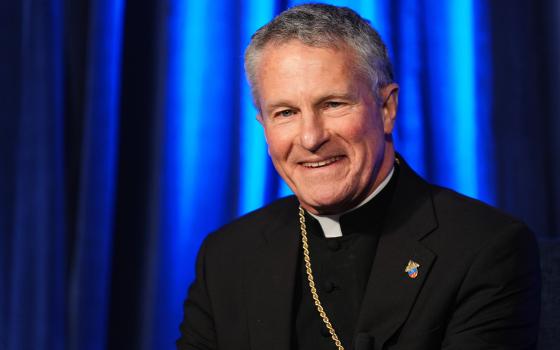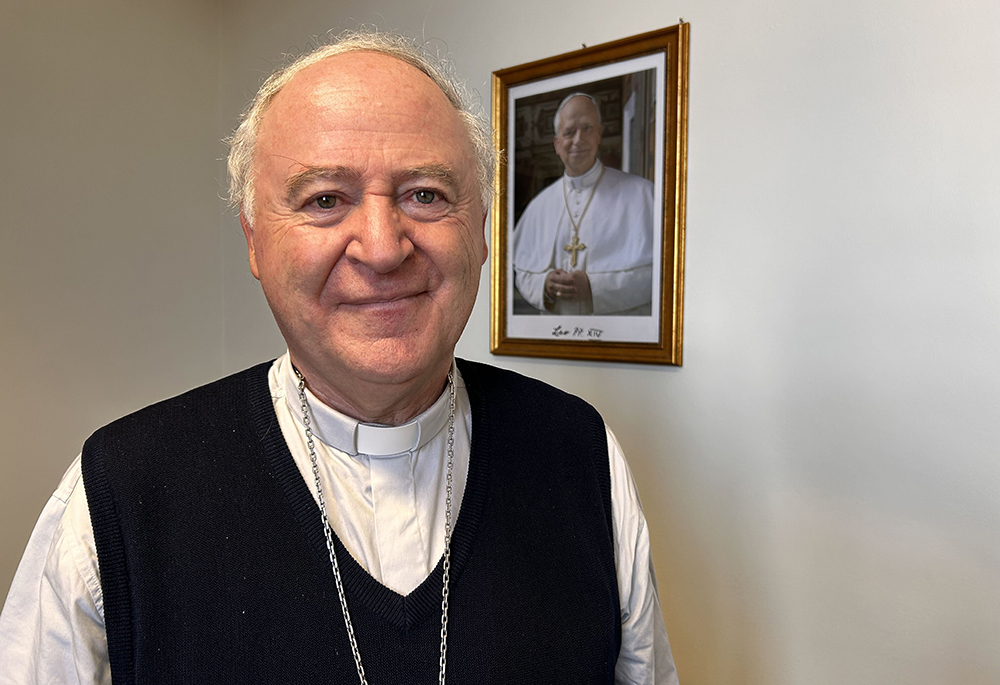
Archbishop Renzo Pegoraro, president of the Pontifical Academy for Life (NCR photo/Justin McLellan)

Join the Conversation
Send your thoughts to Letters to the Editor. Learn more
Archbishop Renzo Pegoraro, head of the Vatican's pro-life office, joined his voice to a chorus of Catholic leaders who decried U.S. Defense Secretary Pete Hegseth's announcement that an upcoming federal execution by firing squad will be livestreamed.
Following clear condemnations of the death penalty by Pope Leo XIV, Vatican Secretary of State Cardinal Pietro Parolin and Archbishop Timothy Broglio of the U.S. Archdiocese for the Military Services in the wake of the announcement, Pegoraro told National Catholic Reporter Oct. 12 that tech companies have a moral obligation to refuse participation in streaming the execution.
While TikTok has already said streaming the execution would break its platform policies, YouTube, Twitch, Meta and X have not said whether or not they would carry the stream. The chair of the Federal Communications Commission said on Friday that it would be up to the Pentagon to decide whether the execution could be aired on broadcast TV.
Pegoraro, president of the Pontifical Academy for Life and tasked with promoting the Catholic Church's pro-life efforts throughout the world, said that livestreaming the planned execution of Nidal Hasan "constitutes a further act of violence against the condemned person." Tech companies considering whether to host the stream must engage in "fundamental ethical reflection," he said, and refuse to participate.
[This interview has been edited for length and clarity.]
National Catholic Reporter: Your office has repeatedly condemned the death penalty. How did you react to the announcement that an execution scheduled for a U.S. prisoner would be livestreamed for public viewing?
Archbishop Renzo Pegoraro: It was an unpleasant surprise for everyone. We have long been aware of the situation surrounding the death penalty in the United States and of the debate over the moral judgment of capital punishment — a judgment that the church has reaffirmed very clearly in recent years.
For decades now, it has been clear that there are other ways to ensure public safety and pursue a form of human justice that, while necessarily limited, does not resort to the death penalty. Today, we have all the means necessary to carry out a prison sentence without depriving a person of either dignity or life, while also leaving open the possibility of hope for someone who has committed crimes that are undoubtedly serious.
There must, of course, be proportionality in sentencing, but that does not require taking a person's life. Added to all of this is the fact that the execution is being made public.
What difference does it make that it will be streamed? The church has already spoken out several times against the death penalty, but now the conversation has changed because it seems that this public spectacle adds a new dimension to the act.
Here, what has caused the greatest uproar, and even protest, is the publicity surrounding the event: this public display of the death penalty, which has drawn negative reactions even from the Holy Father, Pope Leo, and the secretary of state [Cardinal Pietro Parolin]. [The Pontifical Academy for Life] also maintains that this kind of spectacle constitutes a further act of violence against the condemned person, and that is extremely serious.
We have already addressed the death penalty itself, but carrying it out in public adds another dimension of violence. The intention is to send a message to society that certain acts will be punished drastically, harshly and in full public view. But that is not the kind of deterrence we need. In other words, turning punishment into a spectacle does not make it an effective deterrent.
Certain crimes can be prevented much more effectively through prevention itself, through initiatives aimed at stopping harmful patterns before they take hold. Violence is not resolved with more violence.
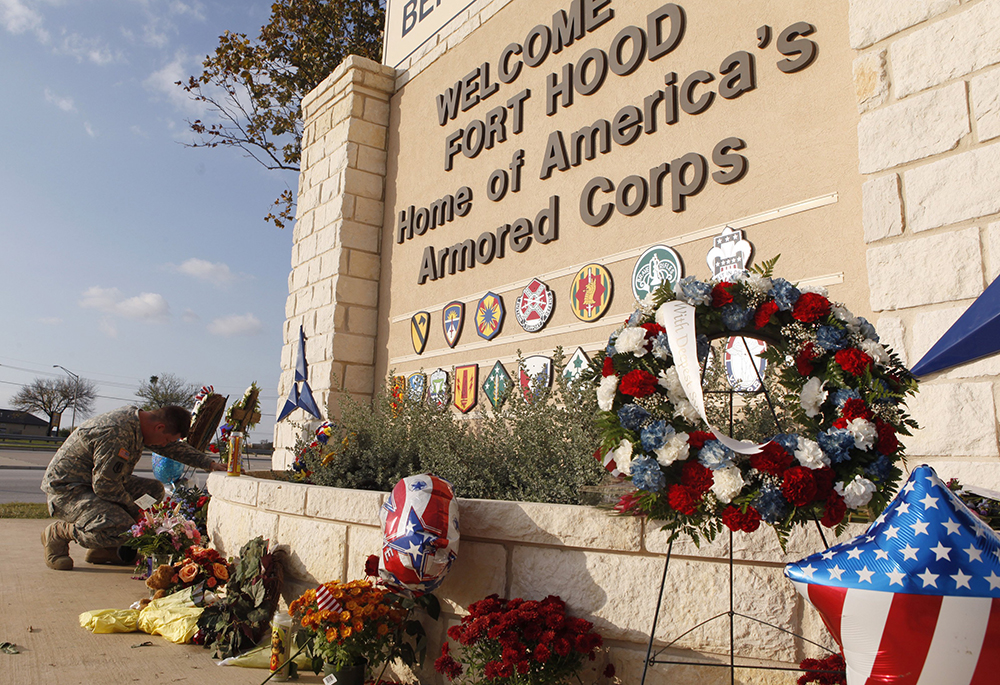
United States Army Specialist Robert Orcutt prays near a makeshift memorial for victims of the shootings at Fort Hood Army post in Fort Hood, Texas, Nov. 9, 2009. (OSV News/Reuters/Jessica Rinaldi)
Part of this debate is over freedom of expression and the role in which tech companies would play in streaming the execution. Some have already said they will not stream it, while others haven't explicitly ruled it out. What responsibility do these tech companies have in their decision to carry the livestream or not?
All of us, including the big tech companies, need to show a little more courage and engage in the kind of fundamental ethical reflection that allows us to say "yes" to some things and "no" to others.
If, in this case, there is a consensus that this portrayal is wrong — that depicting the death penalty as a violent response to violence is morally unacceptable — then saying "no" becomes about more than freedom of expression. It is also a question of responsibility. Large companies need to take their social responsibility seriously. Respect for the person, for life, for justice and for the common good should be shared commitments that also allow us to say "no" to certain things.
Freedom of expression does not mean tolerating or accepting every form of evil or violence. It also requires the courage to act in service of the common good and, when necessary, to say "no."
So by "saying no," you mean that tech companies should refuse to carry the stream?
They, too, must take responsibility for the common good and the protection of people's dignity. In this situation, they should say no.
Advertisement
Returning from France, the pope expressed concern over the appropriation of religion among the far-right. Under the Trump administration we've seen the U.S. Department of Defense open an Office of Religious Affairs and invite conservative Christian pastors into the Pentagon to lead prayer services. What responsibility do Catholics have in response to this?
All religions need to be very careful not to allow themselves to be used for other purposes. The instrumentalization of religion is always a danger, whether for political, economic or social ends.
So we hope that religions will not allow themselves to be drawn into or swept up in this kind of instrumentalization. They must know how to pray — because religions must pray — and cultivate spirituality, including within the military, but always in the service of peace: to prevent war and even the death penalty itself.
If we are speaking about Christians, and Catholics in particular, we must always strive to live in communion with the church and therefore understand the church's teaching on war as well. The themes of peace, nonviolence and justice have been strongly emphasized by Pope Leo and, before him, by Pope Francis and other popes. Magnifica Humanitas [Leo's encyclical on humanity and AI] is also very critical of the use of artificial intelligence in the military sphere and, when addressing war, strongly emphasizes the commitment to peace.
So, as Christians, we have a responsibility to walk together with the church and to be a prophetic voice capable of criticizing what is wrong. We must not give in to certain pressures or circumstances, or allow religion to be exploited. And we must always remain capable of cultivating hope and peace.
The National Catholic Reporter's Rome Bureau is made possible in part by the generosity of Joan and Bob McGrath.