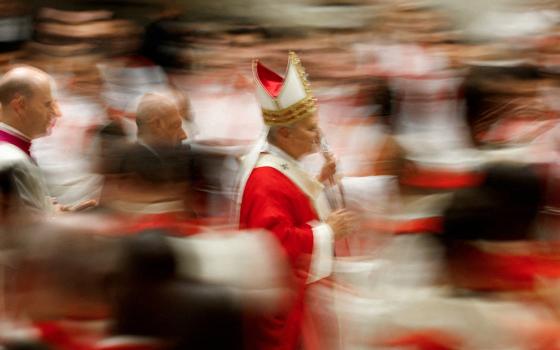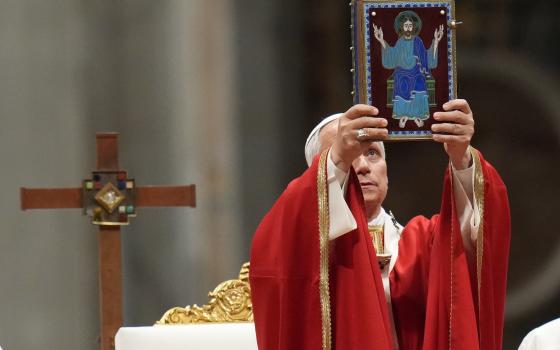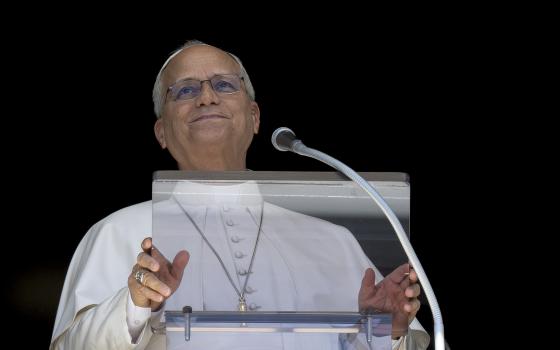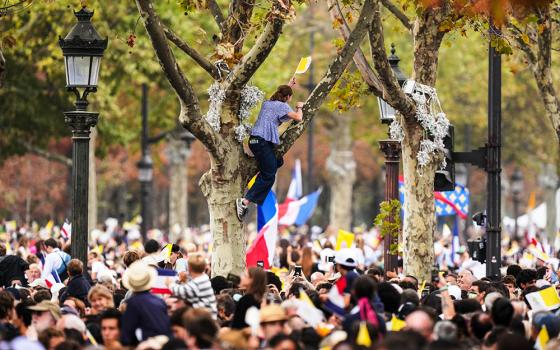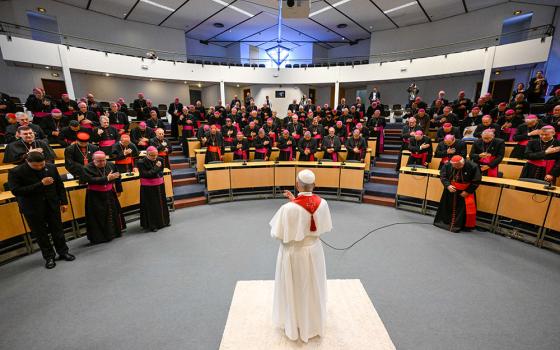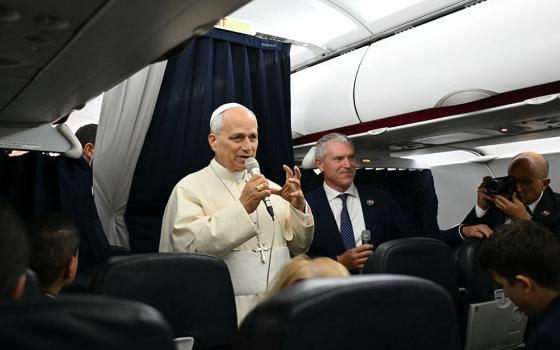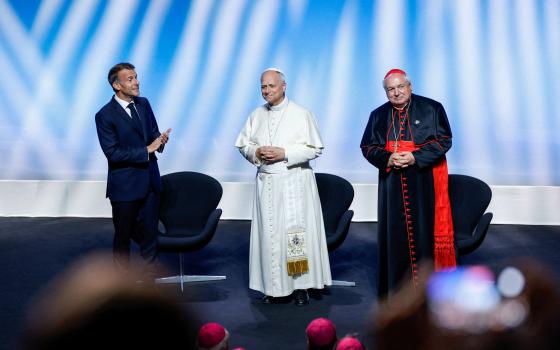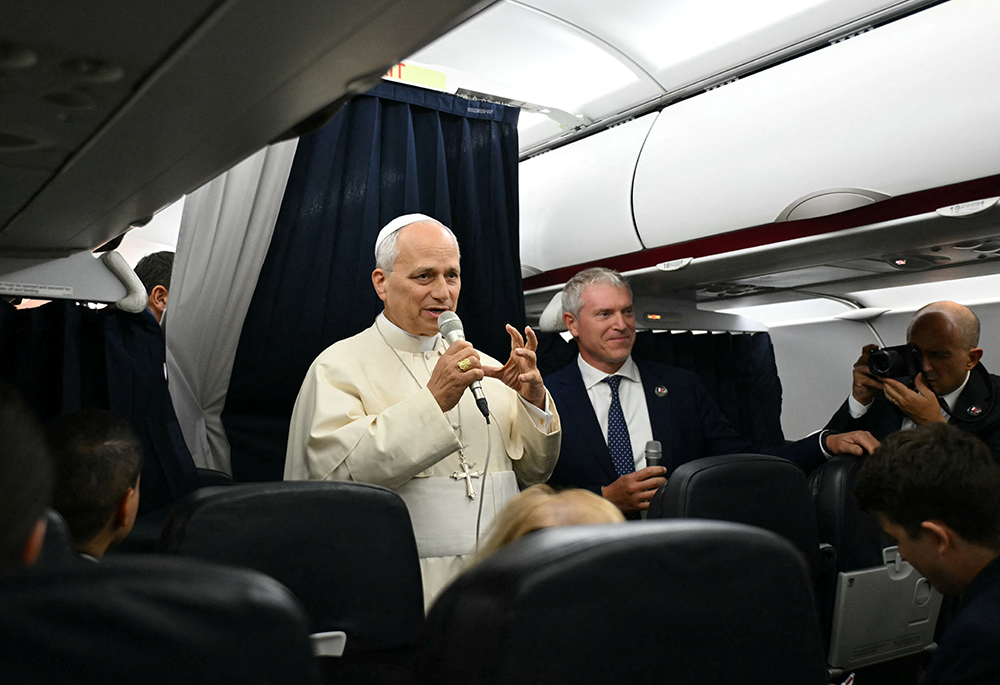
Pope Leo XIV speaks with journalists aboard his flight back to Rome Sept. 28, 2026, after concluding his Sept. 25-28 apostolic journey to France. The pope visited Paris, Saint-Denis, Lourdes and Metz during his trip. (CNS photo/Alberto Pizzoli, pool via Reuters)

Join the Conversation
Send your thoughts to Letters to the Editor. Learn more
Pope Leo XIV waded into the red-hot debate over regulation of artificial intelligence on Monday, stating that the concerns expressed by tech industry leaders over the catastrophic risks to humanity posed by the technology are not "fake news" and "should be taken seriously."
Asked about the seriousness of claims that AI could seriously destroy or even wipe out humanity, which have been dismissed by some tech executives and U.S. President Donald Trump, the pope said that "to simply say, 'Oh it's not going to happen,' and close our eyes to it is probably not the most responsive way to go about that."
The pope said it is not "fake news, as some have said, to try and cause whether financial or some other kind of a benefit."
"This is a problem that we need to sit down and talk about," Leo said Sept. 28 in response to a question from the National Catholic Reporter during his airborne press conference on his return flight to Rome following a four-day visit to France. During that trip, the pope said that society must work to ensure AI serves humanity and does not become "another instrument of domination and injustice."
While U.S. government officials have dismissed concerns over the risks posed to humanity over AI — Trump called efforts to regulate AI part of a "globalist scheme" in his address to the United Nations last week (Sept. 22) — the pope said that "we can't just sit back and pretend that nothing is going to happen."
Yet Leo also said he remains "relatively optimistic" that tech companies can put in place guardrails to avoid losing control of AI entirely.
"If someone would ask me, 'Am I in panic mode?' No, I'm not, I sleep at night," he said. The pope added that through the Vatican's coordination with tech leaders, he is confident there are enough people willing to engage with AI development "outside of the questions of power and 'who gets there first' and 'what happens when Al goes to being what they call general artificial intelligence,' etc."
Advertisement
Despite that, "we need to continue to invite political leaders, the leaders of AI, social organizations, associations, to come together and look at what is happening already and what could be down the road," he said.
Flying from the town of Metz, France, near the German border, Leo was also asked about the rise of the far-right in Germany, which made huge gains in recent state elections earlier this month. The pope said he was intrigued by the "combination of these far-right points of view with a certain kind of religion," which he said is "not an authentic expression of Christianity."
"We can go back to the values of the Gospel, which are not about hatred and division, but they're about understanding and compassion and accompanying," Leo said, expressing his hope that the church can "find ways of reaching out to a majority of people of goodwill" and "enable them to make clear choices for the common good and not for extremist ideas that perhaps will do much more damage than we are even aware of right now."
The church, Leo said, must be "talking about, teaching about, preaching about what we believe: these life-giving values, and not destruction and division and hatred."
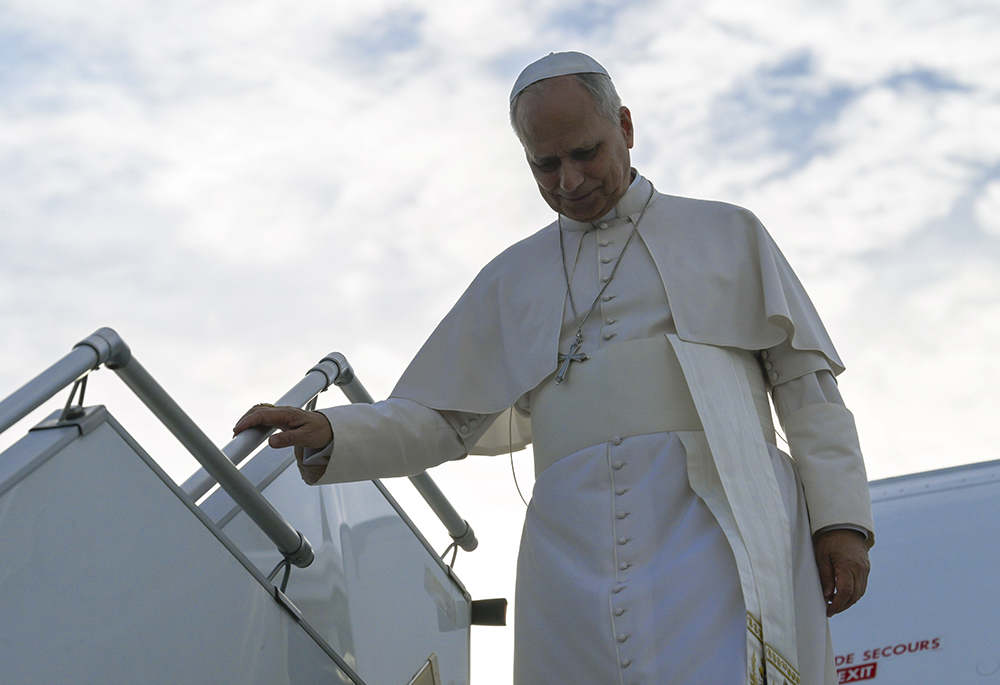
Pope Leo XIV descends the stairs of the papal plane upon arriving at Metz-Nancy-Lorraine International Airport Sept. 28, 2026, during his apostolic journey to France. (CNS/Vatican Media)
After the pope met with seven victims of sex abuse by priests and other church workers in France, the pope told reporters on his flight to Rome that several of the victims "spoke about systemic abuse" during their 90-minute meeting.
The idea of systemic abuse was a key finding of a 2021 report commissioned by France's bishops and the country's religious orders which estimated that some 330,000 children had been sexually abused by priests and other church workers in France from 1950 to 2020.
The report claimed that church structures allowed for widespread abuse and cover-up to occur rather than attributing the abuse solely to individual actors. It was met with hostility in the Roman Curia, and even Pope Francis expressed doubts over the report's methodology and cancelled a planned meeting with the commission that had produced the report to the dismay of victims' groups.
Asked about the systemic dimension of abuse in the church, Leo said that "personally, I prefer to express it in a different way."
"Although I did speak about some organizations within the church who have at times, if you will, as a system, been abusive," the pope said that "sexual abuse is first and foremost a human problem."
"When it happens within the church it actually has another whole dimension added to it, because people's lives of faith are deeply wounded and sometimes even destroyed," he said, "so there's a particular responsibility of the church to walk with them and to help them seek healing."
Discussing his meeting with abuse victims in Lourdes, the pope said that he had "asked them to also help me to express to other victims the willingness of myself, and the church, to listen, to walk with them as they look for healing, recognizing the pain that has been caused in their lives because of situations of abuse."
The National Catholic Reporter's Rome Bureau is made possible in part by the generosity of Joan and Bob McGrath.