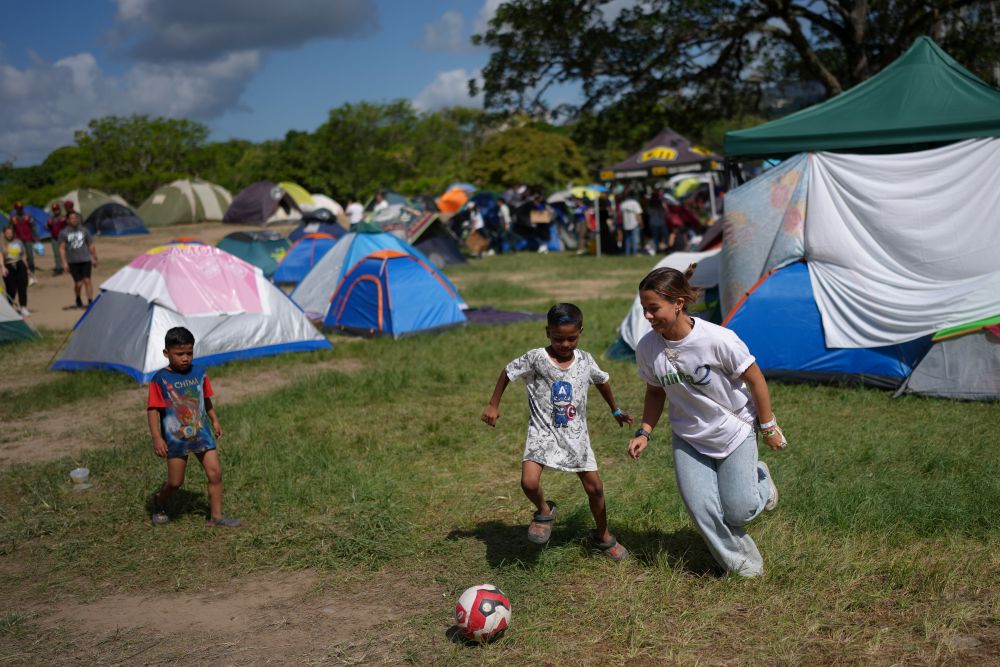
A volunteer plays soccer with children at Francisco de Miranda Park in Caracas, Venezuela, where people whose homes were damaged in the earthquakes are camping, Wednesday, July 1, 2026. (AP/Matias Delacroix)
by Yolanda Chávez
Join the Conversation
Send your thoughts to Letters to the Editor. Learn more
In a recent catechesis session, a Venezuelan woman quietly asked us to pray for her country.
She did not describe the earthquake. She did not tell us how many people had died. She did not speak about collapsed buildings or roads cut off by landslides. She simply asked us to pray. Her request lasted only a few seconds, but after the session ended I found myself unable to move on.
Natural disasters have a way of commanding the world's attention — for a while. During those first days, images of collapsed homes, rescue workers searching through rubble, overwhelmed hospitals and grieving families fill our screens, reminding us of our common humanity.
Then, almost imperceptibly, the world's attention shifts. Another crisis emerges. Another headline appears. Another tragedy claims our gaze.
The cameras leave long before the suffering does.
As I searched for reliable information about the aftermath of the earthquake in Venezuela, one reality kept coming back: the children. Not because of the alarming rumors circulating on social media — many of those remain unverified and should not be repeated as fact — but because the verified information is already heartbreaking enough.
UNICEF and other humanitarian organizations have warned that hundreds of thousands of children affected by the earthquake are now living under conditions that dramatically increase their vulnerability. Many have been separated from parents or caregivers during the chaos. Others remain in overcrowded shelters where privacy, security and consistent protection are difficult to guarantee. Humanitarian agencies have also warned of increased risks of trafficking, sexual exploitation, abuse and violence against children in disaster settings. Those warnings deserve our attention, not because they invite fear but because they invite responsibility.
We don't know how many children have lost both parents. We don't know how many families are still searching for one another. We don't know how many reunifications remain unfinished.
But we do know this: A child does not have to disappear to become vulnerable. Sometimes vulnerability begins with separation. It begins when no familiar voice answers the question, "Whose child is this?"
Every major disaster creates two emergencies. The first is loud and visible: collapsed buildings, broken roads, rescue operations. The second is quieter: protecting those who survive.
History has shown that whenever communities are displaced and institutions overwhelmed, children become especially vulnerable to exploitation. Traffickers and abusers do not create earthquakes, they simply know how to exploit the chaos earthquakes leave behind.
Protecting children cannot be treated as a secondary concern after food, water and shelter have been distributed. Protection is life-saving work. Documentation is life-saving work. Family tracing is life-saving work. Careful reunification is life-saving work.
Advertisement
For Christians, this is not merely humanitarian language; it is Gospel language.
When Jesus placed a child in the midst of his disciples (Matthew 18:2-5), he did something profoundly countercultural. He made the smallest person in the room the measure of every disciple's faithfulness.
Perhaps that is the same measure of the church today. Not only: How many buildings have been rebuilt? But also: Who is watching the children?
This question belongs not only to Venezuela, it belongs to the universal church. Every parish, every diocese, every Catholic organization that prays for Venezuela can also ask what concrete form that prayer might take.
Can we support organizations working to reunite families? Can we strengthen ministries dedicated to child protection? Can we accompany local churches long after international attention has faded? Can we help ensure that no child becomes invisible?
The woman who asked my group to pray for Venezuela probably never imagined that her quiet request would become an examination of conscience for me. Perhaps that is how the Holy Spirit most often speaks, not through dramatic announcements but through one simple request that refuses to leave our hearts.
The church often describes herself as Mother; that image carries responsibilities. A mother does not leave when the television crews leave. She remains.
She learns the names of the children.
She notices who has not returned home.
She keeps searching.
She keeps protecting.
She keeps hoping.
She never moves on.