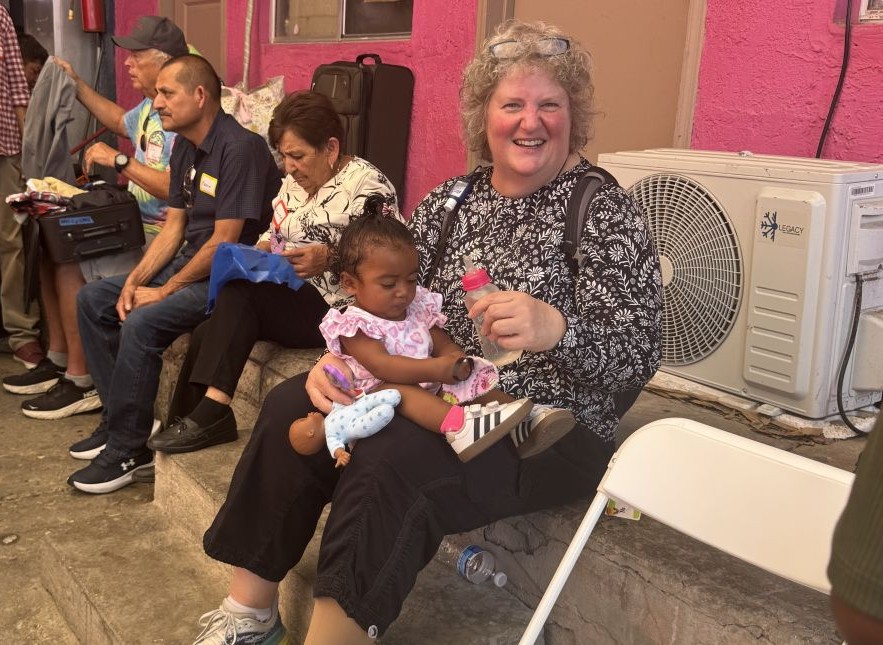
Society of the Sacred Heart Sr. Lisa Buscher smiles at another sister after feeding a child at the Cobina Posada del Migrante shelter in Mexicali, Mexico, June 6, 2026. (GSR photo/Rhina Guidos)

by Rhina Guidos
Join the Conversation
Send your thoughts to Letters to the Editor. Learn more
It wasn't too long ago that it was hard to hear yourself think in the midst of the hustle and bustle of migrants at the Cobina Posada del Migrante shelter in the border town of Mexicali. Children ran around the cement courtyard; global humanitarian aid workers came and went with food, clothes and medicine. Sisters found a way to minister among streams of women, men and children, upwards of 400 of them, who regularly crowded in while waiting for a chance to cross the border into the U.S., a short distance from the shelter.
A year after Global Sisters Report last visited sisters along the San Diego-Mexicali corridor, the shelter — one of the venues where they minister to migrants near the border — had just 33 people.
Gone are the noise, the crowding and movement of the past, which more often than not accompanied dreams of a new life. They quickly died down Jan. 20, 2025, moments after Donald Trump's second inauguration as U.S. president. Appointments some of the shelters' inhabitants had made at U.S. points of entry nearby were immediately canceled, denying them access to the parole and asylum-scheduling processes that would have allowed them in the country while courts weighed their claims.
As the few legal pathways migrants could once count on to enter the United States disappeared, many left the shelter. The few migrants left are asylum seekers who can't return home and those deported from the U.S. Sisters say they find themselves with little to offer, but they still show up to share food, company and a little cheer as the last of humanitarian groups standing by migrants trying to figure out what to do and where to go amid enforcement of Trump's immigration policies.
"When the border closed because of federal policy, everything disappeared," Society of the Holy Child Jesus Sr. Ann Durst told GSR June 7 in San Diego, describing the dramatic change that has taken place in southern California's border region.
Along with halting viable legal channels to enter the country, funding that supplied humanitarian aid also stopped, she said. National Guard troops and policing by U.S. Customs and Border Patrol in the region increased.
"So suddenly, the border's empty and it's militarized," Durst said of the past year.
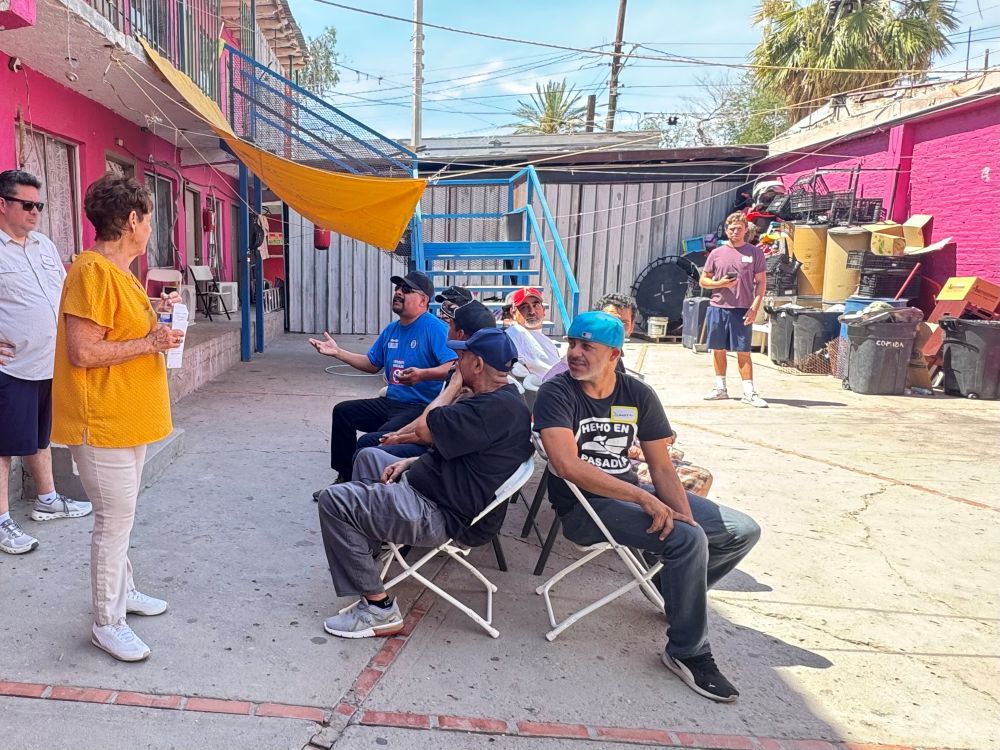
St. Joseph of Carondelet Sr. Suzanne Jabro, in yellow, talks to a group of men at the Cobina Posada del Migrante shelter June 6, 2026. Jabro is the founder of Border Compassion, which facilitates encounters between migrants, sisters, ecumenical groups and others. (GSR photo/Rhina Guidos)
But troops aren't the only ones who've increased their presence. Even as the number of migrants has dwindled, women religious like St. Joseph of Carondelet Sr. Suzanne Jabro said sisters, too, will continue to show up and continue to do what they have done for generations.
"Women religious have always been on the margins," and they have a history of sticking close to the poor, said Jabro, founder of Border Compassion, a ministry in southern California that helps U.S. parishes and individuals volunteer and learn about the plight of migrants by interacting with them at the border.
Even as many congregations in the U.S. have older members who may not be able to be present at the border, "everybody's concerned about the situation," including sisters who live far from the border, Jabro told GSR. On immigration matters, sisters nationally are banding together to see how they can help collectively, she said.
One effort is the sister-led Transborder Coalition for Border Ministries, the administrative arm of a network supported by more than 30 women's congregations that funds the pastoral work of sisters like Jabro. In 2025, more than two dozen congregations pledged up to $300,000 to help the effort and the Conrad N. Hilton Foundation, a major funder of GSR, awarded the coalition that same year a $400,000 grant to build "organizational and financial capacity."
While one group of sisters deals with the administrative aspect of raising funds, another group, known as the Collaborative for Border Ministries, concentrates on boots-on-the-ground humanitarian work, which includes the following:
- Franciscan missionary sisters who run Casa de los Pobres, providing food, shelter and clothing in Tijuana;
- Sisters of Mercy in San Diego, who help migrants more inland at Casa de Misericordia;
- Sisters of Social Service's Southern California Immigration Project, as well as legal help at Casa Cornelia, a not-for-profit law firm founded by sisters from the Society of the Holy Child Jesus, including Durst, who's an immigration lawyer.
Their help has made a great difference to those stranded in desperate situations, said Elizabeth Gallardo, director of Mexicali's Posada del Migrante shelter. Without direct help from the sisters' organizations, the shelter where she works would have closed, she said.
"This past year has been very difficult," Gallardo told GSR. "Other organizations stopped supporting us completely … the sisters' help has meant a lot."
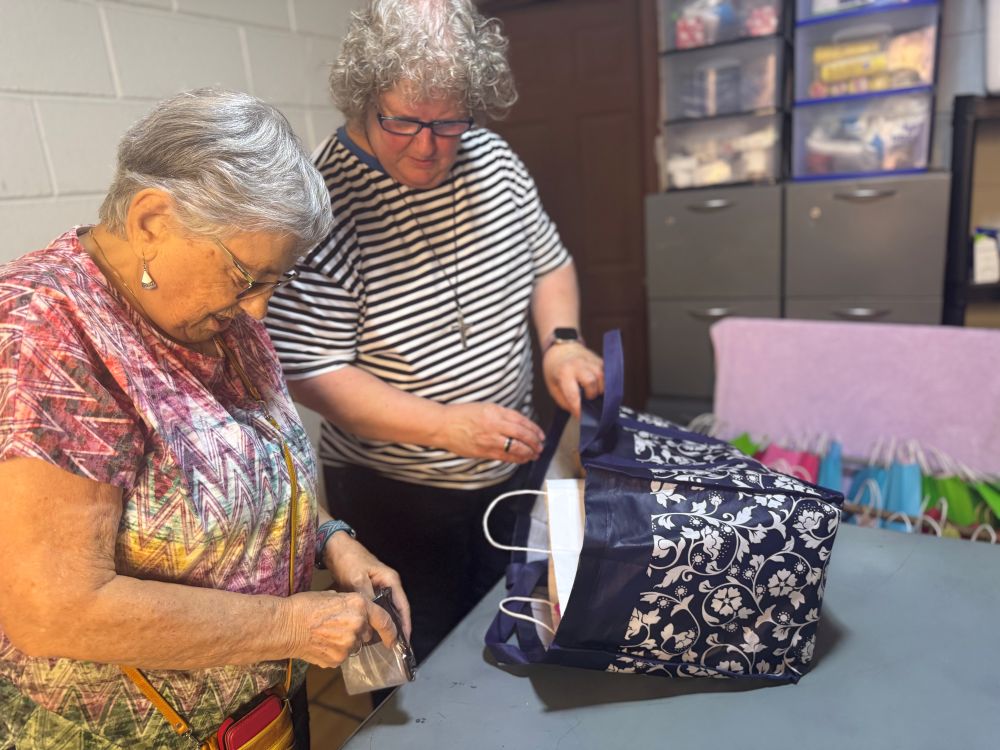
Rochester Franciscan Sr. Phyllis Sellner, of Palm Desert, California (left), and Society of the Sacred Heart Sr. Lisa Buscher prepare gifts for people at the Cobina Posada del Migrante shelter in Mexicali, Mexico, June 6, 2026. (GSR photo/Rhina Guidos)
While some sisters don't have the physical capacity to show up to the border, many have pledged their help in other ways. Some offer prayers, some write letters to their local representatives, some congregations help the effort by donating to the coalition, and even sisters who are infirm have helped by packing whistles, used to alert communities to the presence of ICE agents, said Rochester Franciscan Sr. Phyllis Sellner.
"They feel it's important to be involved in activities for migrants and anybody else in need," she said.
Sisters in the region have witnessed the difficulties migrants on both sides of the border have faced in the past year.
At San Diego's Our Lady of Guadalupe Church, which has Mercy Sisters' presence, some have accompanied parishioners afraid to attend court dates for fear they may not return. The parish set protocols for any ICE activity after Mass. A temporary shelter for migrants that had been full before Trump's second inauguration quickly emptied out and has been suspended, said Jesuit Fr. Scott Santarosa, the pastor.
"People went under" the radar, he said, adding that the community has had to take precautions so that parishioners and visitors don't become targets. The parish also joined a federal lawsuit against the Trump administration for reversing a policy that had prevented immigration enforcement in "sensitive locations."
"We're suing so that we can get back the protection that a church, a hospital or a school should have," Santarosa told GSR.
Advertisement
Durst said sisters are seeing the fear in the area, which has driven many into hiding.
"People are terrified," she said. "It's a whole different world of fear, hiding and sorrow."
It's hard to know what the next year will bring along the region, but sisters and their collaborators, like Andrew Trofka, an Episcopalian who has for years visited the shelter with the sisters from southern California, say they may be the only source of hope left when there are no more options open to migrants.
"There used to be a real sense of hope that people would be able to cross and see their family, be with their families," Trofka said. "But that hope is gone."