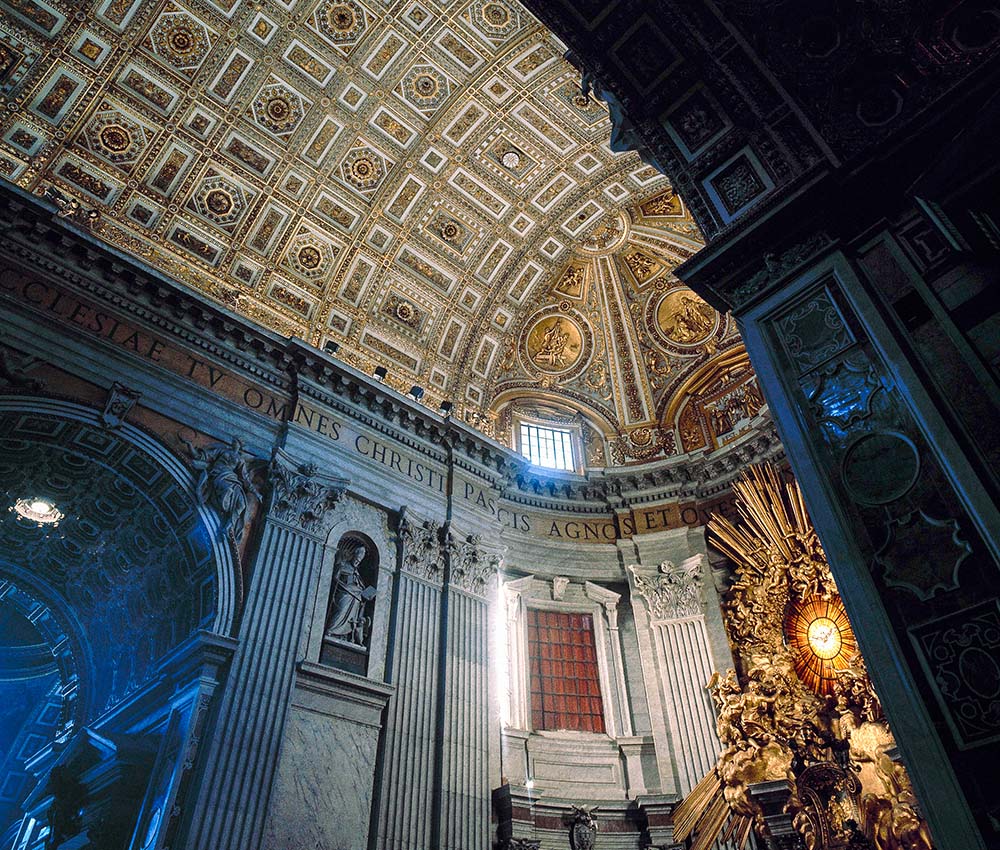
An interior view of St. Peter's Basilica in Vatican City on October 9, 1962, two days before the opening of the Second Vatican Council (AP)

by Marissa Papula
Join the Conversation
Send your thoughts to Letters to the Editor. Learn more

A beloved professor of mine at Boston College kept a framed print of Mark Rothko's "Light Red Over Dark Red" in her office. "It reminds me to take a closer look," she remarked once. "Just when I think I've seen all there is to see, there's another layer, another detail beckoning my attention."
In vignettes that move from the intimate terrain of the body to the vast, unsettled horizons opened by the Second Vatican Council, Stephanie Sy-Quia's debut novel, A Private Man, traces themes of inheritance and longing across continents and generations. As layered and exacting as Rothko's painting, the book is a helix of emotion, embodiment and ecclesiology. A Private Man's revelation emerges in its restraint.
"His grandfather had been a Catholic priest: a short story in ten words or fewer. And him the living proof."
Adrian Fletcher travels to France to care for his ailing grandmother, where he begins to uncover the buried patrimony of his grandfather's life as a Catholic priest. As Adrian tends his grandmother's affairs, moves her into assisted living and mines her failing memory for the truth of his own origin, we come to know his grandparents: David Fletcher, a handsome, once devoted Catholic priest from England, and Margaret Bendelow, a Catholic convert and alumna of Regina Mundi (the closure of which is announced with a quote from our own National Catholic Reporter). Margaret is paired with David to teach theology at a girls' school.
Margaret's recollections to Adrian are staccato and incomplete. This equally grieves and frustrates him, but these disparate memories perhaps reflect the affections David and Margaret allow themselves to indulge in as they fumble against David's vows in the swirl of their deepening mutual affection.
Advertisement
Margaret arrives in David's life a self-contained scholar in her mid-30s who has buried both parents and been singed from a combustible love affair with a married sculptor. Margaret is as cerebral as she is sexual: When she notices the sculptor carrying a copy of Confessions in his jacket, she asks to discuss it with him over a drink, "in that forward way she had cultivated since university." She is smart, sensitive and kinetic.
Her bids for intellectual discourse intrigue David. As they begin teaching together, he thinks her syllabus suggestions are too ambitious but concedes that her Latin and Scripture literacy exceed his. Whereas Margaret presents as self-possessed, with her rich inner narrative and deliberate agency, David is revealed in bas-relief. Margaret's musings about what exists beneath David's surface imply a rich interiority that readers are only privy to through what remains unseen and unsaid.
Buoyed by the possibility of change in the 1960s Catholic Church, Margaret is eager to impart her hopes upon her pupils. David is at once stimulated and made nervous by Margaret's verve. Margaret is enamored and conflicted in kind, reflecting:
All her life, people had tried to make her feel ashamed, had called her pretentious, affected, too clever. This had confused her, indeed, made her feel ashamed. And here was someone who met her there, party to party. Talk with David was a wide expanse of green, and her mind the bright bolt of a chestnut-coloured horse upon it: fully extended, free.
David and Margaret tête-à-tête over theology in encounters increasingly exclusive, moving from the classroom to his kitchen. As boundary lines ripple, their coupling feels inevitable: David is laicized, purchases Margaret's engagement ring, and Margaret becomes pregnant on their honeymoon. Just as they had unfurled into one another over the course of their restrained affair, their marriage unfurls into something profoundly ordinary: chores, parenthood, work, illness, death. Was it worth the rupture?
Vatican II held the promise of bold, swift change. So too did the escalation toward this romantic union presuppose something vigorous and intrepid, only to bump against arrested potential. Margaret and David's urgent reach for one another falls limp across time and reality.

Stephanie Sy-Quia, author of the novel A Private Man (Courtesy of Grove Atlantic/Juliana Bergen)
In the Catholic imagination of A Private Man, the sensuous and the sacramental emerge in what remains unsaid between characters; this muted desperation leaves readers unconsciously holding their breath. David and Margaret relate to one another with the restrained longing of a Sally Rooney novel, the gaping contrast between the characters' chilly interactions and simmering interiority, a via negativa opening a chasm of longing. Likewise, Ron Hansen's Mariette in Ecstasy echoes throughout, the somatic lyricism animating the idiosyncrasies of consecrated life and setting the body as venue for the story. Sy-Quia earns her place alongside Rooney and Hansen in the Catholic literary canon.
Sy-Quia brings theological rigor to what in lesser hands might be mere salacious scandal. That Sy-Quia is also a prize-winning poet should come as no surprise to readers, nor should the care and precision with which she crafted A Private Man once her personal connection to the novel is revealed.
"Let me lessen my request. Let me breathe between the heavens and the earth, a private man," David exhales to Margaret after they've married. (This remark, and the book's title, are borrowed from Shakespeare's "Antony and Cleopatra.") As they soften into an otherwise ordinary life, this story of an ambitious, embodied woman and the pious priest she marries finds its audacity in quiet exploration of the private life, between individuals, across generations, against the backdrop of radical change. We peel back the layers. We attend to the supposed transformation that awaits after rupture, inhabited in the ordinariness, in the way of proceeding that carries on.