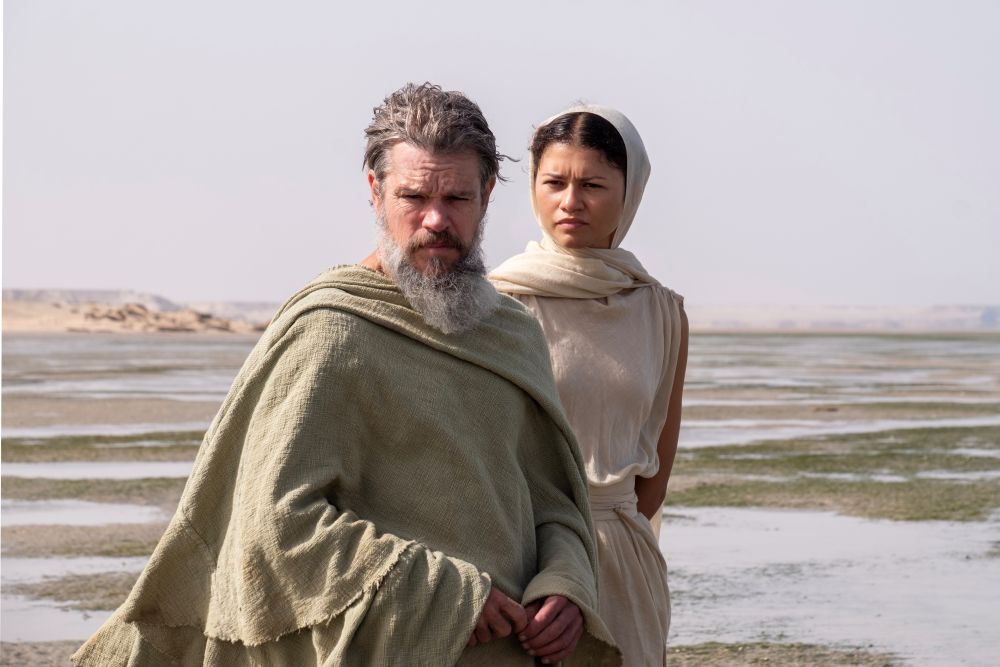
Matt Damon as Odysseus and Zendaya as Athena appear in a scene from "The Odyssey," by director Christopher Nolan. (OSV News/Universal/Melinda Sue Gordon)

by Emma Cieslik
Join the Conversation
Send your thoughts to Letters to the Editor. Learn more
Christopher Nolan’s new film adaption of "The Odyssey" is a modern reflection on the cost of war, one that requires the audience to consider the relevancy of the U.S. assault on Iran and Israel's ongoing annihilation of Gaza. Fans of epic Greek battle tales may find it a surprising interpretation, one that supports Pope Leo's call for peace and his argument that the church's just war theory is outdated.
While the original Homeric epic contained a moral lesson about Odysseus' hubris (all his fellow soldiers die because of his vengeance against Polyphemus), Nolan frames the hero's perilous journey as a metaphor for the universal experience of traumatized veterans trying to reenter what once felt like home. Odysseus (Matt Damon) cries as he tells his wife Penelope (Anne Hathaway) about what the journey cost him: his own physical and mental health, and the lives of the soldiers under his command.
Although he is lucky to return home, the home he remembers no longer exists.
In Odysseus' absence, suitors have flooded in and are clamoring to marry his wife, insisting that it's time for her to choose the next king of Ithaca. Penelope is steadily losing faith that her husband is still alive, much less that he will ever return, and his son Telemachus (Tom Holland) has spent his entire life searching for a father he does not remember. The political instability of Ithaca compels Telemachus to aspire to become king before he is ready, diminishing his mother's work for the island and almost getting murdered by her suitors. Even Odysseus' most loyal friend and blind swine herder, Eumaeus (John Leguizamo), is beaten close to death for his allegiance.
Everyone whose lives touch Odysseus' face the human cost of war, even if they never step foot on the battlefield. In Troy, murder, rape, enslavement and mass destruction run rampant, and the audience watches through the eyes of the man whose ruse of the Trojan Horse made their victory — and bloodshed — possible.
Through the witch Circe, who turns Odysseus' men into pigs, he learns that the men sent adrift after the war threaten everyone they come across, hungry and emboldened by the license to rape and kill.
Nolan's film is fundamentally about how war changes everyone; when dehumanization and murder is institutionalized, social morals disappear.
"The Odyssey" has largely been marketed like a new and improved version of Wolfgang Petersen's "Troy" (2004), glorifying war as inherently masculine and victorious, and so Nolan finds an audience eager to indulge the fetishization of Ancient Greece. But instead of praising brutality or idolizing the hero himself, the film urges us to face the true cost of our modern wars.
Odysseus acknowledges to Penelope that he only won because he disobeyed Zeus' law of hospitality. In a heartbreaking chastisement, Athena, the goddess of war who appears only to Odysseus, takes the form of a young girl whom he saw beheaded during the pillaging of Troy. The decapitated statue of the goddess, head rolling across the screen, is a symbol of profound sacrilege. Odysseus' war was fundamentally unholy.
Many argue that war is the measure of a man and of a nation's strength. But in this adaptation, Nolan offers us a broken hero who is never again able to find home — because the war he waged is what destroyed it.
Advertisement