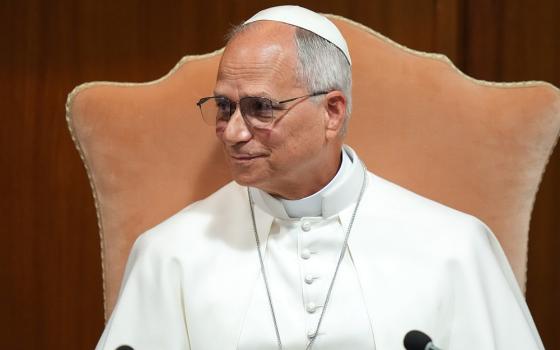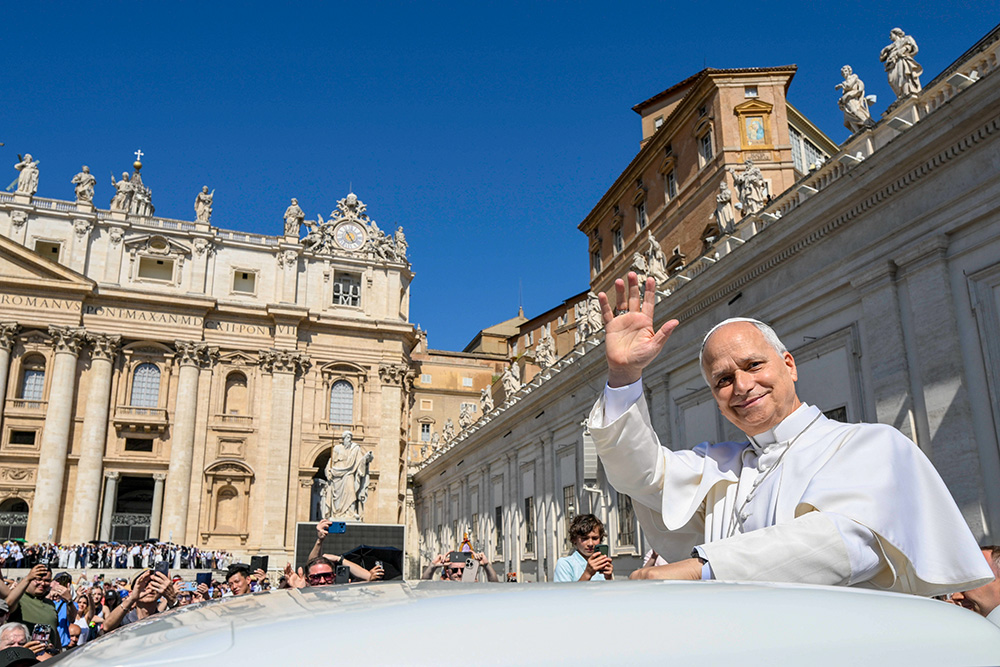
Pope Leo XIV greets visitors and pilgrims from the popemobile while riding around St. Peter’s Square at the Vatican before his weekly general audience May 27, 2026. (CNS/Vatican Media)
Pope Leo XIV has done something the Catholic Church urgently needed. He has spoken about war, peace, technology and human dignity with the clarity this moment demands.
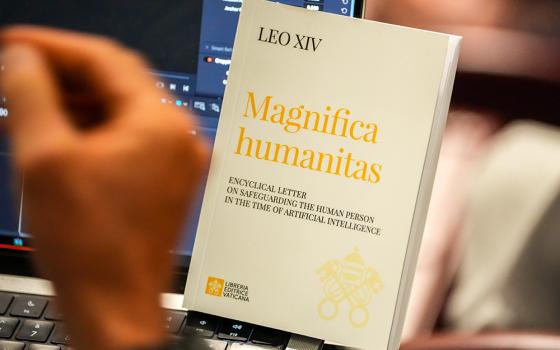
In Magnifica Humanitas, his first major encyclical, Leo does not treat war as one moral problem among many. He places it within a broader crisis of humanity. He sees an age shaped by technological dominance, artificial intelligence, economic control, militarized politics, weakened international law and a public imagination trained to believe that war is inevitable.
The issue before the church is not only whether this or that war can be justified. The deeper issue is whether Christians have allowed war itself to become normal.
Leo writes with unusual directness, "Without prejudice to the right to self-defense in the strictest sense, it is important to reaffirm that the 'just war' theory, which has all too often been used to justify any kind of war, is now outdated."
That sentence deserves to be read slowly. It does not come from a marginal peace activist. It comes from the bishop of Rome, speaking from the heart of Catholic social teaching.
The pope is right. Catholics should now ask what it means to say that just war theory is "outdated."
That does not mean the questions raised by the tradition were foolish. They were not. At its best, just war teaching sought to restrain violence. It asked whether a war had a just cause, whether legitimate authority had declared it, whether it was truly a last resort, whether civilians would be protected, whether the harm inflicted would be proportionate to the good sought and whether there was a reasonable hope of success.
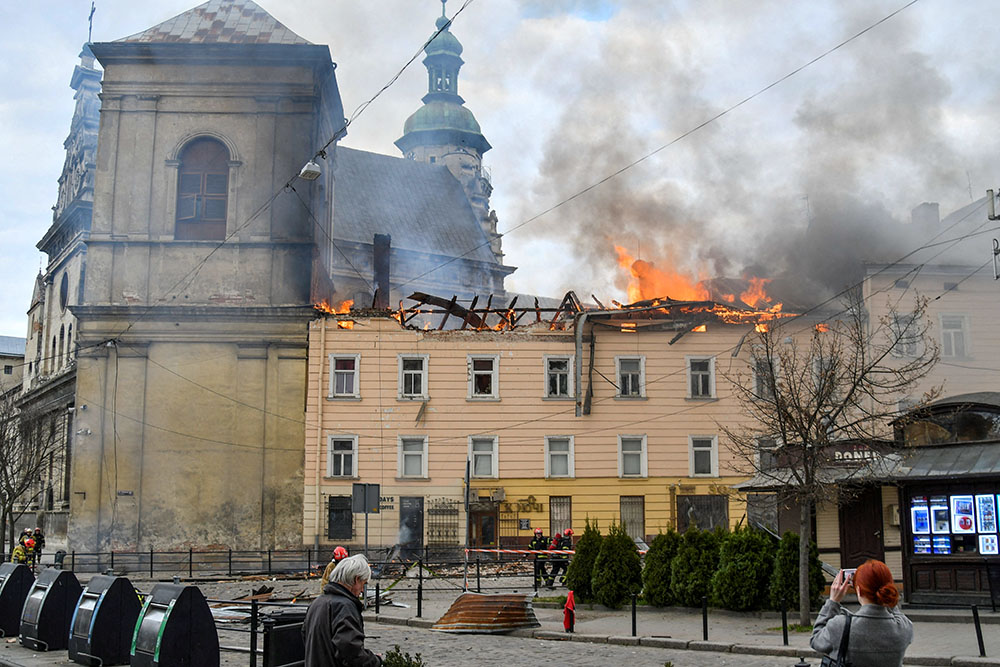
Firefighters work at the site of a residential building in Lviv, Ukraine, hit by a Russian drone strike March 24, 2026, amid Russia's massive nationwide attack on Ukraine that day. (OSV News/Reuters)
Those questions were meant to limit state power, expose aggression and prevent the easy sanctification of violence. But a framework developed in earlier centuries can no longer carry the full moral weight of the Gospel in an age of drones, cyberwarfare, artificial intelligence, autonomous weapons, nuclear arsenals, permanent war economies and civilian populations treated as the battlefield itself.
The wars known to Augustine and Aquinas bear little resemblance to the wars of the 21st century. The battlefield is no longer confined. Hospitals, schools, apartment buildings, power grids, water systems, food supplies and communication networks are routinely drawn into the logic of war. Civilian life is no longer collateral to war. Increasingly, civilian life is the terrain of war.
That is one reason just war theory has become inadequate. But it is not the deepest reason.
The deeper reason is Jesus.
Jesus did not give his followers a theory of justified violence. He gave them a way of life. He told them to love their enemies, pray for their persecutors, turn the other cheek and put away the sword. He healed the sick, fed the hungry, welcomed the excluded, confronted hypocrisy, crossed boundaries of purity and tribe, forgave sinners and stood before imperial power without returning violence for violence.
This was not passivity. It was active, public, disciplined resistance. Jesus resisted evil without imitating it. He exposed domination without becoming domineering. He defended the dignity of the vulnerable without dehumanizing those who threatened him. He did not die because he was harmless. He died because the nonviolent reign of God he embodied threatened systems built on fear, exclusion and force.
Advertisement
That is why the church's turn toward nonviolence is not a retreat from the world. It is a return to Jesus.
The earliest Christians understood this more clearly than later Christendom often did. They were not known for theories of righteous killing. They were known for fidelity to the nonviolent way of Jesus. Over time, as Christianity became entangled with empire, the church developed ways to morally manage state violence. That history should be understood, not caricatured. Just war teaching was not born of bloodlust. But neither should it be shielded from judgment when it no longer restrains the violence it was meant to limit.
Pope Francis began moving Catholic teaching decisively in this direction. In Fratelli Tutti, he warned that "we can no longer think of war as a solution," because the risks of war will likely always outweigh its supposed benefits. He said it is "very difficult nowadays" to invoke the rational criteria developed in earlier centuries to speak of a possible just war.
Francis did not abolish moral judgment. He sharpened it.
Leo now carries that development forward. He places war within a broad spiritual and cultural crisis: the crisis of a humanity tempted to dominate rather than serve, to calculate rather than care, to wield power without wisdom, to treat persons as functions, data, targets or obstacles.
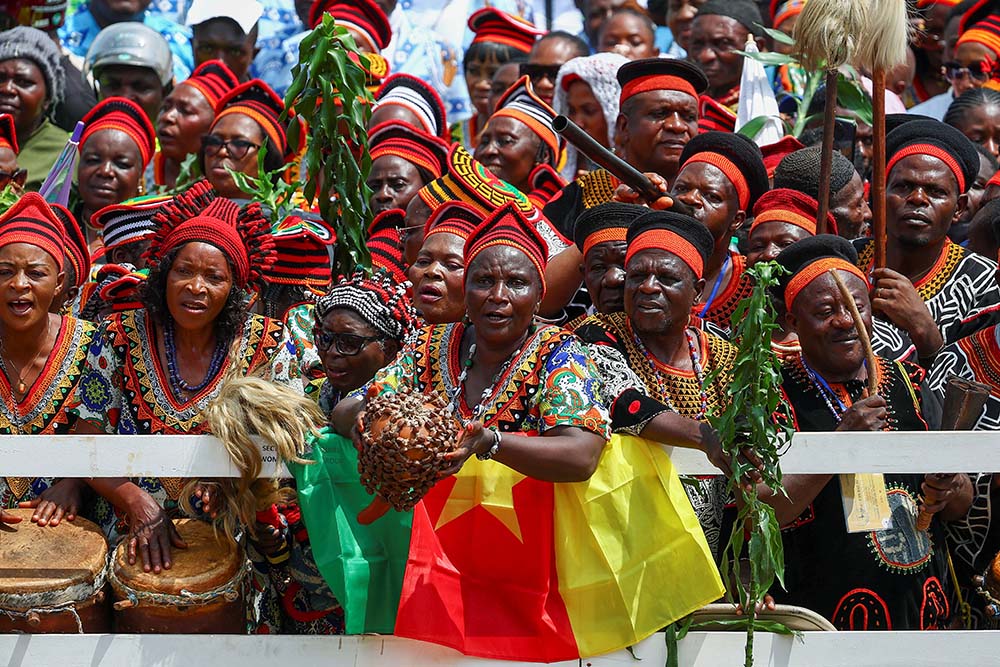
People gather outside St. Joseph's Cathedral in Bamenda, Cameroon, April 16, 2026, as they wait for the arrival of Pope Leo XIV for a Meeting for Peace. (OSV News/Reuters/Guglielmo Mangiapane)
That is why Leo's teaching on artificial intelligence matters so much. Technology is never neutral when absorbed into systems of domination. AI can amplify propaganda. It can reward conflict. It can make surveillance more efficient, weapons more autonomous, decision-making more remote and killing more impersonal. Leo warns that autonomous weapons systems can make war more "feasible" and less subject to human control. He rejects the fantasy that machines can become moral agents.
"No algorithm can make war morally acceptable," he writes.
It also exposes the inadequacy of just war theory in our time. If moral judgment requires conscience, responsibility and recognition of the other as a person, then war systems designed to accelerate lethal decisions beyond human control are not merely dangerous. They are morally deforming. They train human beings to surrender conscience to calculation.
Nowhere is this clearer than in the case of nuclear weapons.
Leo warns that nuclear arsenals are again receiving renewed attention. He notes the weakening of nuclear reduction agreements, the development of so-called tactical nuclear weapons and the widespread yet erroneous belief that nuclear deterrence is necessary for security. The pope is not merely asking for better arms control. He is challenging the moral imagination that treats terror as prudence.
Francis named the moral reality at Hiroshima, Japan, when he declared that both the use of atomic energy for purposes of war and the possession of atomic weapons are immoral. "We will be judged on this," he said.
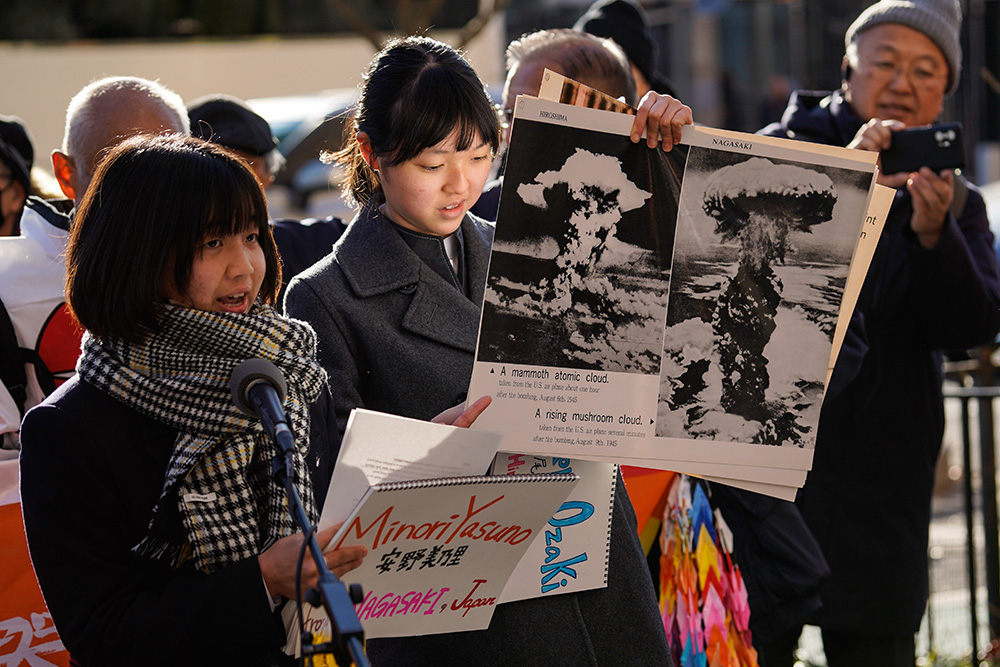
Representatives of the Hiroshima Nagasaki Peace Messengers speak across the street from United Nations headquarters in New York City during a rally to abolish nuclear weapons Nov. 28, 2023. Catholic Worker and Pax Christi members were among the participants. (OSV News/Gregory A. Shemitz)
Leo has now made clear that the old language of deterrence cannot bear the moral weight placed upon it. A peace held hostage by the threat of annihilation is not peace. It is fear organized into strategy. It is the normalization of terror.
Catholics should say plainly that such logic cannot be squared with the Gospel.
That is where Gospel nonviolence must be understood correctly. Nonviolence is not doing nothing. It is not quietism. It is not moral purity from a safe distance. It is active resistance. It is disciplined, organized, courageous resistance to violence, oppression and dehumanization.
It includes diplomacy, conflict prevention, unarmed civilian protection, international law, war-crimes accountability, humanitarian corridors, sanctuary for refugees, material support for victims, public protest, truth-telling, economic pressure, interreligious mediation, reconciliation and the rebuilding of civil society. It also includes the refusal to dehumanize the enemy, even while resisting the enemy's aggression.
Ukraine reminds us why this conversation is difficult. A people under attack cannot be asked to live by slogans. They face tanks, missiles, occupation and death. But Ukraine also reminds us why Catholic teaching must move beyond easy reliance on war. Once violence begins, it spreads its own logic. It consumes bodies, cities, economies, language, memory and moral imagination. It turns defense into escalation, grief into hatred, and legitimate resistance into the temptation to mirror the aggressor's brutality.
Just war criteria may still expose aggression and condemn disproportionate violence. They may still help identify moral limits. But they cannot remain the center of the Catholic imagination. The center must be the nonviolent Jesus, who resisted evil without becoming its mirror.
The world is being taught that security depends on superior weapons and permanent readiness for war. Leo answers with a deeper realism.
The church does not need to erase the just war tradition from memory. But it should stop treating it as the default Catholic imagination. It belongs now in the archive, not at the center. Its criteria may still indict the arrogance of modern war. But the positive center of Catholic teaching must no longer be the theoretical possibility of justified violence. It must be the Gospel command to build peace.
Catholic institutions should respond accordingly, teaching nonviolent action with the same seriousness often given to military history and strategy, praying not only for soldiers and victims but also for disarmament, diplomacy, civilian protection, reconciliation and those who refuse to kill.
The world is being taught that security depends on superior weapons and permanent readiness for war. Leo answers with a deeper realism. Peace is not the fragile pause between conflicts. Peace is the fruit of justice and charity. It is built by those who refuse to give up, protect the vulnerable and open pathways to reconciliation.
Pope Leo XIV has given the church a timely and necessary word. The task now is not to insult those who still rely on just war reasoning, but to help the whole church understand why Leo calls that framework outdated.
The future of Catholic moral witness does not lie in refining the alibis of war. It lies in forming Christians capable of resisting violence without surrendering to it; defending the vulnerable without dehumanizing the enemy; rejecting nuclear terror, algorithmic killing and the normalization of civilian suffering; and practicing the unarmed and disarming peace of Jesus Christ.