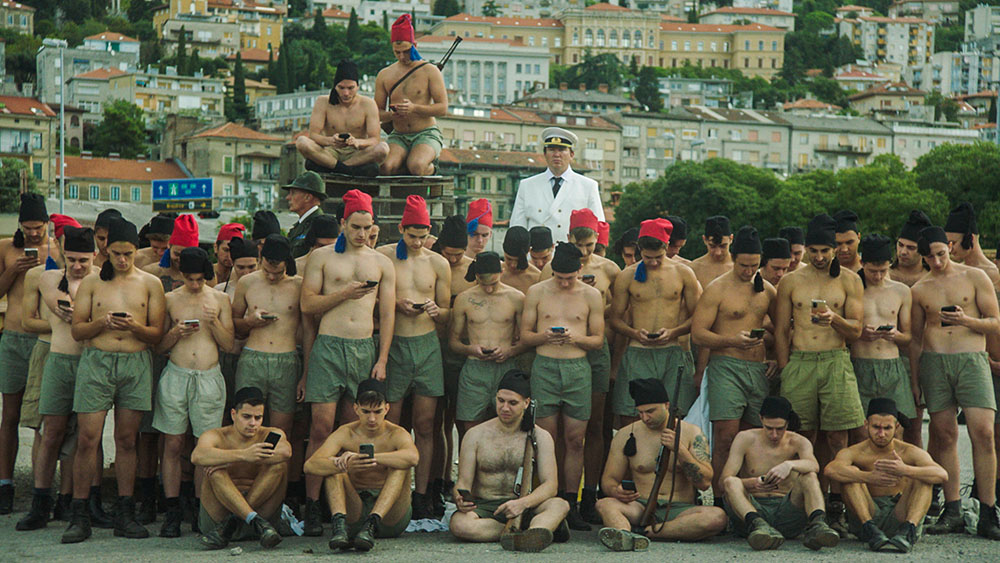
Through archival material and reenactments by present-day city residents of Rijeka, Croatia, director Igor Bezinovic wields fresh ingenuity depicting the 1919 occupation of Fiume by the Italian poet Gabriele D’Annunzio in "Fiume o morte!" (Icarus Films)

Join the Conversation
Send your thoughts to Letters to the Editor. Learn more
There are episodes in history so outlandish they seem to have been pushed out of public memory by their own absurdity. Director Igor Bezinovic's film "Fiume o morte!" revisits one with startling clarity.
In 1919, the famous Italian poet Gabriele D'Annunzio occupied the city of Fiume, now Rijeka, Croatia, and turned it into a spectacle of uniforms, symbols and self-worship that helped paved the way for Italian fascism: D'Annunzio became a direct inspiration for a young Mussolini.
Bezinovic tells the story through archival material and reenactments staged by present-day residents of Rijeka, which gives the film a unique electricity. To recruit his cast in Rijeka, Bezinovic asks random passersby what they knew about D'Annunzio. Some answer right away with details memorized from history lessons, and others recount generational trauma and tales heard from long-gone relatives. Others shyly admit they've never heard the name.
The film doesn't mock ignorance; instead, it emphasizes how quickly crucial historical events can fray from public memory. With this choice, Bezinovic makes it clear that one lingering injury of fascism is the damage it does to a people's relationship with its own past.
Advertisement
"My Italian colleagues warned me not to mention fascism too much in the intro, for the sake of Italian viewers, so I will stop here," explains Bezinovic, tongue-in-cheek, as the film begins.
He understands how easily fascism gets softened by distance and eventually dismissed as an artifact from a different era. "Fiume o morte!" uses contrast and dark humor to provoke discomfort, jolting us into the realization that past and present are in closer proximity than we'd like to think.
The contrast between timelines — not to mention an ingenious allocation of a limited budget — is used to show the ridiculousness of fascism. D'Annunzio's triumphant arrival into Fiume, which he named the Santa Entrata ("Holy Entry"), is redone here with the invading leader sitting in a vibrant red convertible followed by the small number of trucks. A speech once delivered to a huge crowd is restaged before passing traffic, with only the reenactor's family really stopping to watch. The grandeur of D'Annunzio's tactics is brought down to scale.
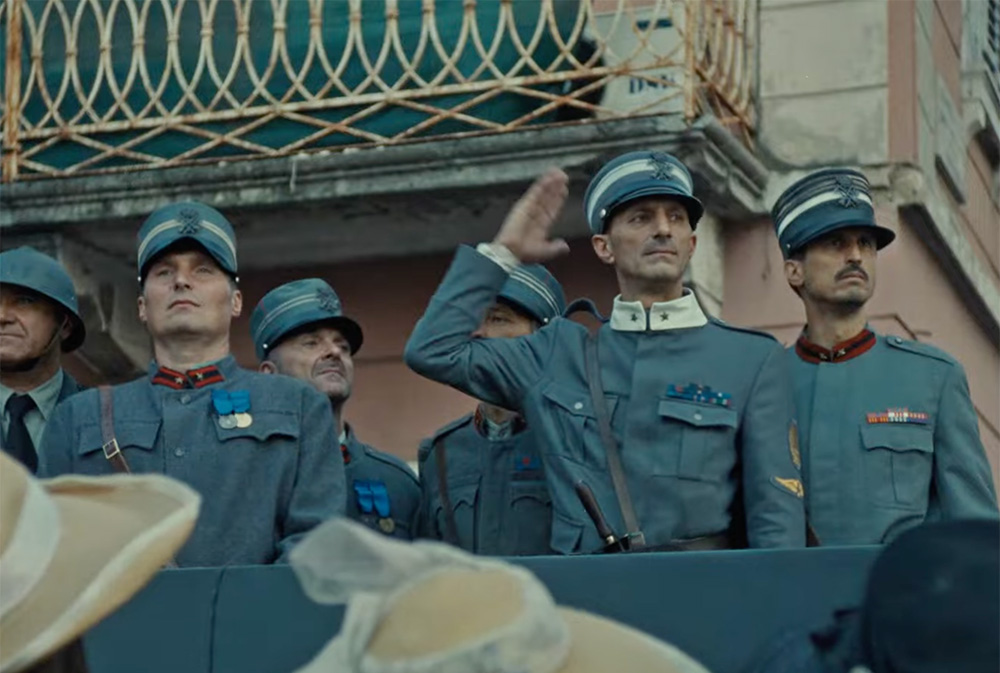
"Fiume o morte!" does not single out contemporary fascist parallels; rather, it trusts the viewer to recognize the machinery at work in the world today. (NCR screenshot/YouTube/Icarus Films)
The director is clever to avoid turning D'Annunzio into a museum villain. He keeps him ridiculous at every turn, and in doing so makes him easier to understand.
D'Annunzio once wrote, "One must fashion one's life, as one fashions a work of art," and the film takes that line seriously enough to expose the danger contained within it. Fiume became the stage on which D'Annunzio put on his performance, a barrage of posing in special events and exaltation of trivial objects. (He once received a stuffed platypus as a present from an admirer and proceeded to rename his favorite tavern in town after it.)
D'Annunzio's vanity became so swollen that it leaked into civic life, his private fantasies becoming a violent reality for the city's inhabitants.
One of D'Annunzio's trusted men, the pilot Guido Keller, once flew over Rome to drop flowers over the Vatican and Quirinal, and then an enamel toilet stuffed with carrots and turnips over Parliament. The gesture has the lunatic extravagance of a prank staged for a modern reality show, which is one of the many tools the film uses to point out that spectacle is one of the key elements through which fascism establishes itself as a new normal. Spectacle turns politics into atmosphere, creating the illusion of public support.
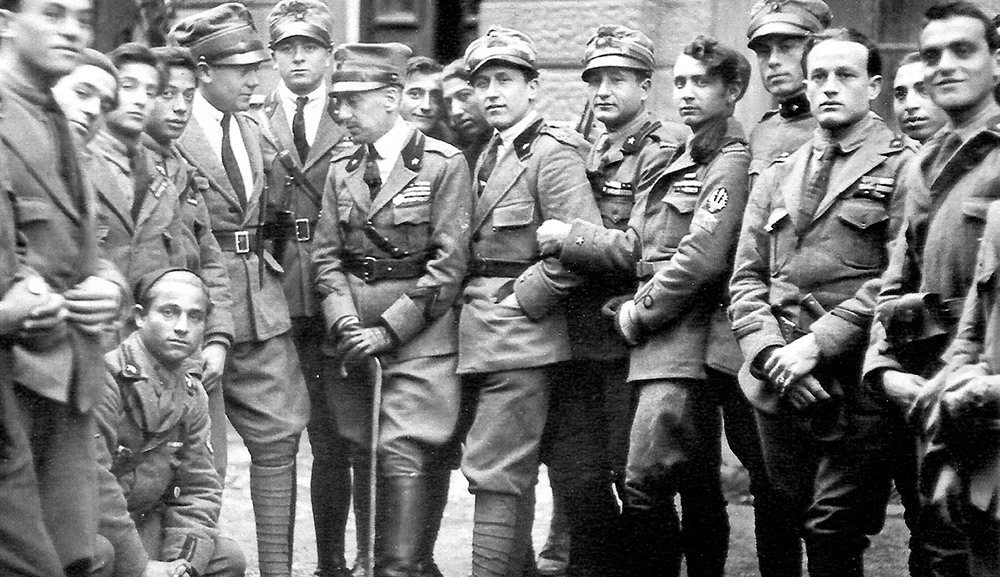
Gabriele D'Annunzio, holding a cane, is seen in a photo taken in 1919 in the city of Fiume — today Rijeka, Croatia. (Wikimedia Commons)
However, the movie's deepest chill comes from what has been omitted from the fascist narrative. When D'Annunzio held a plebiscite to create a democratic mirage, he discovered that the non-Italian majority in Fiume wanted him and his followers to leave. Intolerant of refusal and needing mass approval, he sent his soldiers to destroy the ballots. There are no photographs of that day. While fascism must preserve its glamour obsessively, it sees no need to record its violations.
This twisted logic also applied to the city's symbols. Rijeka's two headed eagle, a civic emblem installed on the City Tower in 1906, was decapitated during the occupation when two of D'Annunzio's men climbed up and cut off one head, transforming it from a Habsburg eagle into a Roman eagle, proclaiming the power of the makeshift emperor. The act itself mistook ridiculousness for bravado; if the men had died during their daredevil feat, they would have been deemed martyrs of the cause.
Mussolini supposedly likened Gabriele D'Annunzio to a bad tooth: 'You either pull it out or cover it in gold.'
For all its historical bite, "Fiume o morte!" remains wonderfully close to ordinary life. The residents of Rijeka who take part in the reenactments are never rendered as props, but instead bring local memory, irritation, curiosity and affection to the proceedings. An elderly woman on the street scolds a young reenactor in uniform without realizing she has wandered into the film. We see her surprise and heartbreak as she advises that a young man should be out at a club with his girlfriend, not serving fascist causes.
As D'Annunzio's short-term reign comes to its end, the story darkens further. After rejecting the Treaty of Rapallo and declaring war on Italy, D'Annunzio's rule in Fiume collapsed in 1920 during the bombardment known as Bloody Christmas. He left the city that had never wanted him, but he was never tried for treason or held accountable for his actions. In fact, years later, he was given the title of Prince of Montenevoso.
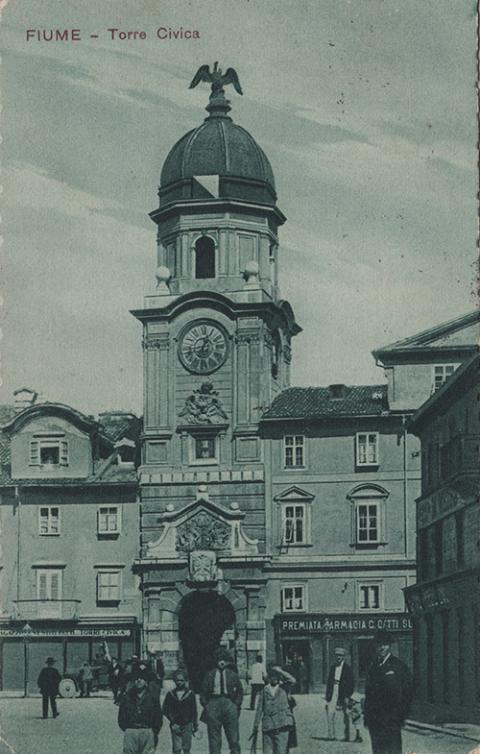
The half-decapitated Habsburg eagle is seen atop the City Tower in an undated postcard of Fiume. (Wikimedia Commons)
Mussolini supposedly likened him to a bad tooth: "You either pull it out or cover it in gold." As if D'Annunzio had been a mere inconvenience to Italy, the rogue poet was covered in gold.
While the stage has changed, the appetite for spectacle and the facile dismissal of fascism has not. In Trump's America, Fiume no longer feels remote. After the Capitol attack of Jan. 6, 2021, Trump returned to office in 2025 and pardoned nearly all those charged in the riot, more than 1,500 people, while his Justice Department has now moved to undo some of the last remaining seditious conspiracy convictions tied to that day.
Meanwhile, public life remains saturated with the leader's image, his voice, his threats, his rituals of display. Trump is in the news every single day. The 250th Birthday of the U.S. Army Grand Military Parade and Celebration held in 2025 was reshaped to coincide with Trump's 79th birthday, turning military pageantry into personal celebration. On April 7, 2026, in the middle of the Iran crisis, he posted that "a whole civilization will die tonight" unless a deal was reached, turning the prospect of mass death into cliffhanger theater.
While D'Annunzio's world was built from balcony speeches, uniforms, songs, trophies and photographs, ours has feeds, rallies, parades, social media posts, and a leader who understands that relentless spectacle can create the illusion of strength if enough people keep watching.
The recent elections in Hungary are another reminder that the story "Fiume o morte!" tells is not sealed in the past or contained by geographical borders. Viktor Orban's defeat may have ended an era, but it did not erase the habits of mythmaking, historical distortion and symbolic revision that defined it.
Bezinovic's film is exquisitely alert to that kind of damage by showing how authoritarianism reaches for public symbols, civic memory and the stories a place tells about itself. And yet the film has no need to single out any contemporary parallels; it trusts we'll see the beheaded eagle, the vanished ballots and the other excessive displays and recognize the same machinery is still at work, ready to bend power to satiate one man's appetite.