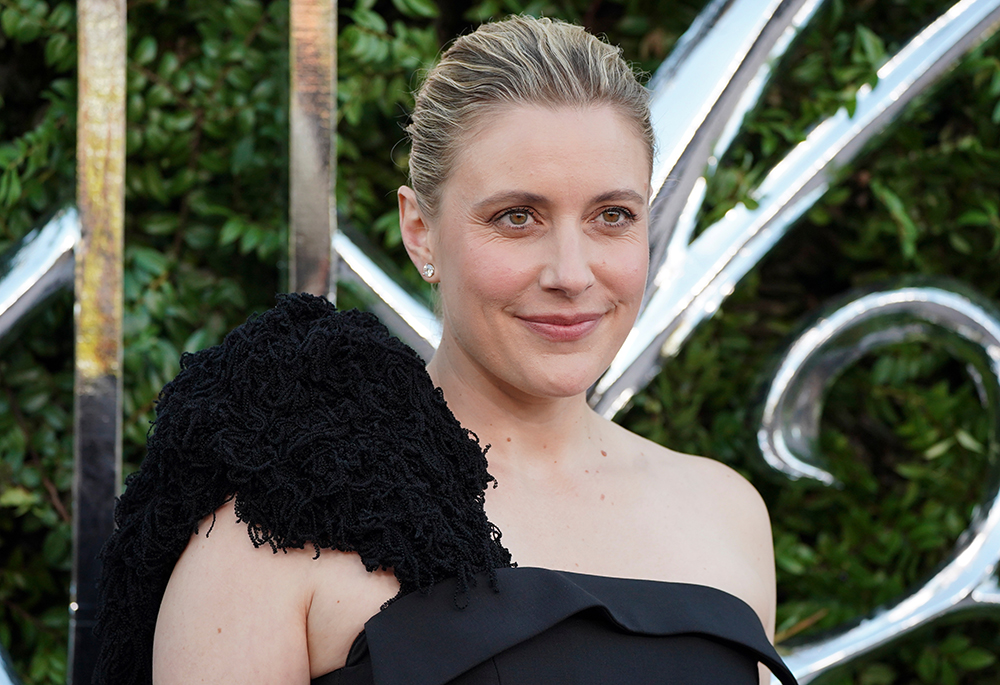
Greta Gerwig, writer/director of "Narnia: The Magician’s Nephew," arrives at the opening night celebration for the Lucas Museum of Narrative Art on Sept. 19, 2026, in Los Angeles. (AP/Invision/Jordan Strauss)

Join the Conversation
Send your thoughts to Letters to the Editor. Learn more
Director Greta Gerwig has received some backlash for choosing a female actor (Meryl Streep) to voice the role of Aslan in her upcoming adaptation of C.S. Lewis' The Magician's Nephew, but when she gathered with some 300 journalists yesterday to unveil the trailer, that controversy seemed far from her mind.
"These books created me," she told Stephen Colbert, who served as her conversation partner for the private event at New York City's AMC IMAX theater on Broadway. "I read them all over and over. These were some of the most formative books of my childhood."
The sincerity on the filmmaker's face and in her voice could be seen and heard even up in row J where I sat, reminiscing about the mystical impact that Narnia had on my own early years. Like Gerwig's parents, my parents read The Lion, the Witch and the Wardrobe aloud to me before I could read. Also like Gerwig, I was 5 years old when the BBC released the eponymous television series that turned a generation of children into wannabe Lucy Pevensies.
But rather unlike the rest of us 1980s Narnia kids, Gerwig can credit that BBC series for sparking a lifelong passion for bringing stories to life onscreen. Still, she never expected to get to work on this particular story, the one that started it all.
Gerwig laughed with self-deprecation as she confessed that she got the job by cornering a Netflix executive at a party and proceeding to doggedly opine for 20 minutes about the order in which the films absolutely must be made. She knew that Netflix had bought the rights to the series; she never expected her spontaneous monologue to land her a writer/director offer, especially not there on the spot. After all, while she had a successful period piece under her belt with "Little Women," there was no proof that she could handle a project of this scale. "Barbie" had not yet been released.
After the Great Pink Summer of 2023 it's hard to imagine Gerwig having anything left to prove. But lately controversy has mounted over the bold choice to cast Streep as the beloved Christ-figure lion, making the voice that sings the world into creation a female one. Traditionalists worry that Gerwig is trying to bring "Barbie" feminism into Narnia without understanding the Christian basis of its mythology.
Advertisement
But naysayers who question a secular director's ability to do justice to Lewisian literature will have a tough time diminishing Gerwig's bona fides. She said that not only has she read every published fiction and nonfiction work of C.S. Lewis (Surprised by Joy is her favorite of his nonfiction books), some multiple times, she has also read most everything Lewis himself read, wanting to herself be formed by the ideas that formed the author she loves. In preparation for and during the writing process, Gerwig visited the places Lewis spent most of his life — Belfast, Cambridge and Oxford — and got to know his family, welcoming them to set and earning their trust and support.
Faith and film have always gone hand-in-hand for Gerwig, she told Colbert somewhat shyly at Tuesday's event (Oct. 12). That admission comes as no surprise to those familiar with her solo directorial debut, "Lady Bird," which was nominated for five Academy Awards, including Best Director. The movie was inspired by Gerwig's own coming-of-age as a Catholic high school student. Growing up, she noticed there were two places where she could expect to share an experience with a large group of people in community: church and the movie theater.
"Going to a theater is an act of faith," she posited to an IMAX theater full of journalists. "Closing yourself in a dark room with a crowd of strangers, not quite knowing what to expect but putting yourself in a place of vulnerability with the potential to be transformed. I just don't know what else you could call it."