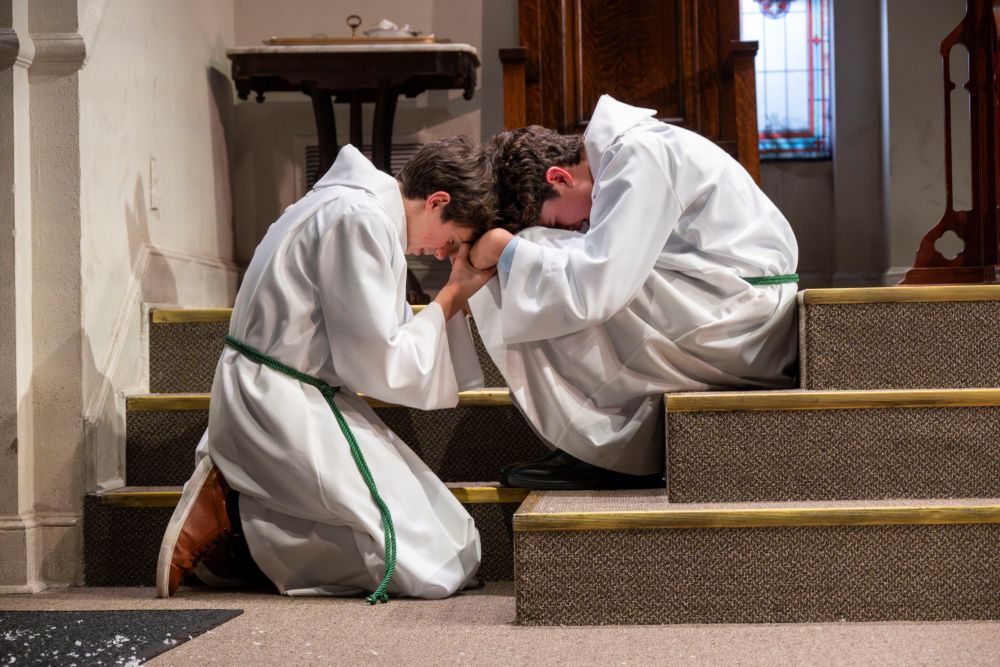
Julius Rinzel and Ivan Howe play teenage altar servers in "The Saviors," written by Bubba Weiler and directed by Jack Serio. The off-Broadway show is produced by the Atlantic Theater Company in New York City. (Ahron R. Foster)

by Jim McDermott
Join the Conversation
Send your thoughts to Letters to the Editor. Learn more
When New York audiences walk into the Atlantic Theater to take their seats for the new off-Broadway play "The Saviors," they will notice two things: The set looks like a sanctuary of some suburban Catholic church, and the audio being broadcast into the theater is a recording of a community at Mass. The liturgy plays in its entirety before the production begins, and there's something quietly relentless about its inescapability. It's there, continuing in our heads, whether we like it or not.
That subtle gesture goes right to the heart of "The Saviors," a four-person play about two eighth- grade altar servers whose encounter with a homeless man in the church leaves them asking questions about Catholicism, God and, ultimately, themselves.
Playwright Bubba Weiler was raised Catholic in the suburbs of Chicago. When he was growing up, his faith was central.
"It was how I understood my life," he shared with National Catholic Reporter in a phone interview, "how I understood morality and made sense of bad things happening to good people, you know, the sort of unexplainable things that you come across as a child as you're coming of age."
When Weiler was hit in the face with a tennis ball, blinding him in one eye and permanently derailing his dreams of being a professional tennis player, his faith provided solace. "It helps, right? I was led to believe that God had a plan for me, and that felt really good in that moment."
"Then I realized that I was gay. And suddenly this thing I had built this understanding around didn't make sense anymore."
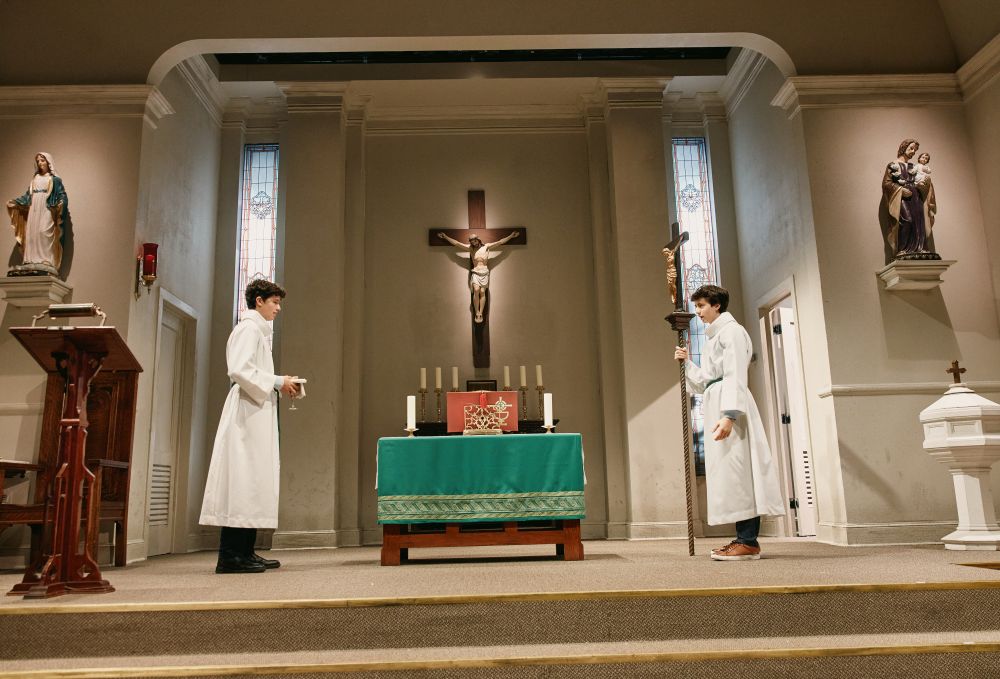
In New York City's off-Broadway play "The Saviors," two eighth-grade altar servers have an encounter that leaves them asking questions about Catholicism, God and themselves. (Emilio Madrid)
In the play, close friends Michael and Paul find themselves on opposite sides about whether to help Julian, a young man without a place to stay. Though Michael is more serious about his faith, he wants to drive Julian away. For Weiler, the conflict was a chance to explore one of the most familiar narratives of Catholicism.
"So often, growing up in Catholic school, you are confronted with this hypothetical of a stranger that needs help," Weiler said. "And you're taught exactly what you're supposed to do." But he wonders how adult Catholics actually think about such a story: "If that did happen, would the adults in the room actually do what they're asking me to do?"
Meanwhile Paul finds in Julian's hardships a chance to share his own questions about God, and about Michael, who he believes might be gay and unable to face that. As the play goes on, we come to see the burden of Catholicism's ideals upon both children.
"Faith is given to children with good intention, right?" says Weiler. "But it can also create so much anxiety to be sort of this perfect version of yourself and have a perfect relationship with God."
It's not just the children who struggle with this. The play's fourth character is Judy, a mother who runs the church youth group. As it turns out, she, too, is hiding aspects of her family life because she feels she is a failure.
"I think sometimes the ideals of the church are just too hard to live up to," Weiler said. "Mary is presented as a gift to Catholic women, but this completely selfless motherly love that Mary exhibits is also an impossibly high standard. And I think the pressure to live up to it can be damaging."
Advertisement
Though "The Saviors" is set in a church sanctuary and frequently involves scenes with the boys either before or after Mass, no priest or explicitly religious figure appears. In part, that reflects Weiler's own experience: "I never really got any time with the priests, you know? They were not accessible figures to me."
But it also reflects the deeper experience of his characters. "Priests take on the role of the people who have answers — whether or not they do," Weiler said. "And this is a play about people who don't have any answers. It's a play full of people who are all questions."
At this point in our history, telling a story that takes down the Catholic Church, or any religion, attracts a ready audience. "Especially when you're doing a play in New York," Weiler notes, laughing. But in "The Saviors" he reaches for more than that.
Judy finds community in the church even alongside her shame, and Michael draws deep comfort from it even as he suffers terrible anxiety. That, too, reflects Weiler's own history: "This play is me trying to hold the pain and beauty of my experience in the church in the same hands."
The result is a play that invites its audience to see and appreciate the complexity of their own experiences of religion as well. In the end, salvation is not a function of burying the aspects of our lives that seem inadequate or wrong, but drawing it all out into the light.