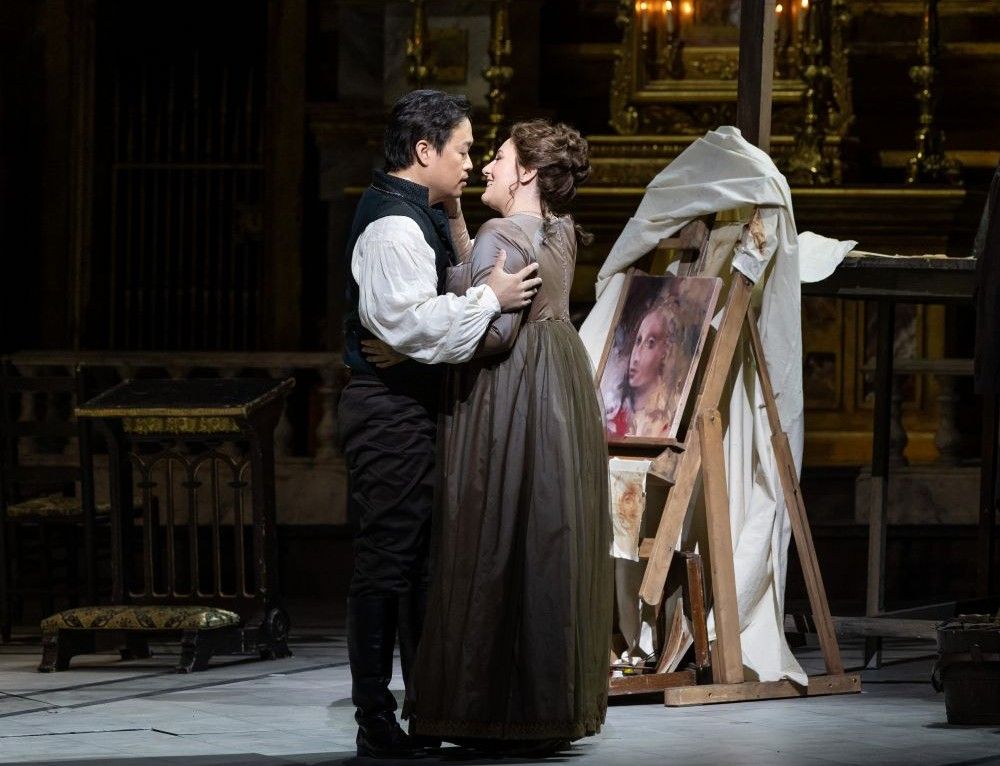
Saioa Hernández plays the title role in the Puccini opera "Tosca" at the Metropolitan Opera in New York City. SeokJong Baek plays her lover, Mario Cavaradossi. (Met Opera/Marty Sohl)

Join the Conversation
Send your thoughts to Letters to the Editor. Learn more
Saioa Hernández remembers being "extraordinarily happy" during the 18 months she spent in a Catholic convent outside Madrid. So happy, in fact, that she began putting on weight, something the Spanish opera star, who had always been self-conscious about being too thin, remembers with amusement.
Her first nights had been difficult, spent crying alone in her cell, but, then in her early 20s, she soon grew attached to the rhythms of religious life — so attached, in fact, that she eventually realized she had to leave.
"I felt that by staying there I was actually more comfortable than I would be outside."
Living her faith in the world, she began to think, might demand more of her than remaining behind convent walls.
More than two decades later, Hernández's life and voice could hardly be more public. On Nov. 1, the Spanish soprano made her Metropolitan Opera debut in Giacomo Puccini's "Tosca," adding another major opera house to a career that has taken her to Milan's La Scala, the Paris Opera and other leading world stages.
Her performance in David McVicar's production, conducted by Oksana Lyniv, drew praise, with critic Rick Perdian complimenting the force of her portrayal and the delicacy of her singing. She returned on Nov. 6 and will appear in four more performances — Nov. 9, 14, 17 and 20 — with SeokJong Baek as Cavaradossi and Quinn Kelsey as Scarpia.
Yet Hernández's understanding of artistic success remains inseparable from the spiritual questions that once led her to contemplate becoming a nun.
She is wary of calling her religious journey a conversion from atheism. "I was never someone who didn't believe in something greater than ourselves," she said in an interview with the National Catholic Reporter. Raised in a nominally Catholic but non-practicing family in Madrid, she abandoned catechism as a child after a friend stopped attending.
The deeper questions emerged in adolescence, through philosophy and other spiritual traditions. At university she studied law with the intention of qualifying for the Spanish Air Force, while joining a choir and taking her first singing lessons. A friend introduced her to a Catholic Scout group involving priests and nuns.
She was drawn less by a dramatic revelation than by "this sense of community, of having something that transcends everyone while also bringing everyone together." At 19 she made her first Communion in a mountain hermitage near Santiago de Compostela.
Hernández had set herself a deadline: Before age 25, she wanted to understand what she was meant to be. "I didn't want to spend my whole life doing a job in which I couldn't give the best of myself," she recalled. After vocational retreats with several religious communities, she entered the Missionaries of Christ the Priest in Las Rozas, outside Madrid. Their spirituality emphasized service: "letting God give something to others through you, being a bridge for them."
Her parents respected the decision, although it pained them, she said. Her brothers declined to attend the entrance ceremony.
Renouncing possessions was relatively easy. A keen runner and accomplished handball player, Hernández discarded her medals and trophies before entering. "I threw them all away," she said laughing out loud and throwing her hands in the air, now amused by her severity. "Maybe I didn't actually need to."
But her departure from the convent proved more complicated. The protected environment had given her a sense of security, she said, while outside she would have to sustain her convictions amid the pressures and uncertainties of ordinary life. She gradually came to believe that her vocation might be to serve God precisely through those encounters, rather than by withdrawing from them.
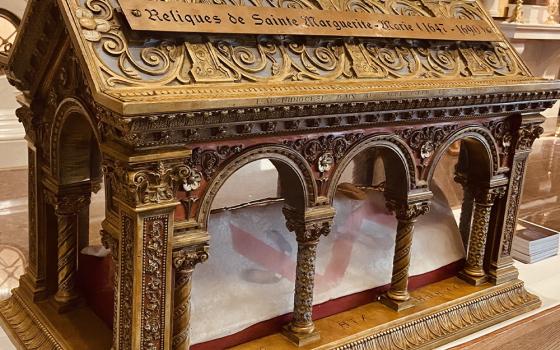
One discovery from those months still structures her thinking. She read St. Augustine and St. Ignatius of Loyola, but it was St. Thérèse of Lisieux who unsettled her assumptions about religious life.
Hernández had imagined serving God through great deeds. St. Thérèse's spirituality instead located holiness in humility and ordinary acts. "I remember how she spoke about making yourself small, becoming almost like a child in order to feel that closeness to God," she said. Hernández often prayed by writing, and she still keeps a notebook from the convent in which she repeatedly asked God, "Make me small, make me small, because I want to be closer to You."
Over time, she concluded that spiritual life "isn't about grand gestures. It's about day-to-day life, about small things."
Leaving the convent did not immediately establish singing as her vocation. The sisters had often asked her to sing, but she wanted to share their other, more demanding work. Music became her profession later.
An essential mentor was the Spanish opera diva Montserrat Caballé, who helped Hernández prepare early roles including in Vincenzo Bellini's "Norma" and "Il Pirata." Hernández and her husband, Italian tenor Francesco Pio Galasso, had been struggling after a difficult experience with another teacher. Caballé helped them rethink their technique, and Caballé's brother Carlos assisted with a debut.
None of them charged for lessons, commissions or even the pianist. "They never asked for a thing," Hernández insisted. "They believed in me so much."
Although the two sopranos never discussed faith, Hernández remembers Caballé's humility as vividly as her musical counsel, such as the spontaneous smile, the laughter during rehearsals, the attention she paid to strangers. Hernández attended Caballé's 2018 funeral and remains close to her family. That generosity informs the work Hernández and Galasso do with younger singers, including through volunteering with the Teatro Real's Crescendo program, which supports emerging artists in Madrid.
"We have a responsibility to leave something for those who come after us," Hernández said. Talent, in her view, is not exclusively "private property," but "a gift God has given us, something we have to work with, but ultimately it isn't ours alone."
There is an intriguing historical parallel between "Tosca" and Hernández's life. Puccini's 1900 opera was inspired by Victorien Sardou's 1887 play "La Tosca." Sardou's heroine Floria Tosca spends part of her childhood among Benedictine nuns before her voice takes her into the world, and she becomes a celebrated opera star.
Hernández acknowledged the parallel, but said the stronger connection is temperamental. She sees Tosca as a fiercely spontaneous woman, capable of jealousy, tenderness and rage in rapid succession — "a fire sign, surely," she joked, "an Aries like me." But Tosca is also profoundly sincere. "She's an artist who is authentic both onstage and in her personal life," Hernández said. "She is so genuine that she can be nothing but truthful onstage."
Advertisement
Hernández's Catholicism shapes how she understands the opera's central crisis. Floria Tosca is a celebrated singer whose lover, the painter Mario Cavaradossi, faces execution at the hands of a corrupt police chief, Baron Scarpia. When Scarpia demands sexual submission in exchange for saving Cavaradossi, Tosca turns to God in the famous aria "Vissi d'arte," asking why a life devoted to art, love and piety has brought her such suffering.
For Hernández, the aria is not quite a protest against divine injustice. "She's saying, 'I've given everything. I don't know what else to do.' " Tosca lies, acts impulsively and ultimately kills Scarpia, then kills herself when she realizes her loved one was also killed.
Hernández hears a woman accustomed to addressing God directly, even when she can no longer understand what is being asked of her. "She knows that if it is God's will for her to experience this situation, she must place herself in his hands," she said.
Tosca's faith is present in the playful jealousy of Act I as much as in the ordeal of Act II. "She lives her faith very naturally. She can experience it almost like a child," Hernández said, returning, perhaps unconsciously, to her description of St. Thérèse. Similar questions of sacrifice and destiny inform her readings of other operas like Puccini's "Suor Angelica," "Madame Butterfly" and Giuseppe Verdi's "La forza del destino.
In New York, Hernández has found herself thinking about how openly artists can speak of belief. The city's multiculturalism gives her a sense of welcome, she said. "You have the feeling that you can live your faith peacefully here, that you can say, 'I'm Catholic.' "
Her next chapter may involve as much teaching as singing. Hernández would like to take on a role in Verdi's "Don Carlo," with its stark portrait of religion and power in Spain. She also hopes to write a book, neither memoir nor singing manual, but about vocation and how people confront day-to-day difficulty when pursuing a career and life in the arts.
She and her husband Galasso also want to continue mentoring young performers through the less glamorous realities of the profession.
"We don't want only to talk about technique," she said. "We want to provide a little guidance about an artist's life as well, because this life can be difficult."
This article is supported by The Bertlesen Fund for Excellence in Catholic Journalism.