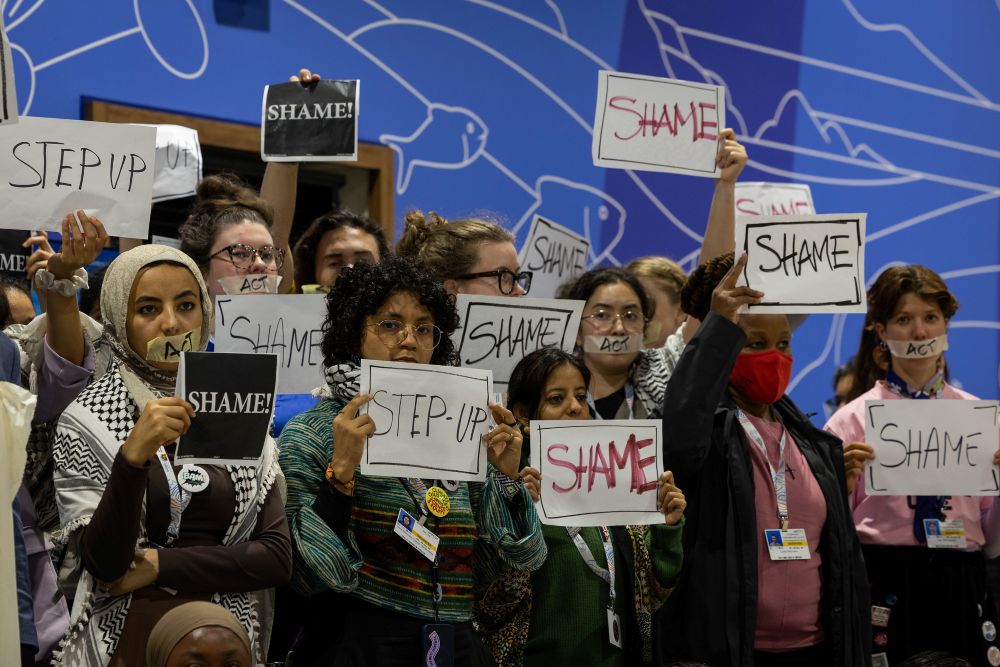
COP31 attendees hold a demonstration Nov. 20 before the start of the final plenary at the United Nations climate change summit in Antalya, Turkey. The conference did not end for another two days over disagreements between countries in a final text on phasing out fossil fuels. (UN Climate Change/Kiara Worth)

Join the Conversation
Send your thoughts to Letters to the Editor. Learn more
Talks at the United Nations climate change summit in Turkey collapsed over the weekend, as a bloc of countries refused to sign onto a proposed agreement that omitted any mention of phasing out fossil fuels.
Catholic and other religious leaders called the failures at COP31 deeply disappointing while widely applauding the stand against a final text, called the Antalya Pact, seen as insufficient in commitments to wind down burning of coal, oil and gas for energy — the primary source of greenhouse gas emissions that are heating the planet to increasingly dangerous levels.
"We cannot claim to be serious about protecting our common home while refusing even to name the problem," said Lorna Gold, executive director of the Laudato Si' Movement, an international network of 900-plus Catholic institutions committed to creation care. "This is a failure of moral courage, and its consequences will be borne most heavily by those who have contributed least to the [climate] crisis."
As COP31 concluded, Laudato Si' Movement joined 50 other religious institutions in calling for a mass mobilization of the global faith community next year to demand a treaty on fossil fuels and a just transition from fossil fuels to renewable energy.
"Phasing out fossil fuels and supporting a fast and fair transition to renewable energy represents the moral imperative of our time," the religious coalition said in a statement.
Negotiations at COP31 in Antalya ended Nov. 22 — two days after its scheduled end and after two weeks of diplomatic negotiations. The event drew more than 90,000 people, including hundreds of lobbyists with the fossil fuel industry, to the Turkish port city. The conference, the latest focused on implementing the 2015 Paris Agreement, was the longest in the three-decade history of the U.N. climate gatherings.

The COP31 United Nations climate change summit ended Nov. 22, two days after its scheduled conclusion. The conference, while the longest in its three-decade history, failed to reach agreement on a main decision over its omission of fossil fuels. (UN Climate Change/Kiara Worth)
Despite the extra time, COP31 did not reach a deal on the Antalya Pact, one of its main documents, a stark sign of the continued division among nations on how to implement the Paris accord's chief aim of reducing emissions in order to limit global warming to 1.5 degrees Celsius (2.7 degrees Fahrenheit). Ahead of the summit, scientists concluded it is "inevitable" the planet will heat to 1.5 C by 2030 and that attention must shift to limiting the overshoot and strategies to bring temperatures back down.
At the center of the stalemate in Antalya was fossil fuels.
Only once, in 2023 at COP28 in Dubai, have countries mentioned fossil fuels in their final decisions, despite scientists for decades stating clearly that countries must stop burning coal, oil and gas to reduce emissions to net-zero.
The proposed draft at COP31 put forward by Turkey, serving as COP presidency, did not include the words "fossil fuels" but only a reference to upholding the agreements made in Dubai. That omission led the European Union to formally object to the draft and was later joined by Panama, the United Kingdom and a handful of small island nation-states. Under the U.N. climate treaty, decisions require consensus, so a single country can block a deal.
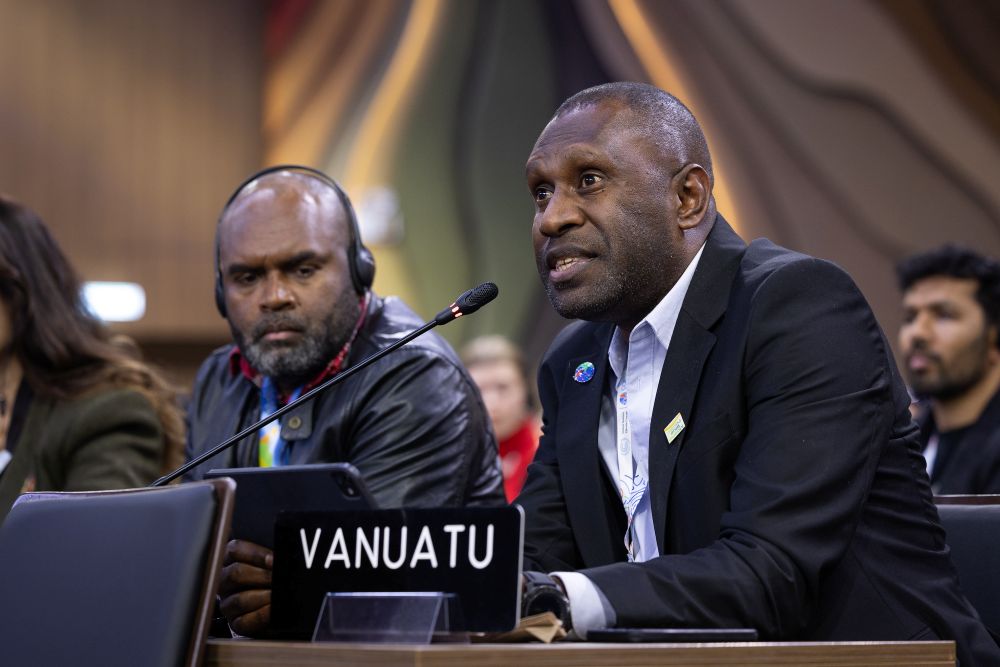
Vanuatu, a Pacific island nation, was among the countries to object to the Antalya Pact at the COP31 United Nations climate change summit over its lack of direct reference to fossil fuels, the main driver of climate change. (UN Climate Change/Kiara Worth)
There was also a lack of agreement on how wealthy countries would fulfill a past pledge to triple funding to developing countries to adapt to impacts brought by climate change. The EU and other developed countries balked at committing any additional funds.
Speaking during the closing plenary, Archbishop Ettore Balestrero, a member of the Holy See delegation and the Vatican's permanent observer to the U.N. in Geneva, said the path to consensus can be difficult but the collective resolve to act must not weaken.
"While the impacts of climate change are intensifying, affecting millions of people, devastating communities, and threatening the prospects of future generations, our international response still falls short of what science, justice, and our common humanity call upon us to do," Balestrero said. "We must be honest with ourselves. We cannot afford to allow the distance between what we know must be done and what we are collectively willing to do to grow any further."
Catholic officials who followed the negotiations said that no agreement, while a failure, was still a better option than adopting a weak one that took significant steps backward.
CIDSE, a network of mainly Europe-based Catholic development organizations, called the stand to hold the line on eliminating fossil fuels "a refusal to sign away the communities who would pay the price" from more extreme storms, droughts, wildfires and other climate impacts.
Gina Castillo, senior climate policy adviser with Catholic Relief Services, said it was "very, very disappointing and quite shameful how political leaders around the world are failing their citizens." A 2024 global survey, conducted among 73,000 people in 77 countries by the U.N. and the University of Oxford, found 72% of people supporting a quick transition from fossil fuels to renewable energy.
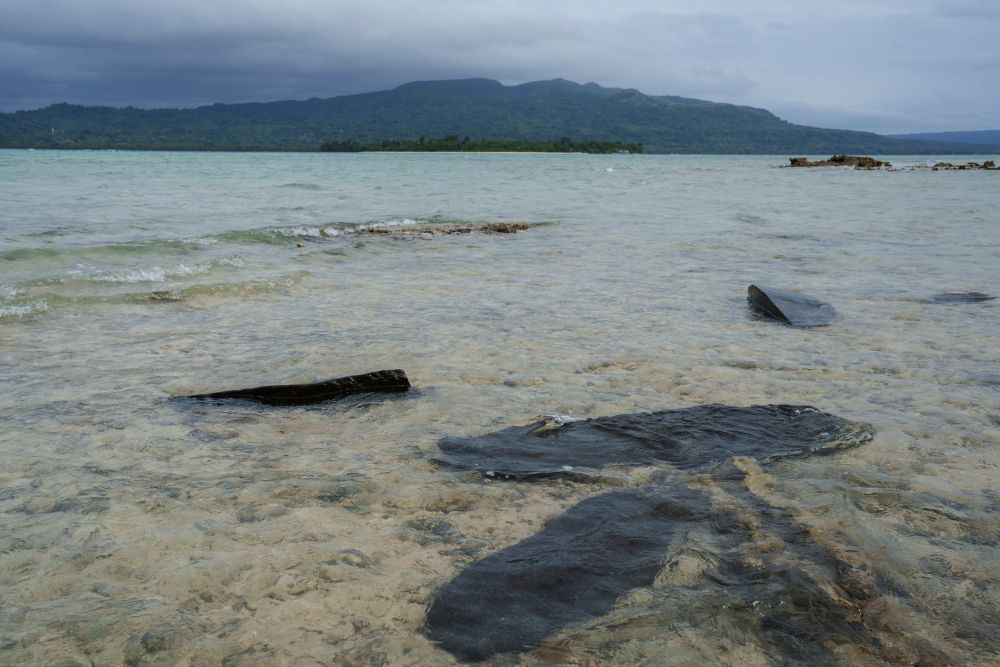
Gravestones sit submerged in water on Pele Island, Vanuatu, a country heavily affected by rising seas July 18, 2025. (AP Photo/Annika Hammerschlag, File)
Rodne Galicha, executive director of Living Laudato Si' Philippines and a coordinator at COP31 for the Network of Catholic Climate and Environment Actors, said a final decision without mentioning fossil fuels or reinforcing the tripling of climate adaptation funds "would send a deeply troubling political signal," particularly for vulnerable communities, at a time when climate impacts are rising and the 1.5 C limit is nearing.
"Compromise has its place in diplomacy, but it must never compromise human dignity, the common good, or our responsibility to care for creation," he said.
At one point during the closing plenary Nov. 22, the Peru delegation proposed a review of the consensus process, warning that the current process is yielding deadlocks at a time when science says action is most urgent.
This is not the first time countries failed to leave a climate COP with an agreement, with the most notable occurrence coming in 2009 in Copenhagen.
Jesuit Fr. Pedro Walpole, coordinator of the River Above Asia Oceania Ecclesial Network, said he did not view the lack of a deal in Antalya as a sign that multilateralism is failing amid difficult geopolitical conditions. Rather, he said, "it is being tested. And those who hold the power are facing a call of deeper integrity."
Carmelite Fr. Eduardo Agosto Scarel, a climate scientist and director for integral ecology for the Spanish Episcopal Conference, said in a reflection that COP31's failures again highlighted the lack of political and moral will to respond to climate change with the pace and scale science says is needed.
"When international negotiations become mired in national interests, short-term economic calculations, or geopolitical rivalries, a deeper wound emerges: the inability to recognize ourselves as a single human family," he said.
In rejecting the Antalya Pact, countries not only rejected normalizing toxic emissions, Castillo said, but also exposed countries who are serious about addressing climate change and those blocking action. Among the countries defending the fossil fuels omission were Russia, Saudi Arabia and other Arab petro-states. The United States, the historical leader in emissions, exited the Paris Agreement under the Trump administration, which has redoubled fossil fuel expansion. It did not have an official delegation in Turkey.
Galicha added the rejection of the Antalya Pact "must now become an opportunity to recover ambition, rather than an excuse for further delay."
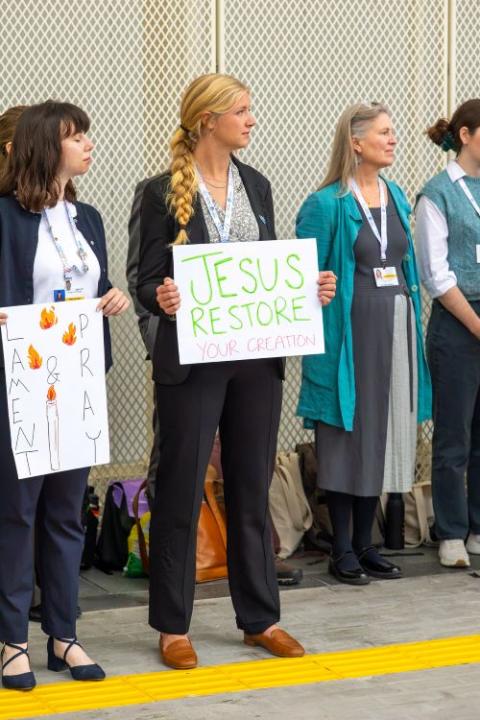
A woman takes part in a faith demonstration Nov. 20 at the COP31 United Nations climate change summit in Antalya, Turkey. (UN Climate Change/Kubilay Ciftci)
Elsewhere at COP31, countries negotiated on more than 100 other items related to climate responses under the Paris Agreement, with some progress made on carbon markets and climate adaptation. Approximately 80 countries signed onto a plan by Turkey and Australia to produce at least 35% of energy consumption from electricity by 2035.
Outside the official U.N. climate process, nearly 60 countries have committed to a process to explore pathways to transition from fossil fuels to renewable energy. Thirty have endorsed a fossil fuel treaty.
Two meetings on a fossil fuel transition are scheduled for next year: in Ireland in May and in the Pacific island of Tuvalu in July. So far, five countries have put forward national roadmaps on phasing out fossil fuels, while Brazil has outlined global roadmaps on eliminating fossil fuels and deforestation. Faith groups have urged more countries to follow suit.
A coalition of 50-plus religious organizations has called for a global week of faith action April 4-11 in support of an international treaty to phase out fossil fuels and finance a just transition to renewable energy for all. The initiative, coordinated by the multifaith climate group GreenFaith, is supported by the World Council of Churches and Parliament of the World's Religions, as well as major organizations for the Muslim, Buddhist and Hindu faiths. Catholic groups committed to the mobilization include CIDSE, Sisters of Charity Federation, Medical Mission Sisters and the Society of Jesus along with several Jesuit organizations.
Advertisement
In a statement, the Faiths Rising coalition cited the role of the faith community in past social and civil movements, including the abolition of slavery, opposing child labor, ending apartheid in South Africa and nuclear deterrence.
"It is time for us to rise again, to prove that our religions' beautiful words and our common commitment still have the power to move mountains," the faith groups said.
Catholic institutions are also looking ahead to the next U.N. climate summit, COP32, set for November 2027 in Addis Ababa, Ethiopia. Already, planning is under way, led primarily by the Symposium of Episcopal Conferences of Africa and Madagascar, to coordinate a strong, united Catholic voice.
"Africa must not simply host the world's climate negotiations; it must help shape their ambition and outcomes," including on issues of justice, debt, adaptation and finance, said Ashley Kitisya, Africa regional director for Laudato Si Movement.
"Our faith calls us to move beyond expressions of concern towards courageous action … COP32 must be a moment of accountability," she said, "where promises are translated into concrete commitments that protect people and our common home."