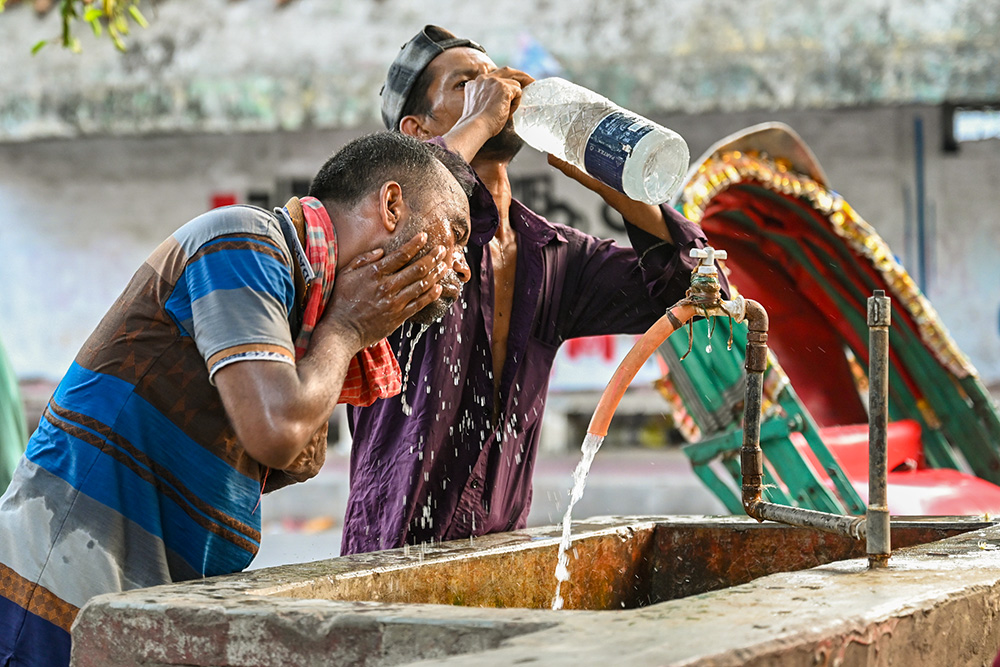
A rickshaw driver washes his face at a roadside water pipeline during a heat wave in Dhaka, Bangladesh, April 27, 2024. (Dreamstime/Mamunur Rashid)

Join the Conversation
Send your thoughts to Letters to the Editor. Learn more
In 2015, nearly 200 countries adopted a central goal to limit global warming to 1.5 degrees Celsius to avert catastrophic impacts from climate change. Now, according to a new United Nations report, the planet will surpass that threshold by the end of the decade.
The "sobering" conclusion must not become reason for resignation or giving up, Catholic officials said, but instead compel a redoubling of moral pressure on world leaders to rapidly phase out the main driver of climate change: heat-trapping greenhouse gases released from burning coal, oil and gas.
"The worst possible response would be to conclude that the battle is lost. The opposite is true: Every fraction of a degree, and every year spent above 1.5 degrees C, matters enormously for vulnerable communities and for the ecosystems on which we all depend," said Lorna Gold, executive director of the Laudato Si' Movement, an international network of 900-plus Catholic organizations committed to faith-based action on climate change and other environmental challenges.
The Limiting Overshoot report, issued Sept. 2 from the U.N. Environment Program, examined current global warming trends alongside pathways to meet the 1.5 C (2.7 degrees Fahrenheit) goal, which was confirmed last year as the "scientifically based consensus target" under international law. Average global temperatures have risen approximately 1.4 C since the industrial age of the mid-1800s, when fossil fuels began powering enormous industrial growth in the United States, England and other parts of Europe.
Advertisement
Under current emissions trends exceeding, or overshooting, the 1.5 C limit is "inevitable," the report said, and forecast it will likely occur by the end of the 2020s. Average global temperature first surpassed 1.5 C for a single year in 2024.
It is unknown if and when temperatures will peak, the report said, nor the magnitude or severity of impacts that will accompany a world above 1.5 C. Key in all those factors is how quickly and deeply emissions are reduced.
The report's authors said the focus now shifts from how to prevent warming from reaching that limit to how to ensure the overshoot is temporary and ultimately reversed while simultaneously navigating the future it presents.
Rapid emissions reductions, with the aim of net-zero carbon emissions by midcentury, remain vital, as does limiting peak warming. But now that must be paired with strategies to remove emissions from the atmosphere, the authors said, both through reforestation and enhancing other natural carbon sinks along with scaling up untested carbon removal and storage technologies. The report states a return to or below 1.5 C is not guaranteed.
It also makes clear that global warming of 1.5 C "is not considered safe for most nations, communities, ecosystems and sectors, and still poses significant risks to natural and human systems." Even temporarily exceeding that level of warming "will result in substantial and often irreversible impacts."
Extreme weather, glacial melt and ecosystem loss are all expected to intensify, each straining food and water access in different ways and posing threats to human health. Coastal cities and some island states face partial or total submersion as seas continue to rise. Persistent temperatures above 1.5 C raise the risk of triggering tipping points in places like the Greenland and Western Antarctic ice sheets and the Amazon rainforest.
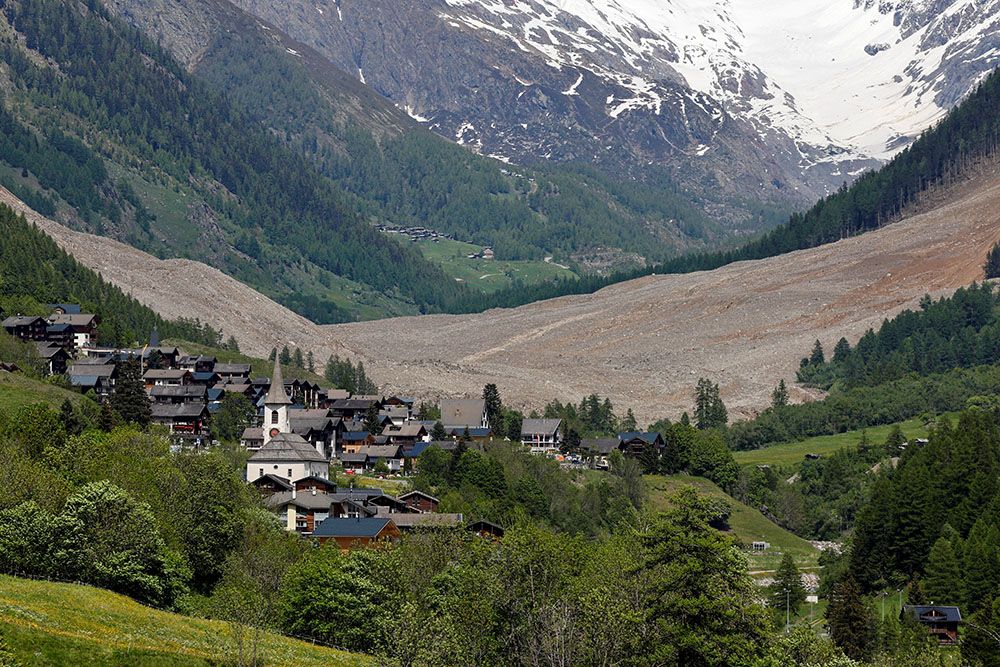
Debris lies from a crumbling glacier May 29, 2025, that partially collapsed and tumbled behind Wiler, near Blatten, Switzerland, May 29, 2025. (OSV News/Reuters/Stefan Wermuth)
The increasing threats to life posed by 1.5 C of warming "make giving up morally impossible," said Rodne Galicha, executive director of Living Laudato Si' Philippines and a member of the Network of Catholic Climate and Environment Actors, an international collaboration that engages U.N. bodies on climate policy.
"We cannot allow 'overshoot' to become another language for surrender. From the Global South, our message must be clear: Every fraction of a degree still matters, because behind every fraction are people, communities, cultures and species," Galicha said.
The report comes as global emissions continue to rise, reaching record levels in 2024, and global attention to climate change has waned. Under the Trump administration, the United States, the largest historical emitter, has withdrawn from the Paris Agreement (which set the 1.5 C target) and its underlying treaty. Wars in Ukraine and the Middle East have sent shockwaves through global oil and energy markets, while the artificial intelligence race has exponentially amplified energy demands. While nearly 60 countries have rallied around a full phaseout of fossil fuels, as a whole nations have fallen short in establishing and implementing climate plans consistent with the 1.5 C goal.
Under current policies, temperatures are projected to reach 2.6 C by 2100. In scenarios where countries enact all climate pledges, temperatures would peak at 1.8 C.
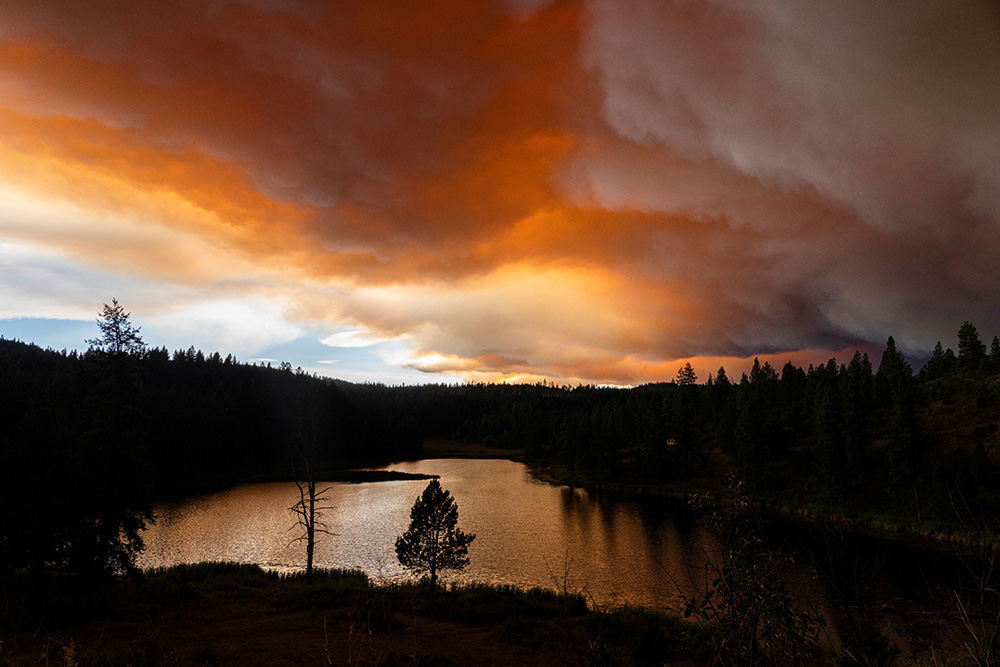
Wildfire smoke looms over the Princeton-Kamloops Hwy between Princeton and Merritt, British Columbia, Canada, Aug. 10, 2026. (OSV News/Reuters/Paige Taylor White)
"Accepting overshoot is an admission that the fates of the poor and creation are just not priorities for global leaders right now," particularly leaders of the top-emitting countries, said Dean Dettloff, research and advocacy officer for Development and Peace, the Canadian chapter of Caritas Internationalis.
Pope Francis in his 2023 apostolic exhortation Laudate Deum "on the climate crisis" echoed warnings that temperatures could reach 1.5 C in the next decade and the transition from fossil fuels to clean energy was not progressing fast enough. "The world in which we live is collapsing and may be nearing the breaking point," he wrote.
When speaking on climate change, Pope Leo XIV has persistently said this is a time for concrete action, not words.
The report came days after a glacier collapse in the Himalayas triggered catastrophic flash flooding in central Nepal that left more than 1,000 people dead and thousands more missing. Scientists continue to analyze a direct link between the disaster and climate change. What is known is the Himalayas are warming two times faster than the planetary average, and glaciers across the globe have receded significantly in recent decades as temperatures have risen.
Lisa Sullivan, senior program officer on integral ecology for the Maryknoll Office for Global Concerns, called the U.N. report "a siren."
"The tragic flooding in Nepal shows what happens when our common home fractures. But an overshoot doesn't mean giving up; it means ramping up," she said.
People of faith cannot be passive bystanders but instead "the positive tipping point that rallies the global community to shift toward a joint effort of deep planetary healing," she added.
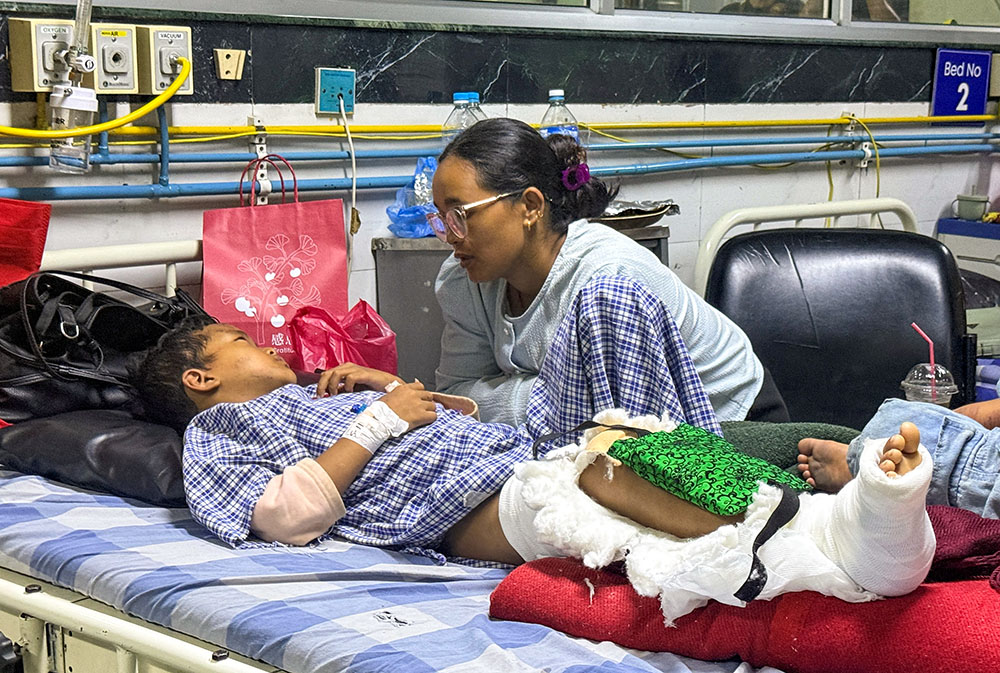
At a hospital in Kathmandu, Nepal, Aug. 28, 2026, Matti Maya Tamang speaks with her son Zoyal Ghale, 8, who was injured in the Aug. 26 deadly flash floods and mudslide. (OSV News/Reuters/Ranup Shrestha)
The flash floods in Nepal are the latest environmental disaster to strike during an unusually active summer of catastrophes.
Flooding has broken out in the northern Philippines, while severe droughts threaten crops in the southern islands. Jesuit Fr. Pedro Walpole, coordinator of the River Above Asia Oceania Ecclesial Network who lives in the Philippines, said the reality of entering an era of 1.5 C means millions of people, especially those who are poor, will be unable to adapt to growing climate extremes and increasing water and food challenges they bring.
"We have no basis for being optimistic," he said.
Indian Bishop Allwyn D'Silva, chair of the Office of Human Development and Climate Change for the Federation of Asian Bishops' Conferences, said in an email that Catholics on the continent — home to some of the world's richest biodiversity and oldest spiritual traditions — must join with other religions to coordinate and call for greater action.
"Asia's faith communities have long understood forests, rivers, mountains, oceans, and lands not merely as resources but as living relationships that sustain life and culture," he said.
Jean D'Cunha, an adviser to the Asian bishops' federation, said that action must entail aggressive slashing of emissions, accelerating scalable renewable energy, and deploying responsible carbon removal mechanisms, all while building more climate-resilient infrastructure.

A man checks out a display for an electric tricycle ambulance at the E-Mobility Expo in Nairobi, Kenya, June 5, 2026. (Dreamstime/Martin Mwaura)
"We have the data and analysis, the science, technology, strategies and finance if responsibly prioritized," she said, adding that what continues to lack is the political will.
Walpole expressed skepticism of carbon capture technologies, calling them "just myth."
"Stop fossil fuel burning. That is the path of hope and reality," he said.
Gold, the head of the Laudato Si' Movement, said the response to the U.N. report must be "one of urgency, motivated by shared concern, not resignation." That begins with governments quickly accelerating the transition from fossil fuels to renewable energy while increasing support for communities to adapt to climate impacts and recover from related disasters.
"And we need the church to use its considerable moral voice, institutions and resources to help drive that transformation," she said.
Gold added that Christians must hold to hope, though that doesn't mean pretending everything will just turn out fine.
"It means refusing to surrender to despair and choosing to act, especially when the stakes are highest. In this new era of climate overshoot, that kind of courageous, active hope is needed more than ever," she said.