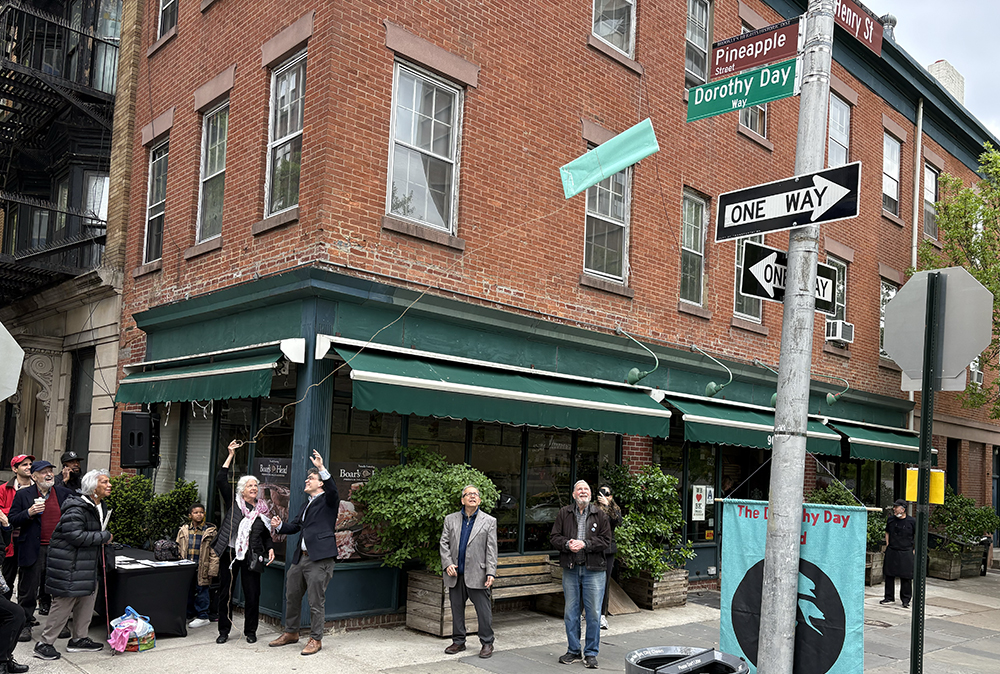
Martha Hennessy, Dorothy Day's granddaughter, and Councilman Lincoln Restler unveil the Dorothy Day Way sign in Brooklyn Heights on May 2. (NCR Photo/Camillo Barone)

Join the Conversation
Send your thoughts to Letters to the Editor. Learn more
On a quiet stretch of Pineapple Street in Brooklyn Heights, a new sign now hangs above the familiar brownstone facades: Dorothy Day Way.
Dorothy Day, the Catholic activist, journalist, and co-founder of the Catholic Worker Movement, was born at 71 Pineapple Street on Nov. 8, 1897. Though she would spend much of her life elsewhere, her birthplace anchors her story in Brooklyn — a New York borough whose history of labor activism, immigration and community organizing mirrors much of what she would later champion.
At the unveiling ceremony on May 2, speakers emphasized that the act of naming a street is never merely symbolic. Kevin Ahern, professor of religious studies at Manhattan University and chair of the Dorothy Day Guild, framed it as a call to action.
"Naming something after an exemplary person has power, has meaning, because naming something is not about just honoring the legacy. It's about inviting others to be inspired by what they did," Ahern said. "We hope that this symbolic renaming does more than mark a place. We hope that it inspires people to ask a question, 'Who is this woman? What did she do? How can I get involved? How can I also be like her?' "
Advertisement
That question — who was Dorothy Day? — is precisely what organizers hope the sign will provoke. Day's life defies easy categorization. She was a journalist close to Communist and Socialist circles in New York, who chronicled the struggles of workers. She later converted to Catholicism and challenged the church to live up to its teachings and was a lifelong pacifist who opposed war in all forms.
Just two days before this ceremony, another street in East Harlem in Manhattan was renamed "Sister Susanne Lachapelle Way" to honor a woman religious who was a Little Sister of the Assumption. Lachepelle, who died in 2023, spent 45 years serving the local community as a nurse and advocate.
The formal path to Day's sainthood began in 2000, when the Vatican named her a Servant of God. This milestone launched a rigorous review of her life and heroic virtue. When Day was born, Brooklyn was a hub of immigrant life and labor organizing — forces that deeply shaped her worldview. Through the Catholic Worker Movement, founded in 1933 with Peter Maurin, Day established houses of hospitality that continue to serve the poor today all over the U.S.
New York City Councilman Lincoln Restler, who helped shepherd the renaming of the street through city processes, spoke about Day's enduring relevance.
"I know this is going to shock you, but I'm Jewish," he said, prompting the crowd's laughter and adding that he has been an admirer of Pope Francis and Pope Leo XIV's calls for the care of the poor.
"I really hope that in having the street sign up here in Brooklyn Heights, people will walk by every day and look up and think about Dorothy Day's phenomenal legacy and ask themselves, 'How can I do a little bit more to advance peace? How can I do a little bit more to advance social justice?' "
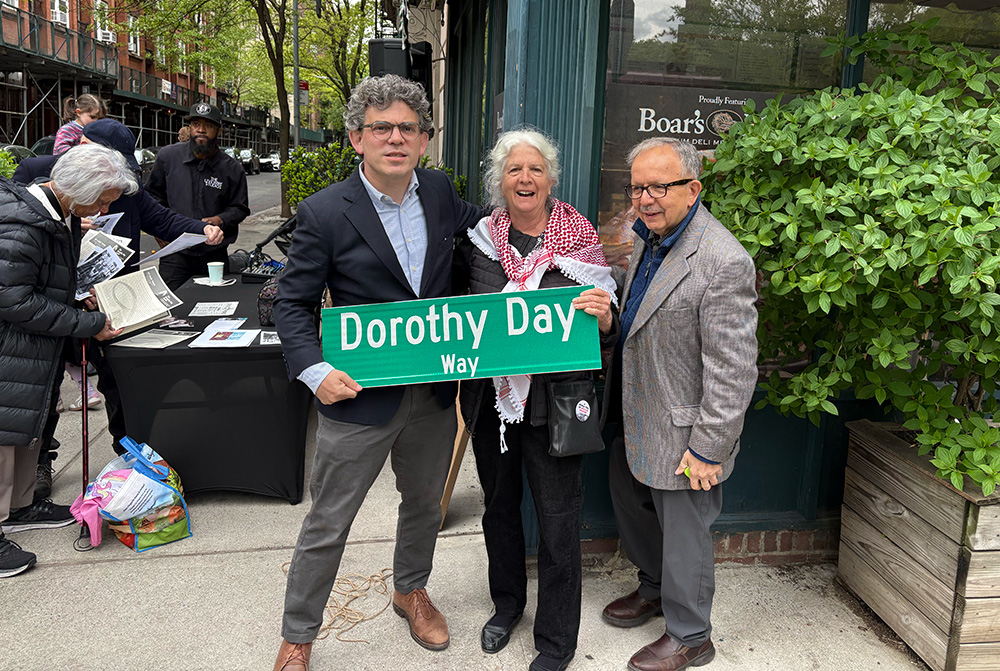
Martha Hennessy, Dorothy Day's granddaughter, Councilman Lincoln Restler (left) and Alex Avitabile, one of the primary organizers behind the street renaming who also knew Dorothy Day personally (right), holding the Dorothy Day Way sign after the unveiling in Brooklyn Heights on May 2. (NCR photo/Camillo Barone)
Yet the question of how to preserve that legacy without diluting it looms large. Martha Hennessy, Day's granddaughter and a longtime peace activist, acknowledged both the importance and the limitations of symbolic gestures like street naming.
"It's significant that a street is being named after her, where she was born, and we're just hearing and seeing more and more about Dorothy Day. And it's a good thing. It's a very timely thing," Hennessy told the National Catholic Reporter after the event.
"Dorothy Day Way is something to celebrate, even though sometimes I get bothered by these little tokens. I'm thinking about Martin Luther King, Jr. and all the streets we've named after him, and how his message was blurred and lost in our culture and society. But it's a good thing in the end."
When asked how Catholics today can authentically carry forward Day's legacy, her answer was direct: "By taking care of the poor, copying Jesus, following the Gospel teachings of caring for one another."
That message was echoed by other speakers and interviewees, each offering their own interpretation of what Day's life demands of the present.
Alex Avitabile, one of the primary organizers behind the street renaming and someone who knew Day personally, emphasized the need for economic justice. "There's no need to have people so rich and people so poor. Working people need to be able to afford to live in decent places, afford to take good care of their children, and to feed them well," he said.
For Avitabile, the renaming is also a recognition of Day's deep ties to Brooklyn, pointing out that she worked in the city's Kings County Hospital during the Spanish flu pandemic after World War I, caring for the sick and dying.
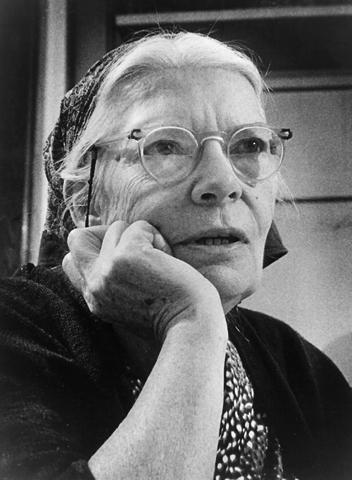
Dorothy Day, co-founder of the Catholic Worker Movement, is pictured in an undated photo. (CNS/Milwaukee Journal)
Fr. Anthony Andreassi, administrative vicar at the Oratory Church of St. Boniface, a few blocks from the newly named street, described Day as someone who resists ideological labels. "I've always liked Dorothy Day because she's someone who you can't put in a box. If you say, 'Was she liberal?' You could say yes. 'Was she conservative?' Yes. Because she was ultimately on fire with the Gospel," he said.
"Having a street where it's Dorothy Day Way, I think the 'Way' is kind of fun, because it shows that her life was also a pilgrimage, but it invites us to think about what is our way, how do we follow Jesus in this world of madness, of war, of suffering," said Ahern.
That sense of pilgrimage is woven throughout Day's story, from her early experiences in Brooklyn and California to her decades of work in New York City. One of the very first formative moments came during the 1906 San Francisco earthquake, less than 10 years after she moved to California with her family, when she witnessed ordinary people caring for one another in crisis — a memory she later credited with shaping her commitment to community and mutual aid.
Back on Pineapple Street, the building where she was born still stands. Its ground floor now houses a small restaurant and coffee shop, while residents live above. There is no marker indicating the exact room of her birth and no preserved relic or museum. Instead, the new street sign serves as the primary public acknowledgment of her origins there.
For some, that simplicity is fitting. Day herself resisted personal glorification, focusing instead on the work at hand: feeding the hungry, sheltering the homeless and advocating for peace.
At the unveiling, her granddaughter offered a brief reflection on her grandmother's enduring message.
"What she taught me was: the way leads to peace," Hennessy said. "She has taught us and will continue to teach us love of the enemy and that we are all one of another. We are all part of the mystical body of each other, and we must remember that."