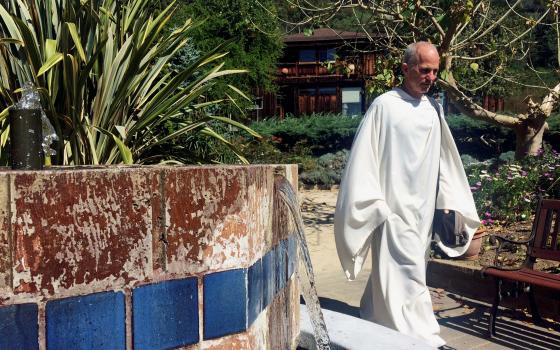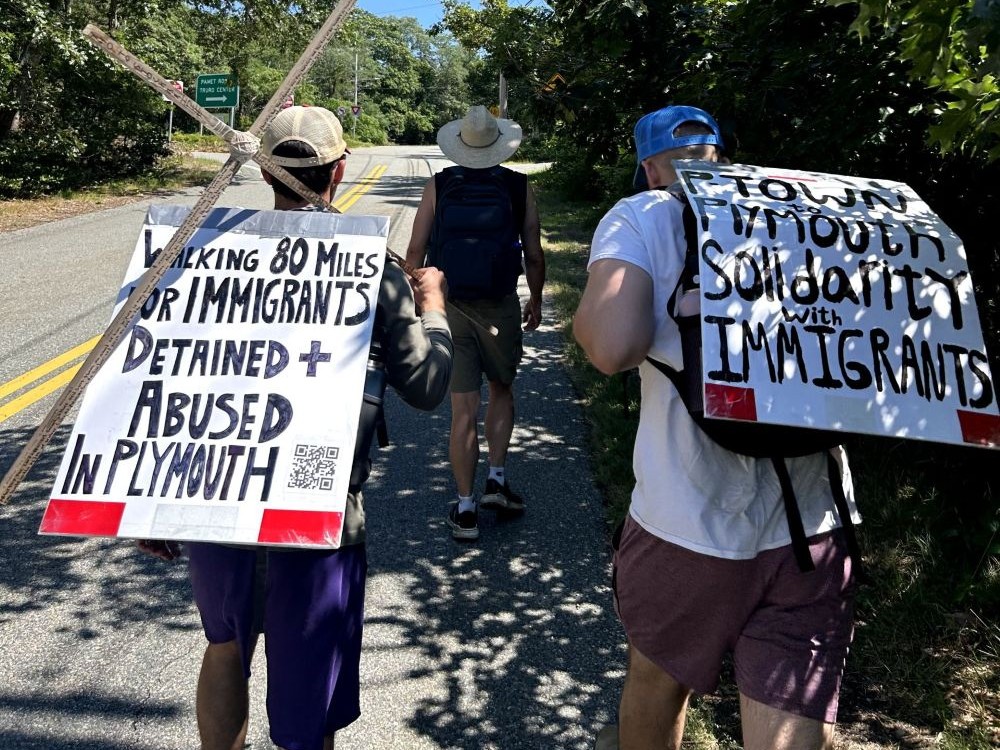
Massachusetts Catholic teachers Connor May and Chris Tansey walk during their July 2026 80-mile pilgrimage in support of immigrants. (Courtesy of Connor May)

Join the Conversation
Send your thoughts to Letters to the Editor. Learn more
Two Massachusetts teachers are walking nearly 80 miles from Provincetown to Plymouth this week in a faith-inspired effort to draw attention to the treatment of immigrants held in federal custody and raise money for immigrant-support work.
Connor May, a theology teacher at Boston College High School in Dorchester, and Chris Tansey, a middle school language arts teacher on Cape Cod, began what they call the "Plymouth Justice Pilgrimage" on July 19 at Pilgrim's First Landing Park in Provincetown. They plan to reach the Plymouth County Correctional Facility on July 24.
The Plymouth County Sheriff's Department facility contracts with U.S. Immigration and Customs Enforcement, or ICE, to hold people in immigration detention.
Initially advertised as a 70-mile journey, the route is closer to 80 miles, the organizers said. They expect to average about 15 miles a day.
"Yesterday we walked 20. Today 11. The average will be 15. In total almost 80. My math was wrong. I'm an English teacher. Connor did the math," Tansey said in a call with the National Catholic Reporter, smiling and sweaty during a break at a coffee shop in Orleans on the second day.
May, 33, lives in Lincoln and teaches Scripture, ethics and social justice. He told NCR the pilgrimage is connected both to his work as an educator and to Catholic social teaching, particularly its emphasis on human dignity and concern for people who are poor or vulnerable.
The two met through Jesuit Volunteer Corps Northwest and later became roommates. Their current walk follows a 2019 pilgrimage they completed from Dorchester to the National Shrine of The Divine Mercy in Stockbridge. The earlier walk took place during the first Trump administration's controversial policy of separating migrant families at the U.S.-Mexico border.
May said that first journey emerged from a sense of helplessness as the two followed reports about immigration policy and conditions at the border.
"So many of us in the modern age, you can get caught up in the doomscrolling of things, and just feeling kind of hopeless and like the whole world's on fire, and that we're completely powerless," he said.
Their response was to use pilgrimage, a longstanding religious practice, as a form of public action. May said they wanted to protest what they viewed as injustice while grounding the walk in their faith.
"We had a conviction that this was an injustice, and we wanted to raise attention to it, but we wanted to do it very informed by our faith and specifically Catholic social teaching principles, recognizing the dignity of all people, prioritizing the poor and vulnerable, and giving voice to that," he said.
The organizers said the pilgrimage is open to people of any religion or political affiliation. Its goals include raising awareness of reported conditions, supporting the Boston Immigration Justice Accompaniment Network and advocating for an end to ICE contracts with Massachusetts correctional facilities.
A 2024 report by Boston University School of Law's Immigrants' Rights and Human Trafficking Program and Prisoners' Legal Services of Massachusetts reviewed complaints and official findings spanning more than two decades at the Plymouth facility. The report described allegations involving medical and mental health care, sanitation, food, language access, solitary confinement and other conditions.
May said the report helped inspire the route and the walk's policy focus. He described one long-term objective as state legislation that would prevent correctional facilities in Massachusetts from contracting with ICE.
"Politically, to have Massachusetts pass the legislation that disallows any contracts with ICE and prison facilities," May said. "And then, from a more kind of spiritual place, inspiring people in our community to really stand on the convictions of their faith tradition, Catholic, Christian and other religious traditions that really require us all to stand up for those who are being persecuted and being treated without dignity."
The teachers also have personal connections to immigrant communities. May said they have a friend who is protected under the Deferred Action for Childhood Arrivals program, known as DACA. His wife, a teacher at Cambridge Rindge and Latin School, has students whose parents have been detained by ICE, he said.
Advertisement
The walkers said the public response had been largely supportive. About 20 people gathered at the Provincetown starting point, May said, and a similar-sized group accompanied them for the first few miles. Roughly 10 people joined part of the route the following day on a bicycle path, with motorists honking in support, a woman offering drinks and Dunkin' workers giving the group free doughnuts. He said the encounters helped as fatigue and old injuries began to affect the walk.
Tansey said the response to the fundraising campaign had also exceeded expectations. The organizers created an online fundraiser benefiting BIJAN, a network that provides accompaniment, advocacy and other assistance to immigrants and asylum seekers.
"Our original goal was $4,000. We're almost at $7,500 and we're only on the second day of the walk," Tansey said. As of July 22, they had raised more than $8,800.
With two days to go, the pair experienced their first negative reaction. On July 22, May and Tansey placed their backpacks and signs outside a coffee shop in Barnstable while speaking with baristas, who expressed support for the pilgrimage. A woman May believed to be the owner asked the walkers to turn around the signs to hide their messages. "Walking 80 miles for immigrants detained + abused in Plymouth" and "P-town to Plymouth, solidarity with immigrants," the two signs said.
After purchasing coffee and sandwiches and eating outside, the group was asked to leave, May said.
Tansey said that the pilgrimage was intended to focus on treatment of people in detention rather than on partisan identity.
"The idea isn't so political. The idea is human rights and treating people with dignity and respect," he said. "I hope that no matter where we fall, we can agree that all people deserve dignity."
For May, the public nature of the pilgrimage is central to its purpose. He said private prayer alone was not sufficient when religious principles called for action.
"It cannot be just prayers in our bedrooms," he said. "Jesus' ministry was one that was inherently public, and so we too need to take our spiritual convictions to the public square as well."
The walk is scheduled to conclude outside the Plymouth County Correctional Facility, where the teachers hope the final miles will bring further attention to immigration detention in Massachusetts.