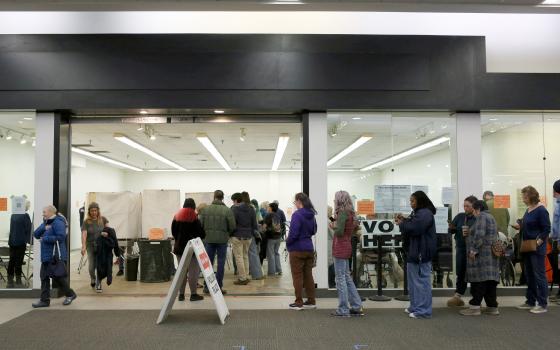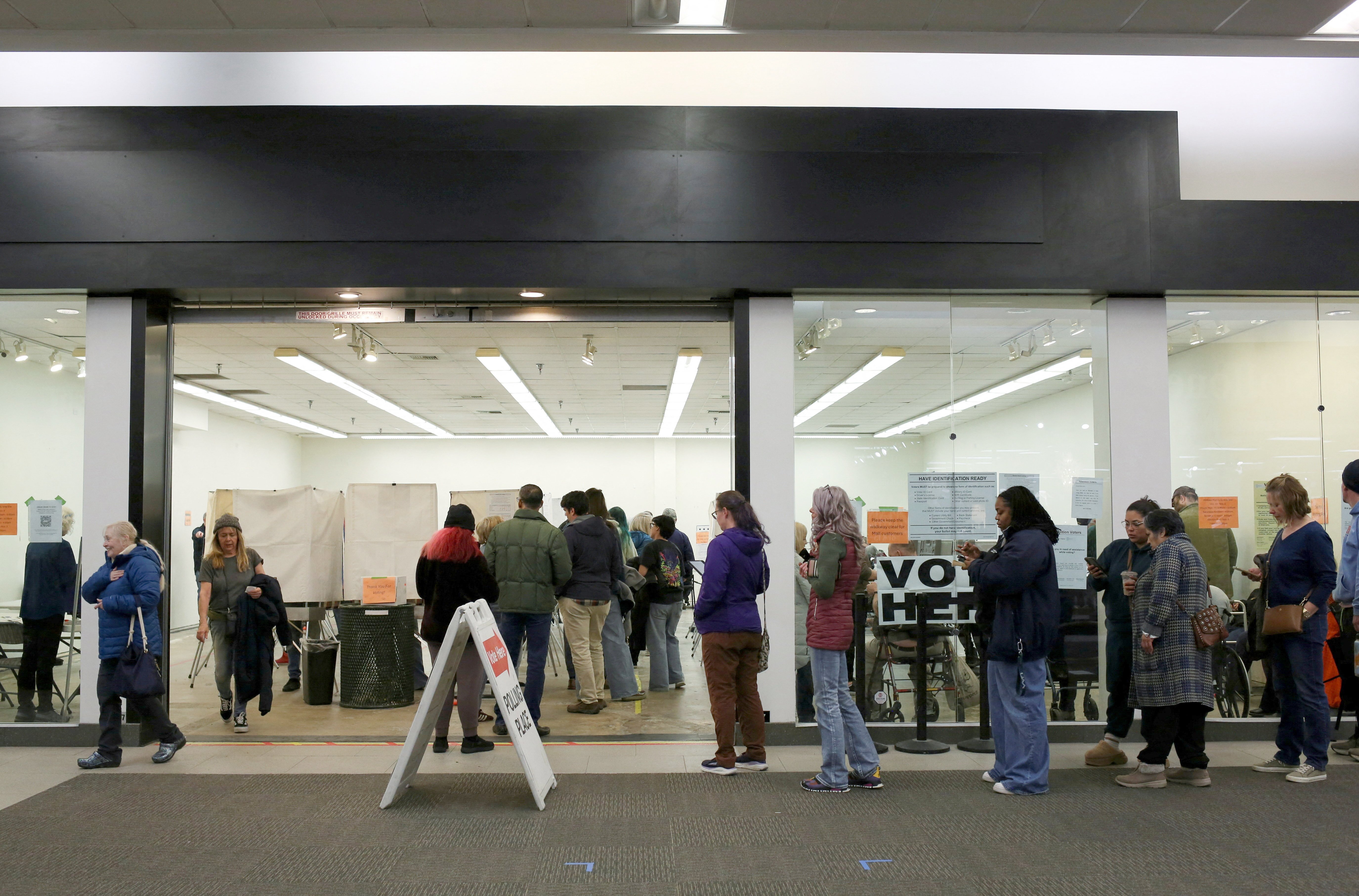
People wait in line to cast their vote for the congressional midterm election at a polling station at Midtown Mall in Anchorage, Alaska, Oct. 30, 2026. (OSV News/Reuters/Emily Mesner)

OSV News
Join the Conversation
Send your thoughts to Letters to the Editor. Learn more
As the nation heads to the ballot box at the midterm elections, Catholics are working to ensure peace at the polls.
Those efforts come as the U.S. Catholic bishops call on the faithful to prayerfully discern their election choices and exercise their right — and responsibility — to vote, prioritizing faith over politics and seeking the common good.
"There's a lot of anxiety in the lead-up to the election, and fears that our free and fair elections could be undermined," said Robert Christian, director of strategy for the Franciscan Action Network.
The Washington-based nonprofit works to promote peace, human rights, care for creation and economic justice in U.S. public policy.
FAN organizes a poll chaplain program, which this year will see some 375 individuals from several dozen states bring "a peaceful presence to the polls — a deescalating presence so that people feel good about voting on Election Day," Christian told OSV News.
He explained that each chaplain is trained to adhere to state and local laws at the polls, which typically regulate who can be present in a polling station in order to prevent election fraud, intimidation and violence.
"They're not in the polling station with the poll workers; they're outside, and they have training to make sure they're following all the rules and being a helpful presence," he said.
Franciscan friars, sisters and secular members, along with "laypeople and people from different denominations," are serving as poll chaplains — and ministering largely through "their presence alone," Christian said.
"If they see some sort of conflict, or people getting agitated in line, they may be able to step in," he said. "And if there is a significant issue that would affect the elections and the functioning of democracy, they can speak in a calm, peaceful manner, or call someone to inform them there's an issue."
Advertisement
In Detroit, Archbishop Edward Weisenburger teamed up with other faith leaders for an Oct. 21 "Vigil for Voting" hosted by that city's Gesu Parish. The ecumenical prayer gathering, sponsored by Religious Leaders Forum of Metropolitan Detroit, focused on interceding for voters' rights and poll worker safety.
In San Diego, Catholics have partnered with other faith communities to "just be present at the polls," said Jesuit Fr. Scott Santarosa, pastor of Our Lady of Guadalupe Parish.
Santarosa was one of several faith leaders who participated in an Oct. 28 press call on countering election threats, with the discussion moderated by CNN political commentator Jamal Simmons.
Noting that faith-based accompaniment to immigration hearings and check-ins has helped vulnerable persons "feel a little bit safer," Santarosa said, "That's our hope with poll monitoring, to help people feel like it's safe to go and vote."
On Oct. 25, he and other faithful had a Eucharistic procession through the neighborhood to a ballot box.
"We encouraged all of our folks to participate, whether they could vote or not — to be present in prayer and song," Santarosa said. "We arrived at a ballot box where we formed a line of people who reverentially deposited their ballots in the box."
Santarosa said the Eucharistic procession "was really a way of saying 'there's safety in numbers.'"
"People are afraid of ICE," he said, referencing U.S. Immigration and Customs Enforcement. "But when we walk together, we're safer."
In Southern California, ICE agents have been accused of racially profiling Latinos and exercising brutal tactics that have caught up U.S. citizens. U.S. District Judge Maame Ewusi-Mensah Frimpong in Los Angeles, in a ruling made public Oct. 29, said there is a "mountain of evidence" ICE agents have engaged in racially profiling Latinos and ordered the agency to pursue detentions based on individualized suspicion.
In Long Beach, California, the mayor has demanded an investigation into ICE agents who were captured on video apparently swerving their vehicle, while driving the wrong way down a one-way street, into a Latino U.S. citizen on an e-bike, who was then violently detained and suffered a broken arm Oct. 17.
Santarosa said the Eucharistic procession to their local polling place was also "a way of saying, 'Don't be disenfranchised. Participate in this. Even if you can't, maybe your neighbors or children can.'"
In response to a question from OSV News, Santarosa said that young people in his "mostly Mexican Latino community" feel "disenfranchised."
"What we have said to people is, 'Look, if you have not believed that elections can change your life, let's just look two years ago and see how the election of this current administration did change your lives,'" said Santarosa. "And that has awakened people in a way."
Looking beyond the Nov. 3 elections, Christian told OSV News that overcoming the nation's deep political polarization, even within families, "is a long-term issue."
"Don't expect this to get fixed overnight," he cautioned, noting that FAN is considering additional "work on depolarization" after the elections.
Christian pointed to the impact of social media, which "primes us to behave ... like we're all 'hot-take' artists now, ready to jump down each other's throats."
"A different approach is needed," he said. "I think it starts with listening to hear where someone else is really coming from, then maybe finding some shared values."
He also advised "recognizing that people have different perspectives, and they actually might end up where you are on a given political issue, but they're going to travel there on a different road."
In that case, he said, "It's better to carefully try to walk that road with them a little bit."
Above all, said Christian, political differences should not destroy relationships with loved ones.
"Put that loving relationship before political victory," he said.