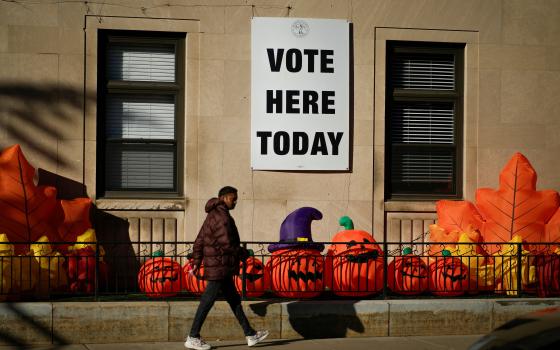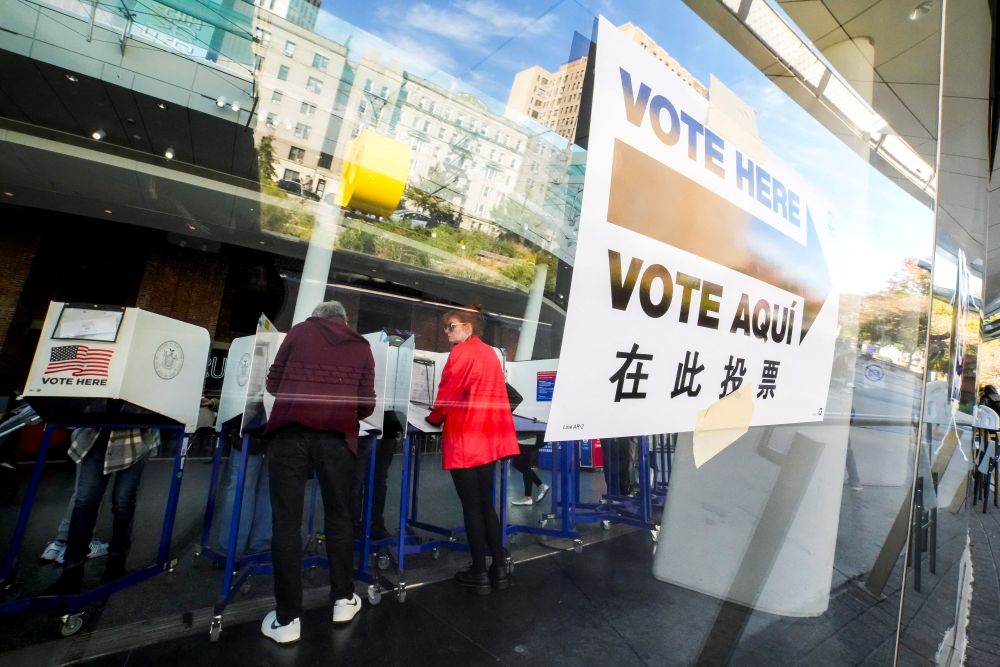
People vote at a polling station in Brooklyn, N.Y., Oct. 24, 2026, the first day of early voting in New York state for the U.S. midterm elections. (OSV News/Reuters/Eduardo Munoz)

by Tom Deignan
Join the Conversation
Send your thoughts to Letters to the Editor. Learn more
Parental rights are on the ballot in nearly a dozen state initiatives this Election Day, including controversial topics like abortion and gender identity.
In Washington, Initiative 001 focuses on what parents should know about public school educational teaching materials. In Colorado, a "yes" vote on Proposition 135 would "prohibit healthcare professionals from performing or providing surgeries to persons under age 18 for the purpose of altering biological sex characteristics."
In Virginia, Question 1 would establish a "right to reproductive freedom" in the state constitution, while Missouri's Amendment 3 covers abortion and gender transition surgeries.
Bishops and other state-based Catholic groups have generally aligned themselves with conservative sides of these debates, though groups like Catholics for Choice, as well as individual Catholic elected officials have taken different stances.
All parties generally claim they're defending a parent's right to raise their own child.
Several 2026 ballot initiatives mandate informing parents about decisions their children might make about abortion or — as in Colorado — prohibit surgeries related to gender identity.
Catholic bishops there have encouraged "all Coloradans to vote 'yes' … on the Colorado ballot to protect parental rights and the safety and dignity of children."
In Washington, Gov. Bob Ferguson, a Catholic, has said Initiative 001 — designed to increase parental awareness about education topics, including sexual health — "actually weakens existing laws by removing parents' rights."
The Washington State Catholic Conference supports a "yes" vote on Initiative 001, "since care of a child's health is a parental right and responsibility," and would also, they say, ensure "that parents are not kept in the dark about an issue that impacts their child's health," executive director Jean Welch Hill, said in a statement provided to NCR.
A ballot measure in Nebraska will decide whether or not the state constitution will designate school and college athletic teams "based on biological sex."
Groups such as Rainbow Parents of Nebraska support a "no" vote.
Tom Venzor, executive director of the Nebraska Catholic Conference, said in a statement to NCR that while the group did not "take an 'official' position on ballot initiatives this election cycle," it has "supported nearly identical legislation."
"The sad fact is we find ourselves in a confused culture where basic realities about sex and human sexuality are muddled and undermined," the statement said. The conference urged Catholics in the state to "keep in mind Catholic social teaching on human sexuality" in their voting.
Advertisement
Many of the claims about parental rights are rooted in a Supreme Court decision Pierce v. The Society of Sisters — a 1925 ruling that involved schools run by an order of women religious in Oregon that centered on a state law requiring all children to attend local public schools.
Catholic schools, such as those run by Oregon's Society of Sisters of the Holy Names of Jesus and Mary, were at the center of this legal dispute. A coalition that viewed immigrants and Catholics as dangerous supported the Oregon law, but the Supreme Court ruled unanimously against it.
Conservatives have seized on this decision in the wake of debates over diversity, equity and inclusion initiatives, stressing that the court protected the rights of parents in raising their children, not the government. The phrase, "the child is not the mere creature of the State," in Pierce, has been cited in a wide range of recent legal and political conflicts.
Conservative advocacy groups have also referred to Meyer v. Nebraska, a 1923 Supreme Court decision that revoked a state law banning the teaching of foreign languages to elementary school students. The case involved Robert Meyer, a teacher at a Lutheran school in Hampton, Nebraska, who was found guilty of teaching students in German.
The dispute reflected not only lingering anti-German sentiments from World War I but the broader nativism of the early 1920s, a time of mass immigration. Critics believed the U.S. was becoming too diverse, and losing unifying bonds, including a common language.
The court, however, ruled such laws violated the 14th Amendment, and specifically cited a parent's right to raise a child using methods, even language, of their own choice.
The rulings have shielded Catholic and other religious educators in the U.S. — including home-schoolers — from excessive local or state government restrictions.
But on Election Day, voters in several states will determine a modern-day interpretation of parental rights.