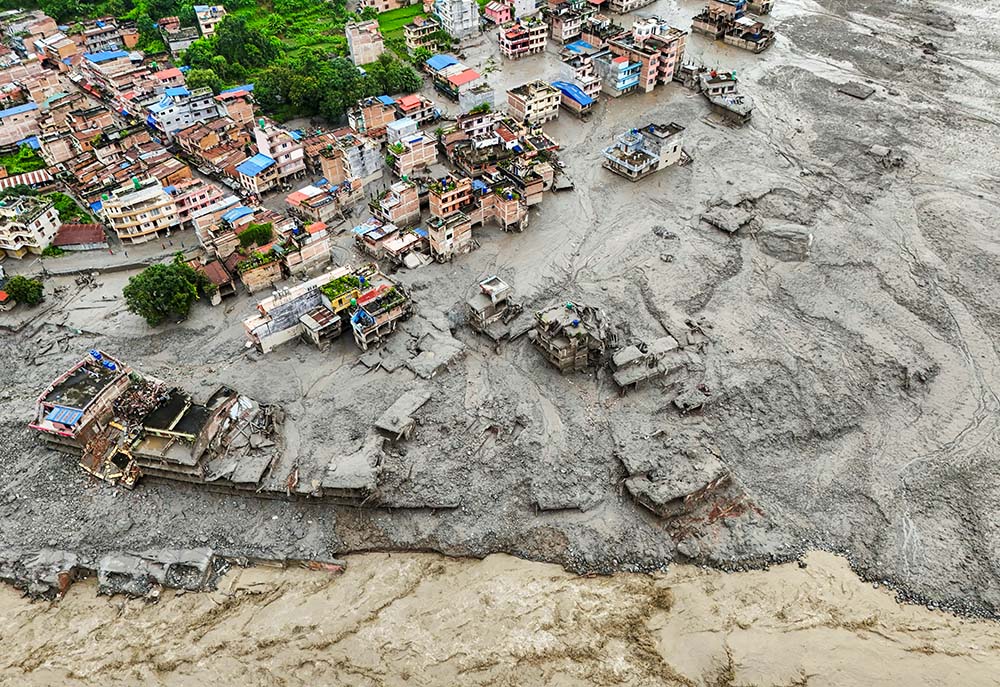
A drone view shows mud covering properties at Trishuli in Nepal's Nuwakot district Aug. 27, 2026, following devastating floods. (OSV News/Reuters/Navesh Chitrakar)

Join the Conversation
Send your thoughts to Letters to the Editor. Learn more
Within 24 hours after the collapse of a massive glacier in the Himalayas triggered deadly flash flooding in northern Nepal, Senthil Kumar Gurunathan was boarding a plane in Delhi on his way to assist in the relief efforts.
The country representative for CRS India, Gurunathan arrived Aug. 27 in Kathmandu to work with staff already on the ground with CRS Nepal. Both are country chapters of Catholic Relief Services, the U.S. bishops' international development organization.
As of Sept. 1, the death toll from the flooding had climbed past 1,000 people, with as many as 4,000 people missing across Nepal and Tibet. The devastation was apparent in the early hours of the Aug. 26 disaster. According to Caritas Nepal, another Catholic humanitarian group, entire villages and settlements along the Trishuli River had been wiped out.
"We are seeing an incredible amount of destruction right now," Gurunathan said in an email Aug. 28.
"So many people have lost everything, including their homes and are staying in whatever spaces they can find," he said.
The flash flooding in Nepal is the latest environmental catastrophe to strike this summer. Extreme flooding has also occurred in other parts of Asia, as well as Ghana, Peru and across the U.S., while major earthquakes have razed parts of South America and East Asia. Wildfires have sparked across the U.S., Canada, Spain and France. And heat waves have dotted the global map.
Advertisement
"It definitely is unusual," said John Service, a senior technical adviser for the CRS humanitarian response team for 13 years. "This is more than we normally have at one time."
The flurry of natural and weather-related disasters this summer comes as international aid has experienced extensive cutbacks, including from the United States. While some new grants have been awarded and new funding sources tapped, the decline in funding — and with it personnel — has strained efforts of relief organizations like CRS to quickly respond.
Service only recently returned to CRS headquarters in Baltimore after spending five weeks in Venezuela following the dual magnitude-7 earthquakes that struck within minutes on June 24.
Weeks earlier, a magnitude-7.8 earthquake in southern Philippines killed at least 106 people and injured more than 1,300. Those were followed by major earthquakes in Japan, Peru and China in July and in Colombia and Indonesia in August.
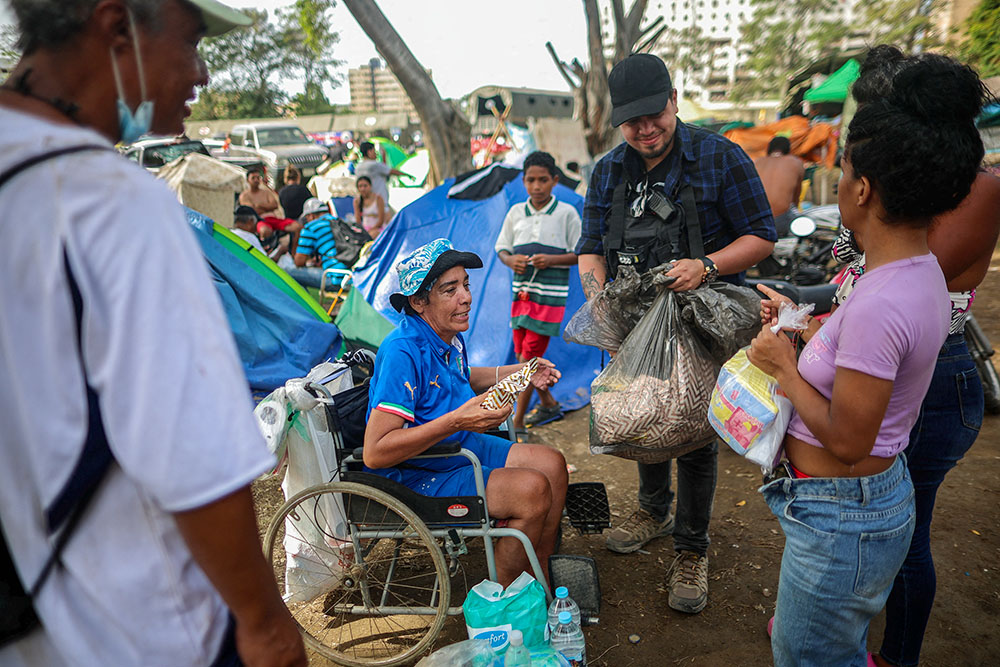
Displaced people shelter at a temporary camp in La Guaira, Venezuela, July 4, 2026, following the aftermath of the June 24 earthquakes. (OSV News/Reuters/Adriano Machado)
Destruction around La Guaira, the Venezuelan coastal city that was ground zero of the quakes, was massive, Service said. Parts of the city were completely leveled, reminding some colleagues of scenes they saw in Gaza. For him, it was among the worst damage he'd seen in his 26-year career with CRS.
The U.S. Catholic agency worked with Caritas Venezuela and a network of 26 parishes to provide assistance to impacted people. Service said incredible amounts of dust in the air from the debris combined with hot temperatures to make living on the streets or in shelters in stadiums incredibly difficult. Some people resorted to setting up camps and shantytowns on the mountainside.
"First, they were traumatized, and then they were starting to get desperate because they weren't sure exactly what was going to be their future, and would the aid continue," Service said.
A central contributing factor in any disaster is its proximity to major population centers. Another increasing factor is climate change, which in the case of hurricanes, storms, wildfires and heat waves is magnifying the intensity.
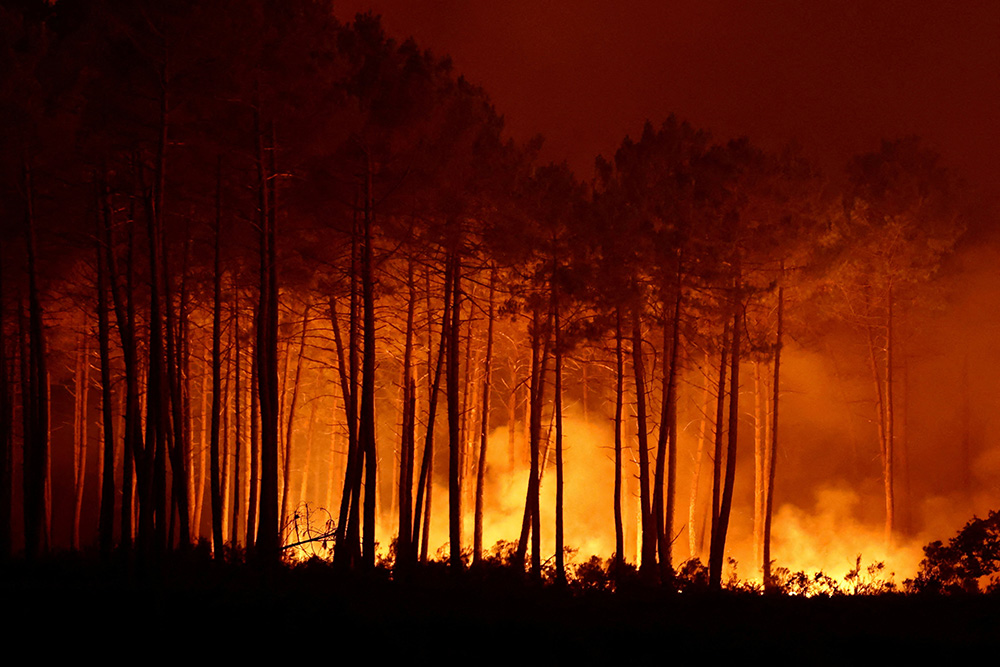
Smoke rises as flames burn during a wildfire in Ares, France, July 25, 2026. (OSV News/Reuters/Stephane Mahe)
More than 1.2 million acres have burned in wildfires across Europe this summer, with Spain and France accounting for more than 60% of the blazes on the continent. In Canada, nearly 4,800 wildfires have burned up 10 million acres this year, a decline from the 19 million acres consumed last year. In Washington state, a wildfire near Spokane damaged at least 800 buildings and forced evacuations of 65,000 people.
The heat dome that contributed to wildfires in Canada also fueled extreme heat in the U.S. that led to July becoming the country's hottest month ever since record-keeping began in the late 1800s. Europe baked under a series of extreme heat waves this summer, with the EU reporting more than 35,000 more heat-related deaths than usual. Northern Africa saw temperatures surpass 113 degrees Fahrenheit in early August.
In Nepal, the flooding is believed to have been triggered in part by rock that collapsed beneath a glacier, causing a massive piece of ice to fall into the valley below. Scientists are still studying what role climate change may have played in the glacier breaking away. The combination of water, ice and debris tore through the river system. Nearly every village in the region along the Trishuli River was impacted, even if they weren't destroyed, said Gurunathan, the CRS India official.
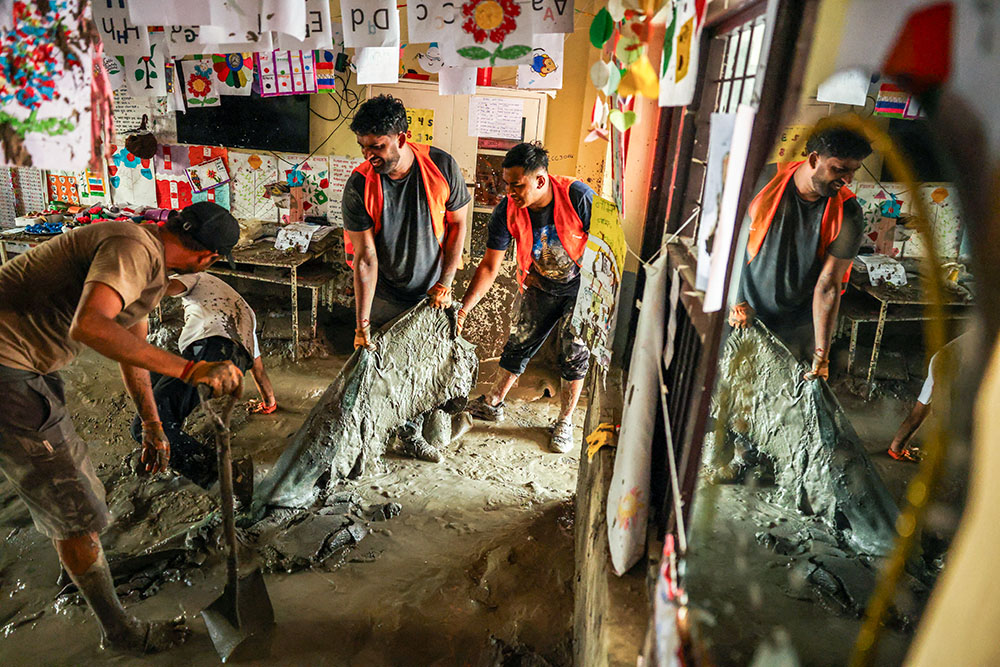
Volunteers remove sludge inside a classroom at Shree Bagheswori Madhyamik School at Galchhi in Nepal's Dhading district following deadly flash floods and mudslides. (OSV News/Reuters/Athit Perawongmetha)
"These communities rely on the rivers, and the debris and mud has essentially paused their lives. They are frozen in time because of this disaster," he said.
The race to provide aid is on.
Gurunathan said they have heard from local partners near the impacted area of villages with enough food for a single day. In one case, a single house was hosting 30 people.
The immediate needs, he said, are food, safe drinking water, and a safe place to stay and sleep. A major obstacle to delivering those provisions is the geography, as the impact zone is high in the mountains in the Tibetan plateau. Key roadways have been damaged, including at least 19 bridges and 25 miles of road washed away, limiting access to villages and forcing supplies to go by air or along smaller alternate routes.
"We are forced to move slower, and we cannot transport as many supplies as we would like," Gurunathan said.
These disasters have unfolded as nations have pulled back on foreign assistance and as war and conflicts battle for resources. International aid saw its largest drop — 23% — in 2025, fueled by a 57% decline from the U.S. to $29 billion.
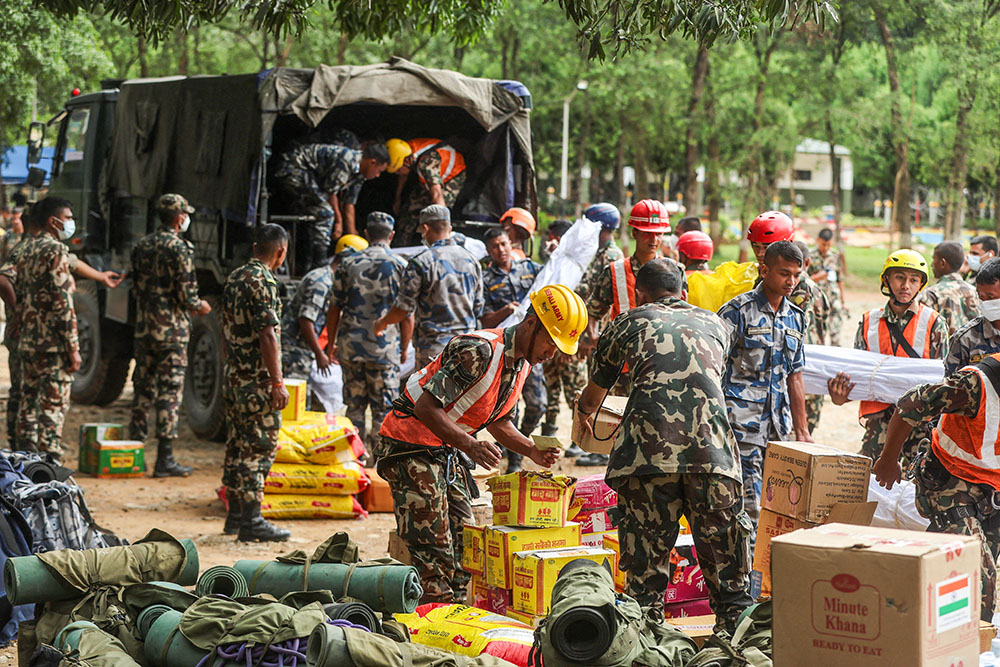
Armed Police Force and army personnel unload relief material from a vehicle at the Maithili Barrack Army training center at Trishuli in Nepal's Nuwakot district Aug. 31, 2026, following flash floods and a mudslide. (OSV News/Reuters/Francis Mascarenhas)
Slashing of U.S. foreign assistance by the Trump administration last year and its dissolution of the U.S. Agency for International Development, or USAID, had severe repercussions for CRS, which was the leading grant recipient from USAID among nongovernment organizations. In 2024, it received nearly $700 million in federal funds; the cuts forced the elimination of a third of its staff and programs.
In June 2026, the State Department awarded CRS a new $240 million grant focused on rapid humanitarian aid deployment in crisis areas. Some of that grant, which was signed Aug. 7, has gone toward relief efforts to the earthquakes in Venezuela and Colombia and is expected to assist work in Nepal, as well.
A portion of the grant is also directed toward an El Niño preparation initiative to create capacity to respond quickly in Latin America to more extensive flooding and droughts driven by the recurring cycle of warmer waters in the Pacific Ocean. Scientists have projected this year's El Niño, which formed in June, could be the strongest ever on record and possibly in centuries.
"Those are things that we can anticipate and we can get ready for," Service said.
In any emergency recovery situation, he said there are three key elements: money, materials and people.
"By and large, supply is holding and we're able to get funding, which is once again positive," he said, crediting CRS donor support for the agency's agility in securing supplies in advance of disasters. "So really, then the strain becomes about people because you have to be able to manage all those resources. And the scaling up is always a lot harder than once it's already up."
CRS is working to restart some operations and hire new staff to assist in recovery efforts around the globe. That includes Nepal, where it is working to rehire a former staffer with logistical expertise in the region from the 2015 Gorkha earthquake. The staffer's position was lost last year due to the U.S. federal funding cuts.
As rescue operations continue, recovery for the river communities in Nepal will take a long time.
"So many of them have lost everything. They don't even have a change of clothes right now," Gurunathan said.
Along with food, clothes and other aid, the CRS India official said they need to deliver hope to the mountains, as well.
"This is a traumatic experience they have just been through. They need to know that they are not alone," he said. "They need your prayers and your support. They need it now and they'll need [it] for weeks and months to come."