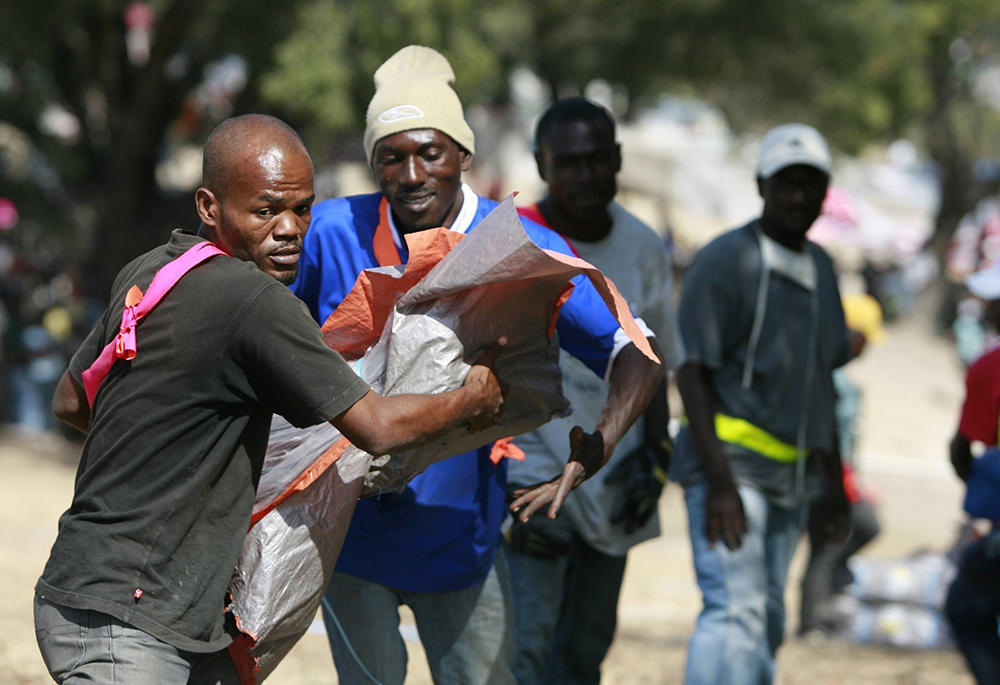
Workers distribute shelter kits assembled by Catholic Relief Services at a camp for survivors of the 2010 earthquake in Port-au-Prince, Haiti. The U.S. Department of State announced June 5, 2026, that a $240 million grant in humanitarian and disaster response assistance — the first of a series of such grants — will be made to CRS, the overseas relief and development arm of the U.S. Catholic Church. (OSV News/Bob Roller)

Join the Conversation
Send your thoughts to Letters to the Editor. Learn more
A year after the Trump administration's wholesale cuts to U.S. foreign aid levied a heavy toll on Catholic Relief Services, slashing hundreds of millions from its budget and with it a third of its staff and programs, the State Department awarded the agency $240 million for disaster and humanitarian assistance.
The funding was announced June 5 during an event in Rome with CRS and State Department officials.
"We see this as a very positive sign of CRS and the United States working closely with local church, local partners and local government to be able to maintain the historic position that the United States has had in assisting people in their times of crisis," Sean Callahan, CRS president and CEO, told National Catholic Reporter.
"And the value that this really has for the U.S., not only the local people being assisted but also for the U.S. as well," he said.
Catholic Relief Services is the official overseas humanitarian and development organization of the U.S. Conference of Catholic Bishops. Formed in 1943 to aid survivors and refugees in Europe during World War II, it has served the world's most vulnerable populations in 122 countries. Its work has spanned relief for refugees in conflict zones, support of Mother Teresa's global ministry to the poor, food assistance during the 1980s famine in Ethiopia, sustainable agriculture techniques in Africa, Asia and Central America and emergency aid after numerous natural and weather-related disasters, including those worsened by climate change.
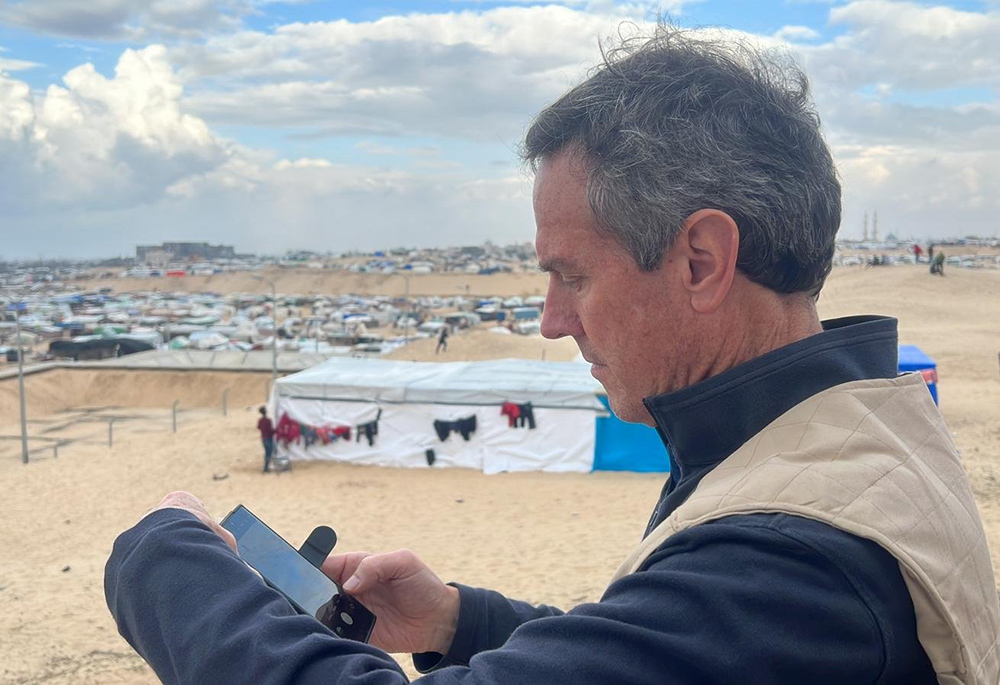
Sean Callahan, president of Caritas North America and CEO of Catholic Relief Services, is pictured during his visit to southern Gaza Jan. 23, 2024. (OSV News/Courtesy of Catholic Relief Services)
In a press release, the State Department said the new funding to CRS, more than $240 million, aims to support rapid humanitarian aid deployment in crisis areas around the globe and boost a rapid response fund when disasters arise or surge. The funding is the first in a series the department plans to award to vetted organizations able to respond to crises within 24 hours.
The funding term covers one year, at which time it could be renewed, said a senior State Department official who spoke with NCR on background.
The State Department cited CRS's "extensive network of local partners" — including 162 chapters of Caritas Internationalis, the Catholic Church's global aid network, in 155 countries — "ensuring that assistance reaches the most vulnerable populations efficiently and effectively." It noted its relief efforts in Cuba with local partners in the aftermath of Hurricane Melissa in October to ensure aid to those impacted without interference from the Cuban government.
That on-the-ground presence and network was a leading factor in selecting CRS, the State Department official said.
"They're extremely effective in what they do. They have a broad reach globally to be able to reach a lot of [these crisis zones]," the official said, adding the White House has encouraged the State Department to partner with faith-based organizations on humanitarian assistance.
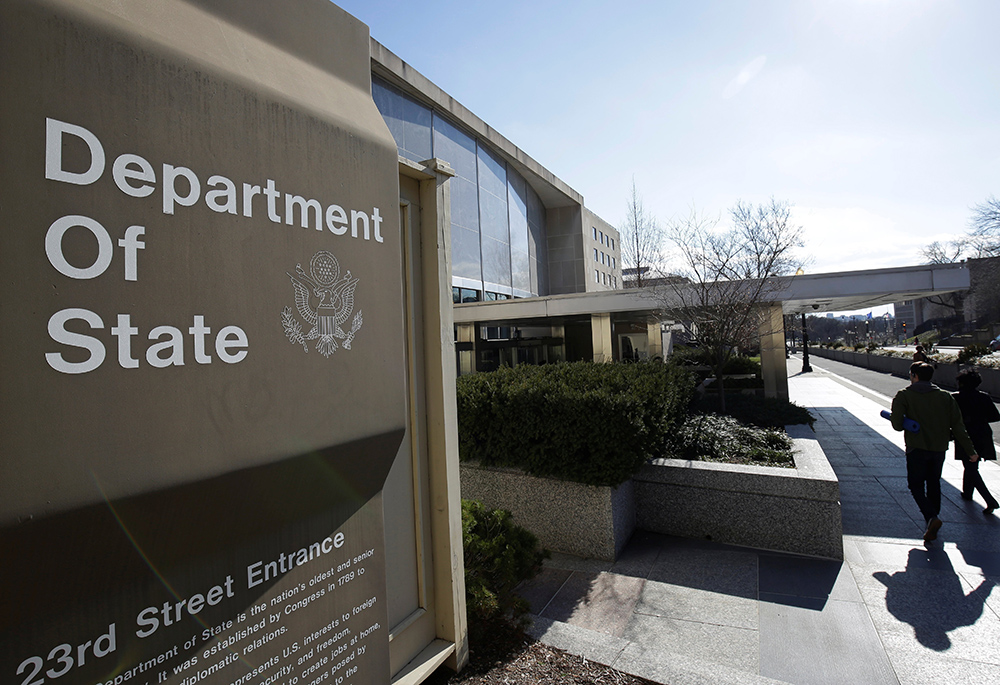
People are pictured in a file photo entering the U.S. Department of State building in Washington. (OSV News/Reuters/Joshua Roberts)
The Catholic Relief Services funding is designated to provide assistance around food, health, water, sanitation and shelter in countries "with significant levels of humanitarian need," the State Department said, listing Ethiopia, Haiti, Nigeria and Sudan. A portion of the funds will support CRS's ongoing response to the Ebola outbreak in the Democratic Republic of Congo.
The majority of the funds are expected to be released to CRS by mid-July.
Along with the Ebola crisis in Congo, Catholic Relief Services sees as an immediate priority delivering food assistance in countries within the Horn of Africa to prevent a larger hunger emergency in the region.
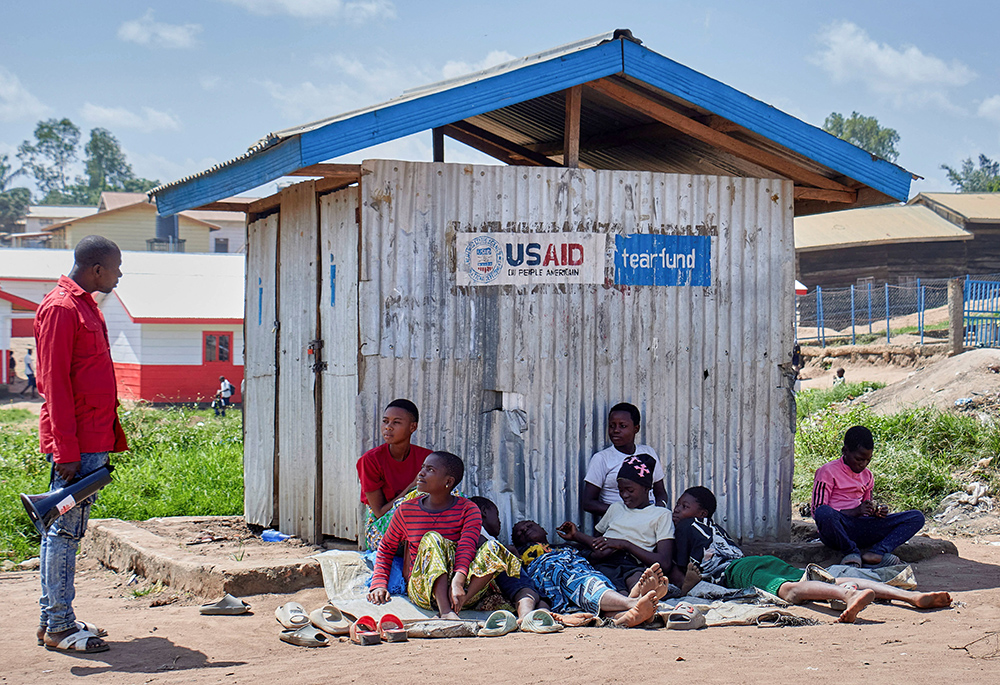
Richard Mbagaro, a supervisor at the Kigonze camp for internally displaced persons, speaks to residents in Bunia, Congo, May 25, 2026, urging them to wash their hands with soap or ash as fears grow over the spread of Ebola, as authorities intensify efforts to contain an Ebola outbreak caused by the Bundibugyo virus. (OSV News/Reuters/Gradel Muyisa Mumbere)
"Some of the areas there are having a very difficult food security issue now during the lean season, and we need to make sure that people are being able to address that right away so that it doesn't get into a more severe food crisis," Callahan said.
The new federal funding comes roughly 17 months after the Trump administration in one of its first moves canceled or froze roughly $60 billion in foreign assistance, a sweeping, frenetic effort led by tech billionaire Elon Musk as head of the newly formed Department of Government Efficiency. In its wake, the U.S. Agency for International Development (USAID) was dismantled, six decades after its creation under President John F. Kennedy. At the time, U.S. foreign assistance made up less than 1% of the federal budget.
CRS was the leading grant recipient from USAID among nongovernment organizations. In 2024, CRS received $568 million from USAID and nearly $700 million overall in federal funding, per public spending records. Prior to the Trump cuts, U.S. government grants and agreements made up roughly half of CRS's annual budget, which hovered around or above $1 billion.
The new $240 million award nearly triples the $85 million the Trump administration had issued previously to CRS since February 2025, with the bulk of those funds resolving prior agreements. Since December, the administration has provided $3.8 billion in humanitarian assistance in 21 countries to the United Nations Office for the Coordination of Humanitarian Affairs.
The State Department official said the pause in funding was needed to conduct an internal audit of foreign spending and prioritize programs the administration viewed as necessary. The official added that countries in Europe have also reassessed their foreign assistance.
Various studies have estimated hundreds of thousands of children and people have died as a result of the USAID cuts. According to one study published June 2025 in the Lancet medical journal, the continuation of funding cuts could lead to more than 14 million deaths by 2030, including 4.5 million children under the age of 5.
As U.S. foreign aid was halted at that time, CRS braced for significant impacts on its programs and staff. In a February email to staff, first reported by NCR, Callahan warned the cuts could reduce its budget by half.
In the end, CRS programs and staff each shrunk by roughly one-third, Callahan told NCR.
"We fortunately maintained much of our infrastructure, despite the fact that it was reduced, and we prioritized particular areas so that we could continue to respond," he said.
Callahan added the agency also maintained hope that if given the chance to present its case and show the impact of its work that federal support might return. While they sought out new donors and foundations to keep programs operating, they continued meeting with administration officials and members of Congress. Callahan and Bishop A. Elias Zaidan, head of USCCB's Committee on International Justice and Peace, made visits together to Capitol Hill, as did other bishops on the CRS board.
Discussions about the potential for renewed federal assistance for CRS initiatives began in March, when the agency invited a senior State official to its board meeting. Conversations advanced from there.
Advertisement
Among those in attendance at the Rome event were Ryan Shrum, a senior State official on disaster and humanitarian response; Jennifer Poidatz, CRS vice president for humanitarian response; Caritas secretary-general Alistair Dutton; and Lynda Blanchard, the U.S. rep for U.N. services in Rome; and Brian Burch, the U.S. ambassador to the Holy See.
In a press release, Poidatz said CRS is grateful for the chance to use the funds to help more people in need, "at a time when humanitarian needs far exceed available resources."
"Supporting people in crisis is not only the right thing to do; it is also in our shared interest as a country," Poidatz said. "It helps preserve stability, uphold human dignity and demonstrate solidarity with those facing unimaginable hardship."
"In a world of growing and interconnected crises," she added, "this commitment reflects our common values and reminds us that we are strongest when we stand together."
In some cases, CRS programs that were canceled but align with the Trump administration's priorities will be restarted. Others, like some of its water-smart agriculture and other adaptation and resiliency projects in response to climate change will continue through other donors and foundations, including its recent accreditation with the Green Climate Fund.
Looking back on the disruption of the past year and a half to its work serving the world's poorest communities facing life-threatening crises, Callahan acknowledged new administrations come into office with their own sets of foreign aid priorities and makes changes through those lenses.
"If we're doing the right thing in the right way, it will be recognized, and we're just pleased of the recognition that they've seen on this," Callahan said. "And we're pleased that our local partners and others stuck with us during this time and are ready to implement these programs right away."