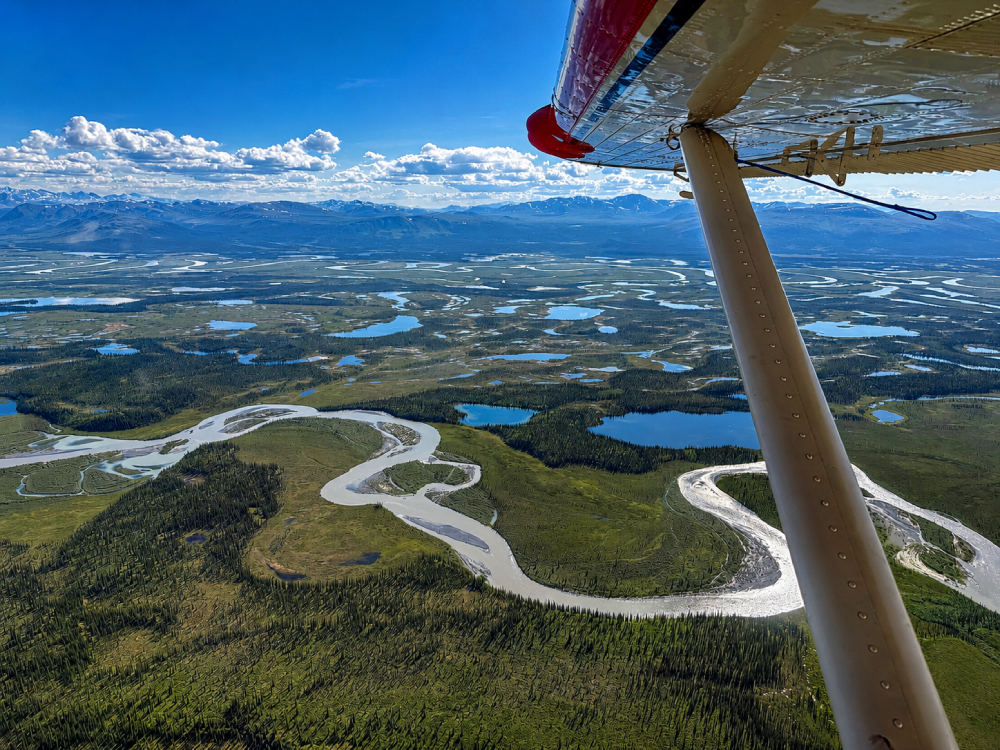
The Arctic National Wildlife Refuge is seen from the air. In June 2026, a group of faith leaders journeyed into the 19-million acre federally protected reserve in northeastern Alaska to call attention to the region's biodiversity and need for renewed protections. (Courtesy of Andrew Black)

Join the Conversation
Send your thoughts to Letters to the Editor. Learn more
Upon returning home from her journey to the Alaskan Arctic, Franciscan Sr. Joan Brown remained in awe of a vast and remote land she saw teeming with life.
New wildflowers and miniature trees burst through the permafrost as gray mountains towered above. Peregrine falcons and songbirds flew overhead. Rivers ebbed from trickling to roaring as glacier melt fed new water. Visible far off in the distance was the Arctic Ocean. On the last day, caribou walked through the campsite. Throughout the trip, in late June, sunlight shone at all hours of the day.
"It's just so vast and quiet and massive … just very amazing, very sacred place," said Brown, a longtime environmental leader in the U.S. Catholic Church who at times was brought to tears by what she described as a "cathedral" of nature.
The abundance of life she witnessed over five days and five nights in the Arctic National Wildlife Refuge (ANWR) stands in sharp relief to portrayals of a barren, frozen tundra that often permeate debates in political corners about oil drilling in the 19-million acre federally protected reserve the size of South Carolina along the Beaufort Sea in Northeastern Alaska.
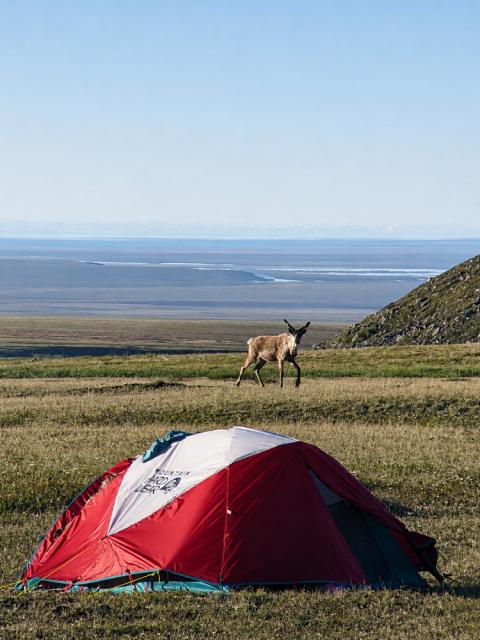
A Porcupine caribou walks near the faith leaders' campsite in the Arctic National Wildlife Refuge. (Courtesy of Andrew Black)
At a time when climate change and business pursuits pose ever-growing threats, it's that image that Brown and other faith leaders on the expedition hope to reframe — to reposition the Arctic in the minds of Americans as not just a place worth preserving, but one essential to life and ecosystems across the country.
"Why the Arctic is really critical for people of faith is that it's one of the few places left on Earth that is truly untouched since God created it. I mean, it's an expansive landscape of mountains and prairies and valleys," said the Rev. Andrew Black, a Presbyterian minister and founder of EarthKeepers 360, a group that works to educate and activate faith leaders on environmental issues.
"This trip is fundamentally about reawakening the soul of America to how important the Arctic is from a biodiversity, climate and spiritual perspective."
A journey north begins
The faith leaders' journey to the Arctic was organized by EarthKeepers 360 and the American Lands Project, a conservation organization that works to connect policymakers and other groups with public lands and waters. In the past, it has arranged Arctic visits for elected officials, journalists and hunters, but before June had not recruited a religious delegation.
American Lands Project connected with Black, who also serves as director of tribal lands and waters for the National Wildlife Federation. In 2016 he led a similar journey of 40 faith leaders to Utah to offer solidarity with Native Americans opposing efforts by the first Trump administration to drastically shrink the footprints of two national monuments, Bears Ears and Grand Staircase-Escalante.
The Arctic trip took place two weeks after the first of four drilling lease auctions along ANWR's Coastal Plain mandated by Congress as part of the 2025 One Big Beautiful Bill Act. According to the U.S. Geological Survey, an estimated 4.25 billion to 11.8 billion barrels of recoverable oil lies beneath the Coastal Plain.
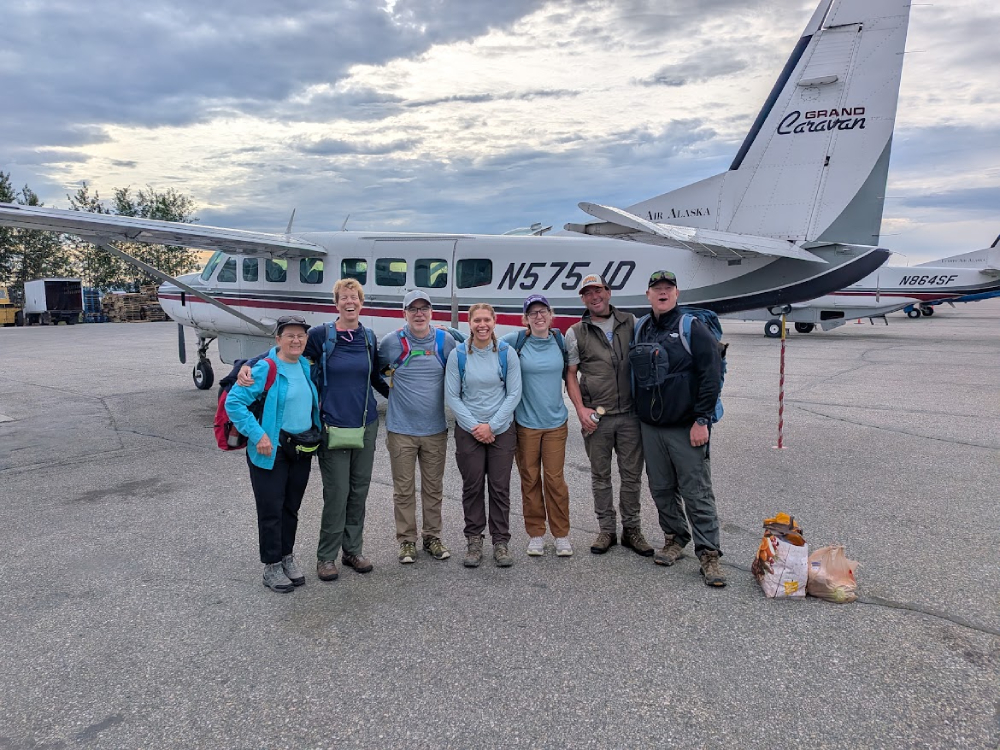
The faith expedition prepares to board a small passenger plane on their way to the Arctic National Wildlife Refuge in northeastern Alaska. (Courtesy of Joan Brown)
The timing was "a bit providential," Black said, as planning had begun in early 2026 before the auction date had been finalized.
"That was a little bit of the humbling reality to know that we were going to be heading to a place that was under very tangible threat in terms of development," he said.
The lease sales, which so far have drawn few bidders, are part of an aggressive push by the Trump administration to open more public lands and waters in Alaska and across the country to extraction and development. The president has also attempted to advance construction of two roads through Alaska's wildlife refuges and open the Coastal Plain's nearly 1.6 million acres to oil and gas drilling, reversing Biden-era protections.
Standing with the Gwich'in people, whose traditional homelands encompass the national refuge, and other Alaskan Natives opposed to drilling and development was a leading motivation for the trip, Black said.
"We go to witness, to learn, to pray in this sacred place, but also to gain understanding and to stand alongside the Gwich'in, who are working to protect a place that has enormous beauty and spiritual significance to that tribal community," he said.
As he planned the trip, Black reached out to Brown, with whom he often collaborated on environmental issues in New Mexico. As founder and longtime director of New Mexico Interfaith Power and Light, Brown often advocated against mining projects that threatened the land and communities, including Native Americans, in the state's Permian Basin. In those struggles she saw parallels to the challenges faced by Alaskan Natives in the Arctic.
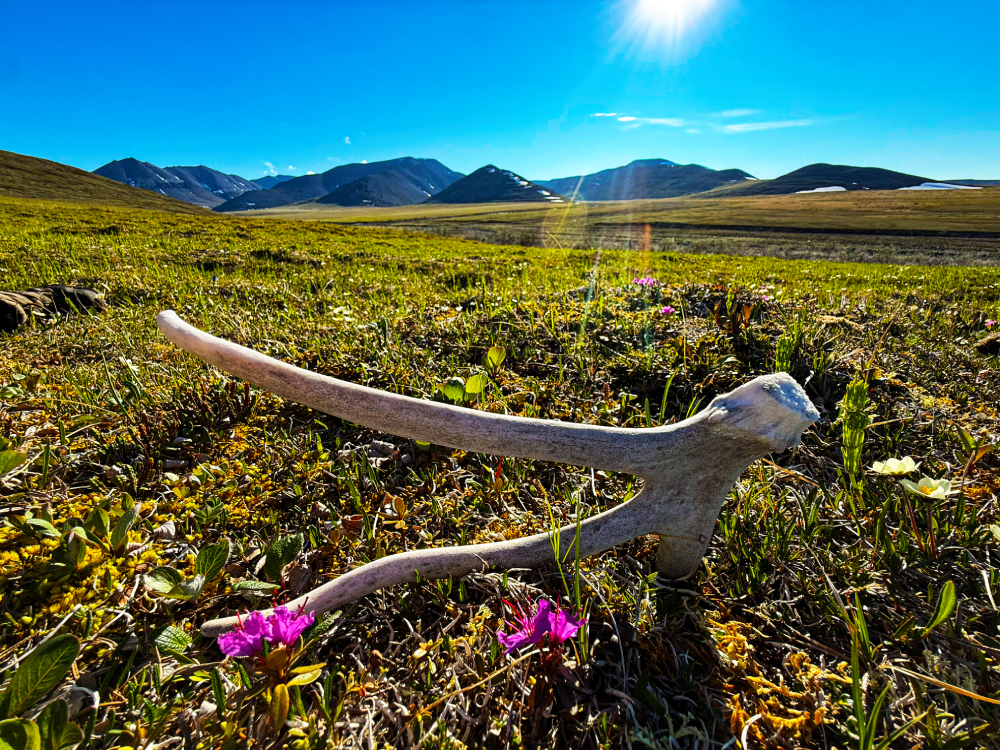
A caribou antler is seen in the Arctic National Wildlife Refuge in June 2026. The Porcupine caribou herd, counting upwards of 100,000, undertakes the longest North American land mammal migration as it travels 1,500 miles from the Porcupine River in Canada to the refuge, home to its calving grounds. (Courtesy of Andrew Black)
In all, five faith leaders joined the trip, along with a guide and an American Lands Project representative. Departing from Fairbanks in southern Alaska, their journey would take several hours and multiple flights in small planes with seating for less than 10 people each. For Brown, the oldest of the group at 73 and no fan of flying, it meant time in prayer with God and her religious order's founders, St. Francis and St. Clare of Assisi.
"And a good pilot."
A 'keystone' for life on earth
The faith expedition flew first to the Arctic Village, a Gwich’in town on the outskirts of the refuge. From there, they divided into smaller planes to travel over the Brooks Range to Sunset Pass, a valley at the northernmost end of the Sadlerochit Mountains where they set up camp overlooking the coastal plain.
Mornings began with prayers and reflection, which also closed some evenings. In between, they hiked together each day. Beyond that, there was little agenda.
"I had no goals in going there, other than just to listen and be present," Brown said.
As a Franciscan, what she heard from Sister Mother Earth was, as the Gwi'chin people hold, this was a sacred place where life often begins.
Their campsite was not far from the calving grounds for the herd of 100,000 Porcupine caribou. More than 200 bird species, many of which fill backyards and churchyards across the lower 48 states, migrate to the refuge each year. Even mosquitoes, often viewed as pests, serve a central purpose, in prompting the caribou herds to move and by providing a food source for the migrating birds, including the sandhill cranes Brown sees flying in the skies of New Mexico.
"[It is] one of the keystone places for life on the planet," she said," and we just don't have a sense of that and that sacredness and the balance and our need for that place."
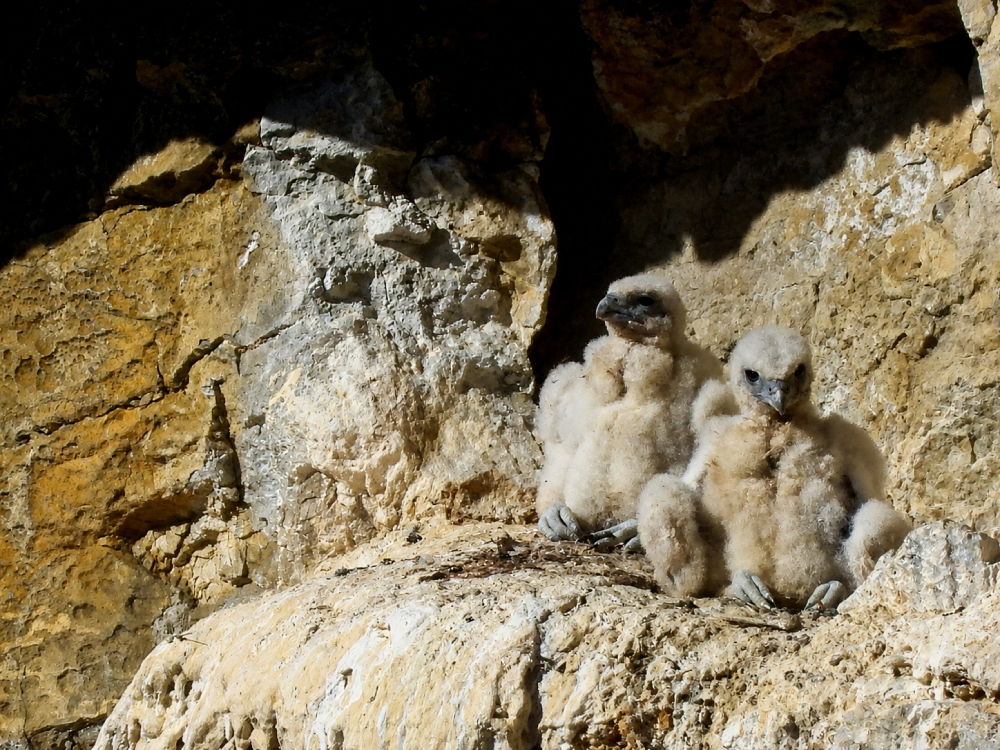
Two Peregrine falcon eyases (babies) perch on a cliff inside the Arctic National Wildlife Refuge. (Courtesy of Andrew Black)
The Arctic is warming two to four times faster than the rest of the planet, according to the National Oceanic and Atmospheric Administration. Its 2025 Arctic Report Card found last year was the region's hottest and wettest on record. In Alaska, glaciers have lost 125 vertical feet of ice on average since the mid-20th century, while thawing permafrost in 200-plus watersheds have led to "rusting rivers" where toxic metals turn streams orange and threaten water quality and biodiversity.
In addition, Alaska's snow season has shrunk roughly two weeks in recent decades, a finding in a 2024 report on Alaska's changing environment by the Alaska Center for Climate Assessment and Preparedness at the University of Alaska-Fairbanks. Rain in winter has become more frequent, which when it freezes can make roads more dangerous, hinder moose movement and trap vegetation for animals under ice.
During their time in the Arctic, the faith leaders conversed about what it means for a place to be a refuge (ANWR being the nation's largest) and how it relates to scriptural references to God as a refuge and Jesus' parable of the Good Samaritan.
They also met with Gwich'in communities to understand their spiritual connections to this place, which begins with the caribou. Traditional stories, like "Dinjii Vadzaih Dhidlit" ("The Man Who Became a Caribou") remind them humans are not above other animals, and their deep respect for the land, guided by prayer, has ensured the health of fish, caribou herds and plants in the Arctic refuge for generations.
In an email, the Gwich'in Steering Committee welcomed the support of people of faith in the coalition to protect their homelands. "We hope that seeing these lands and waters in person helps people feel a deeper spiritual connection and understanding of how we are all connected through the Arctic," they said.
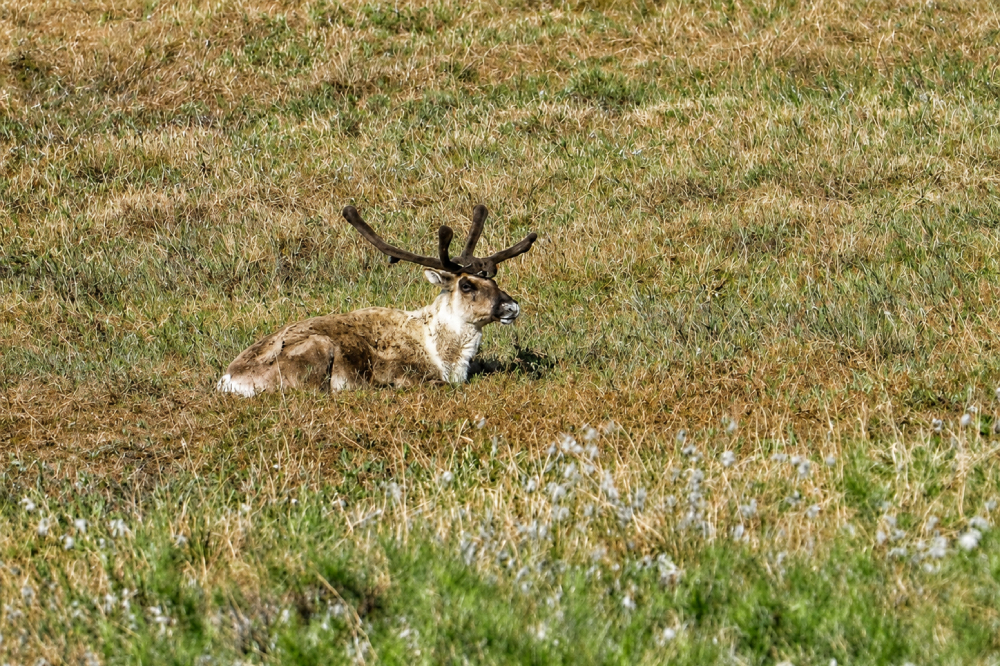
A Porcupine caribou lounges in the grasses inside the Arctic National Wildlife Refuge. (Courtesy of Andrew Black)
They told the faith leaders too how seasons have undergone dramatic changes. They pointed out indentations where lakes have disappeared as water drained due to melting permafrost. That releases methane, a potent greenhouse gas, trapped in the ice, triggering a feedback loop that accelerates warming.
Returning to the caribou, Gwich'in leaders described how a period of extreme cold this winter delayed their birthing period, which requires snow to melt to find food in their calving grounds. The herds have dwindled over time, as have other species.
"Their life depends on the caribou, for their culture, their spirituality, for food source, for identity, that they would not be a people if they did not have the caribou," Brown said.
On the last day of the trip, Black hiked off alone into the northern foothills of the Brooks Range and prayed in the silence and solitude. In that time, he realized he too had been guilty of an extractivist mindset toward the Arctic, seeking out a memory to take home when God was calling him to simply be in relationship with the land.
As he came to that realization, two caribou appeared, the first he had encountered on the trip.
"I found a oneness with creation and an expansiveness in my soul that I didn't even know I had, being in that moment," he said.
Expanding Arctic concern
After five days on the tundra and under eternal sunlight, the faith leaders returned home, committed to share their experiences and educate about one of the country's most critical biomes.
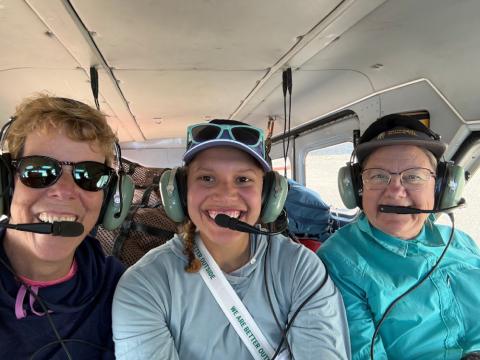
From left, Presbyterian Rev. Courtenay Willcox, Susie Faria, and Franciscan Sr. Joan Brown, aboard a plane on the way to the Arctic National Wildlife Refuge. (Courtesy of Joan Brown)
For Brown, she plans to use her experience in the Arctic to educate more people about the region and encourage them to join advocacy campaigns to ensure its protection. One focus is opposing a proposal to allow the Bureau of Land Management to waive environmental reviews for oil and gas projects in the Western Arctic. It's similar to an effort in her home state of New Mexico around drilling in the Permian Basin.
She intends to connect with her Franciscan community as well as other religious congregations.
"We need to move our heart and our spirit to collectively work together. It's not a cerebral or a mind or a factual kind of thing that's going to do it," Brown said.
The present threats to the Arctic Wildlife Refuge, and U.S. public lands more broadly, are unprecedented, said Andy Moderow, senior policy director with the Alaska Wilderness League, a national nonprofit that works on protections of the state's federal lands and waters.
"This administration's drive to privatize those lands, to develop them, to give them to multinational resource extraction companies over just allowing simple uses like hunting, fishing and access for wildlife migrations is really astounding," he said.
While the push under Trump to open up more public lands to mining has reached new heights, the pursuit of oil and valuable minerals underneath Alaska's land has persisted for decades. In 2023, President Joe Biden drew criticism from some supporters, as well as religious groups, for greenlighting the multibillion Willow oil drilling project along Alaska's North Slope in the state's National Petroleum Reserve. At the same time, he announced conservation protections in other parts of the state.
Advertisement
The threats facing the Arctic are not isolated to a remote part of Alaska, the Presbyterian minister Black said, pointing to places like Oak Flat in Arizona; the boundary waters in Minnesota; Chaco Canyon in New Mexico, and even Utah's Bears Ears and Grand Staircase-Escalante, which President Donald Trump has again attempted to shrink after Joe Biden reversed his previous effort.
"There's a bigger challenge right now within the American society around what does it mean to protect these sacred landscapes and to stand in solidarity with tribal and Indigenous communities," Black said.
Reflecting on her message to government officials following her week in the Arctic, Brown said she would ask them to connect them to this place, this keystone place on the planet, just as she did among the songbirds, the sprouting wildflowers and endless sunshine.
"What are their souls saying to them? Are the souls saying, 'Oh, we need to drill, we need to make more money, make more money,' or is there a different purpose why you have been put on this planet?"