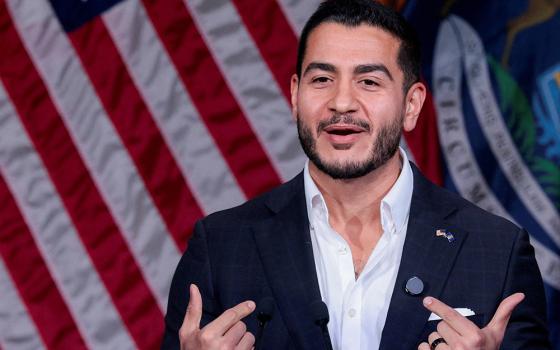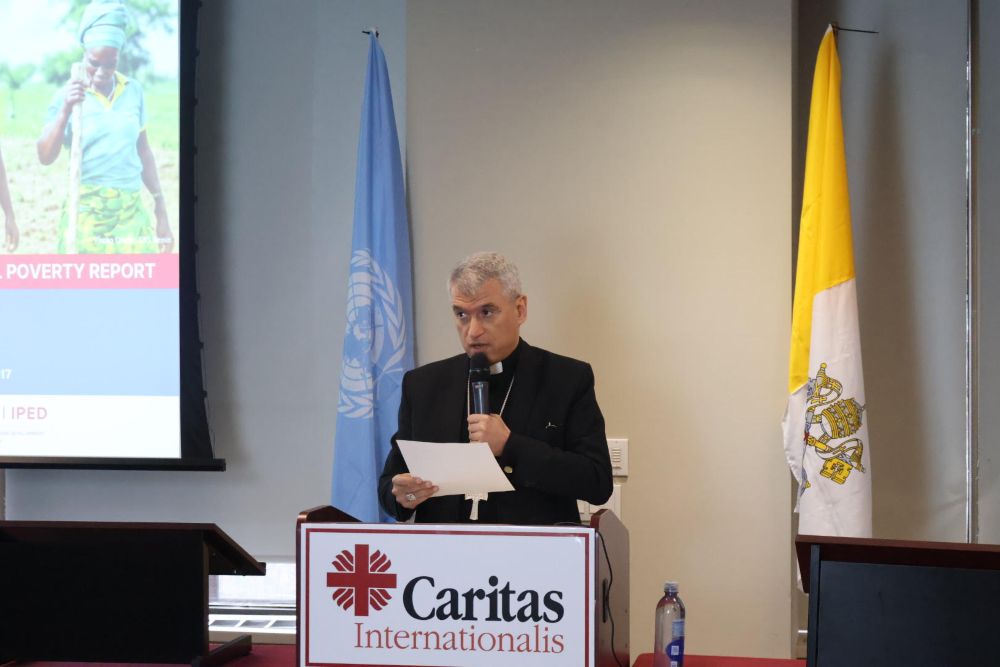
Archbishop Christophe-Zakhia el-Kassis, the Vatican's permanent observer to the United Nations in New York, speaks at an event Nov. 13 marking the release of Fordham's Pope Francis Global Poverty Report for 2026. (Courtesy of Henry Schwalbenberg)

Join the Conversation
Send your thoughts to Letters to the Editor. Learn more
The world's recovery from the poverty setbacks of the COVID-19 pandemic appears to be losing ground, according to Fordham University's 2026 Pope Francis Global Poverty Report, which also warns of a sharp decline in international development assistance.
The report was released Nov. 13, ahead of the Catholic Church's Nov. 15 observation of the 10th annual World Day of the Poor.
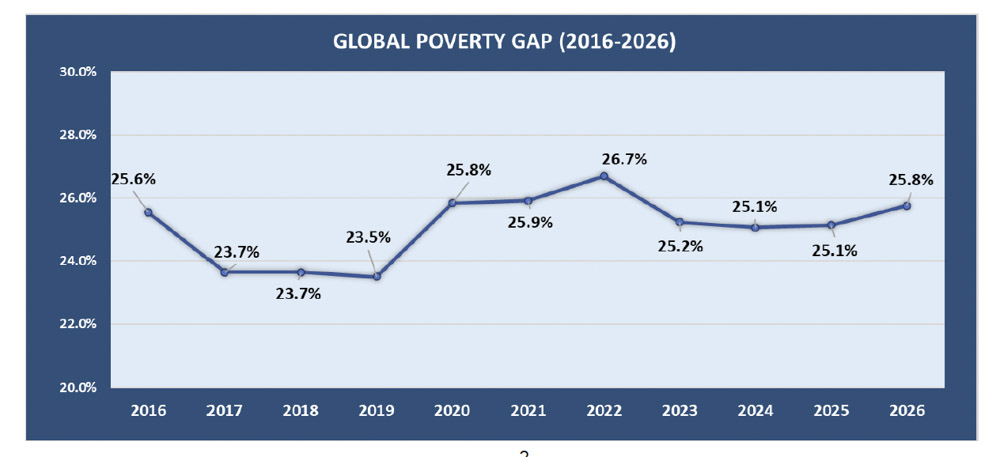
The report's global poverty gap — the global average of the relevant world population that lacks access to the seven basic human needs fundamental to human dignity — reached 25.8% in 2025, up from 25.1% in the previous edition. The increase of 0.7 percentage points follows a period of improvement after the pandemic, suggesting that the recovery may now be reversing.
"It should be going down instead of going up," said Henry Schwalbenberg, a Fordham economics professor and editor of the report, in an interview with the National Catholic Reporter. He cautioned that one year's movement is not enough to establish a lasting trend. "It could go either way next year," he said.
Inspired by Pope Francis' 2015 address to the United Nations, the annual Fordham measure goes beyond income and examines whether people can meet seven basic needs: water, food, housing and decent employment, as well as education, gender equity and religious freedom. This is the third year the university has issued this report.
The global poverty gap is the average share of people lacking access across these seven categories. It does not mean that 25.8% of the world's population is poor, since the categories cover different populations and may overlap.
The index also traces the impact of COVID-19. Its global gap reached 26.7% in 2022, then dropped to 25.2% in 2023 and 25.1% in 2024, before remaining unchanged in 2025.
A mixed picture of basic needs
The latest figures — based on the most recently available data for 2025 — show modest advances in some areas, but major deprivation remains widespread. In 2024, about 696 million people, or 8.5% of the world's population, lacked basic access to drinking water from an improved source within a 30-minute collection trip. Access has gradually improved over the past decade, although the greatest shortfalls remain concentrated in sub-Saharan Africa.
Food presents a more difficult picture. In 2023, the latest year used in the report, about 688 million people, also 8.5% of the global population, were undernourished. The report found only a small recent improvement after several years of rising hunger. Haiti had the highest reported prevalence of undernourishment, followed by Somalia.
Housing remains another serious challenge. About 1.3 billion people, or 16.1% of the global population, lived in inadequate housing in 2024, according to the report's estimates. Such housing can have floors made of earth or dung, or roofs and walls made from inadequate materials. Researchers warn that changes in measurement make long-term comparisons difficult.
The employment picture is somewhat brighter. The report estimates that 711 million people, representing 18.8% of the world's labor force in 2025, were unemployed or earned less than $4.20 a day, after adjusting for differences in living costs across countries. This marked a slight improvement from 2024, when 19.2% of the global labor force was in the same situation, a decrease of 0.4 percentage points. Employment has recovered from the pandemic shock, although the pace of improvement has slowed, the report shows.
But progress on basic education has been limited, according to the new available figures. In 2024, about 753 million adults, or 12.3% of the adult population, were unable to read, write or understand a simple statement about everyday life.
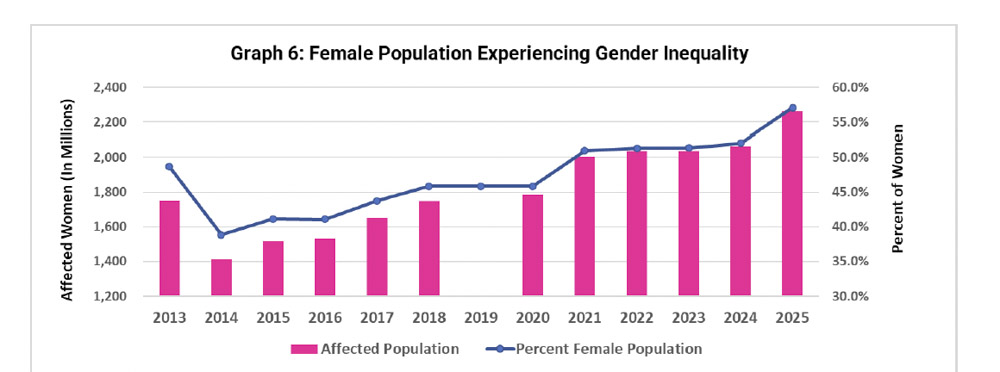
The sharpest setback concerns gender equity. In 2025, an estimated 57.1% of women and girls worldwide –– approximately 2.3 billion –– lived in countries with severe gaps in women's health and survival, compared with 51.3% in the previous scorecard. The measure considers factors including healthy life expectancy and the ratio of girls to boys at birth.
Religious freedom is also a major concern. The report estimates that 59% of the world's population, about 4.7 billion people, lived in countries with severe government restrictions on religion. But that figure is based on 2022 data, so its lack of movement this year should not be read as evidence that conditions have stayed the same, Schwalbenberg said.
Foreign aid under pressure
For the first time, the report includes a section on international aid, reflecting growing concern about whether wealthy countries will continue supporting poorer nations.
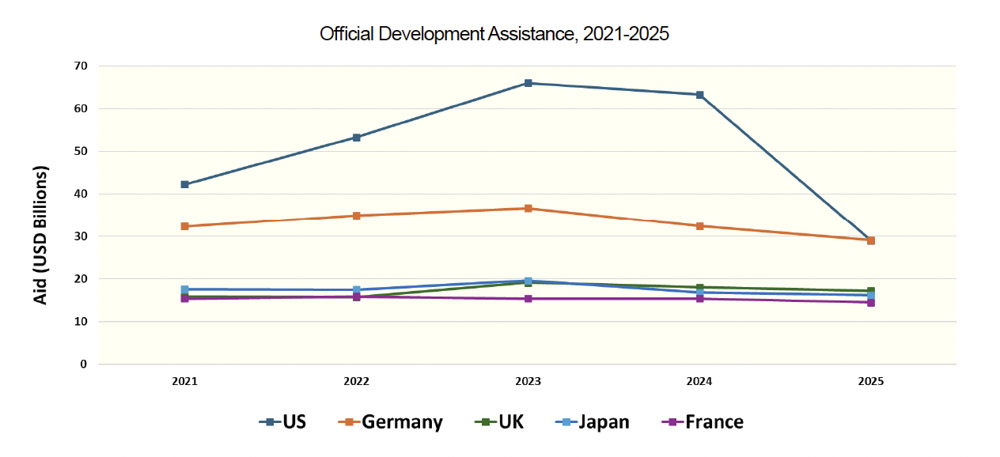
Using figures from the Organization for Economic Cooperation and Development, Fordham reports that its member countries provided $174.3 billion in official development assistance in 2025. Germany became the largest contributor, with $29.1 billion, narrowly ahead of the United States at $29 billion. The United States contributed the equivalent of 0.1% of its gross national income, compared with Germany's 0.6%.
Schwalbenberg said that many donor governments had reduced assistance as military spending connected to the war in Ukraine grew. The U.S., however, stood out for the scale of its cuts, which he described as roughly halving American aid in 2025.
He linked the disruption to the Trump administration's dismantling of the U.S. Agency for International Development, or USAID. With aid responsibilities now moving to other federal departments, Schwalbenberg hopes that the flow of assistance may improve, though he does not expect a return to previous levels.
Advertisement
Catholic organizations remain a vital force in the fight against global poverty and inequality, even as cuts to international aid threaten their work, he said. Schwalbenberg said their greatest contribution is their determination to continue serving vulnerable communities despite financial difficulties.
"They didn't pack up their bags and give up and go home. They're still there. They're still in the field," he said. Catholic humanitarian organizations have been seeking alternative funding from businesses, governments and United Nations agencies to compensate for lost assistance. Although these efforts have not fully covered the shortfall and many organizations have had to lay off staff, Schwalbenberg emphasized that they remain active and committed to their missions.
Despite these challenges, he still sees reasons for cautious optimism. Recalling a recent visit with his students to Catholic Relief Services offices, he said there was a noticeable change in the atmosphere compared with the previous year. "This year, no more doom, just gloom," he said, suggesting that the situation remains difficult but is no longer as desperate as it once seemed.
"There's still a foundation to build on," he said.
The report places its findings in the context of Pope Leo XIV's appeals for international cooperation. Its foreword quotes the pope's view that development is "both a duty and a right," and that people need the means to flourish without being trapped in dependence.
Archbishop Christophe-Zakhia el-Kassis, the Vatican's permanent observer to the United Nations in New York, attended the Nov. 13 report release event and praised the project. "Your collaboration unites scholarship, service and international dialogue in common cause that people living in poverty receive the attention, respect and opportunities that human dignity demand," he said at the event.
El-Kassis noted that Leo focused his World Day of the Poor message on Psalm 14: "The Lord is the refuge of the poor."
"The Holy Father asked us to draw close enough to listen, to learn people's names and to recognize their hopes," he said. "He also reminds us that the poor are not merely recipients of care. They have gifts to offer and their experience should inform the decisions that affect us all."
This article is supported by The Bertelsen Fund for Excellence in Catholic Journalism.