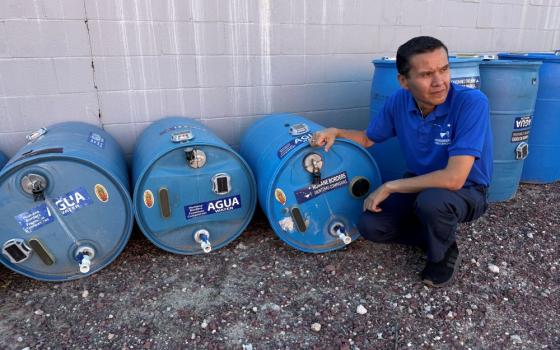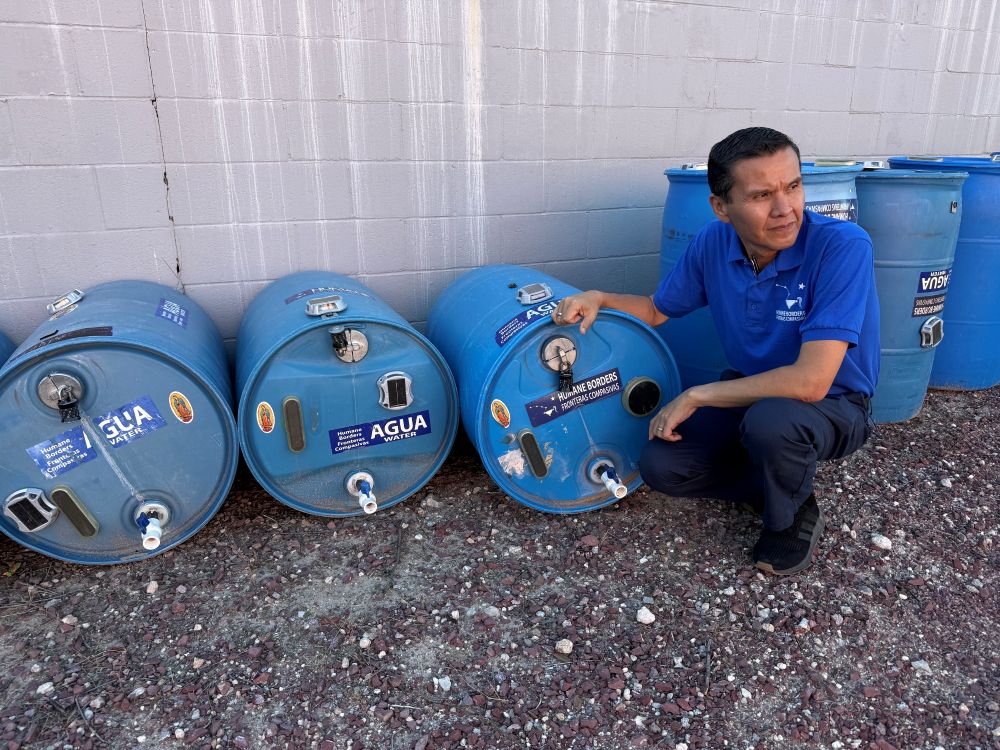
Octavio Fuentes, executive director of Humane Borders, crouches on Nov. 4 alongside water stations the nonprofit is storing at its Tucson site. (Anita Snow)

by Anita Snow
Join the Conversation
Send your thoughts to Letters to the Editor. Learn more
Octavio Fuentes was an 8-year-old kid on a trip to Tijuana with his Mexican American family when he was floored by a slogan he saw on a banner hanging from the rafters of an event space.
"Si no vives para servir, no sirves para vivir," read the Spanish language quote, said to be a favorite quote of Mother Teresa of Calcutta. "If you don't live to serve, you don't serve to live."
"When I saw that as a child it just got baked into my brain," said Fuentes, who earlier this year became executive director of Humane Borders, a nonprofit in Tucson, Arizona, that maintains water stations for migrants in the desert. "It's kind of been a mantra throughout my life."
Fuentes said that call to serve has invigorated the Catholic faith of his childhood after the federal government forced the removal of nearly a third of the water stations Humane Borders has kept for migrants in Arizona's most arid, remote regions. Volunteers for the faith-based group also come from other traditions, including mainline Protestants and Jews.
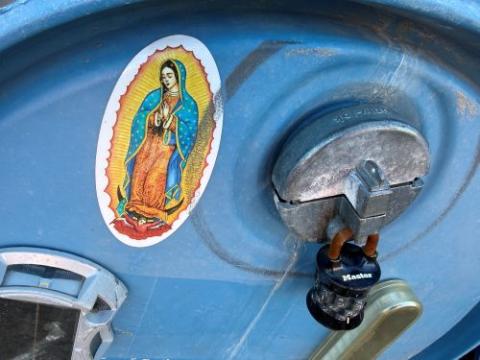
An image of the Virgin of Guadalupe, the patron saint of Mexico, is seen on a blue barrel in this Nov 4 photo taken in Tucson of water stations being stored by Humane Borders. (Anita Snow)
Fuentes said he has also been energized by Pope Leo XIV's advocacy for migrants as they are increasingly targeted for discrimination and mass deportation.
"We cannot grow accustomed to counting the dead," Leo said in June when he visited the Port of Arguineguin in Spain's Canary Islands. "Human dignity has no passport and does not lose its value when crossing a border."
In recent months, the U.S. Forest Service, Bureau of Land Management and Fish and Wildlife Service have refused to renew one-year permits for a dozen water stations required for their operation on federal land, ending a 25-year partnership with the humanitarian organization.
Humane Borders volunteers have since removed those 12 stations, including several on the rugged Organ Pipe Cactus National Monument that has been a popular border crossing area in recent decades. The remains of presumed migrants are often found in that area where temperatures soar into triple digits in the scorching summer.
President Donald Trump's administration defends the move.
"This decision addresses ongoing safety, resource protection, and law enforcement concerns associated with water stations near the international border," said a statement from the Department of the Interior, which oversees the three federal agencies that did not renew the permits.
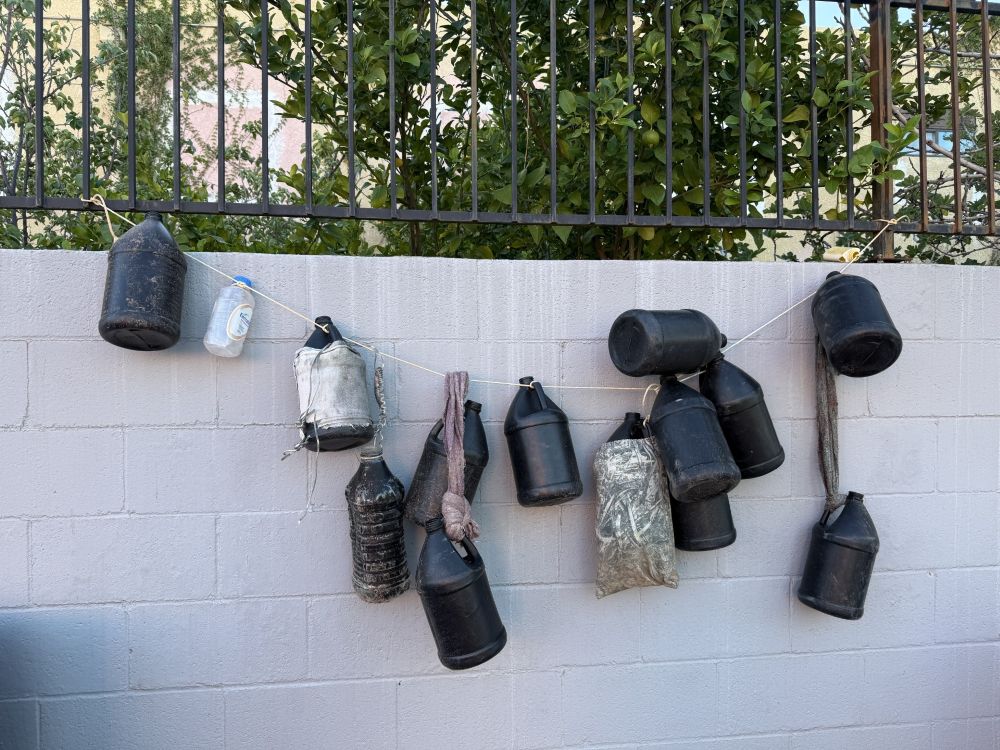
A collection of water bottles, many painted black by migrants to avoid detection in remote areas, hang on a wall in Tucson on Nov. 4 after being picked up in the desert by Humane Borders volunteers. (Anita Snow)
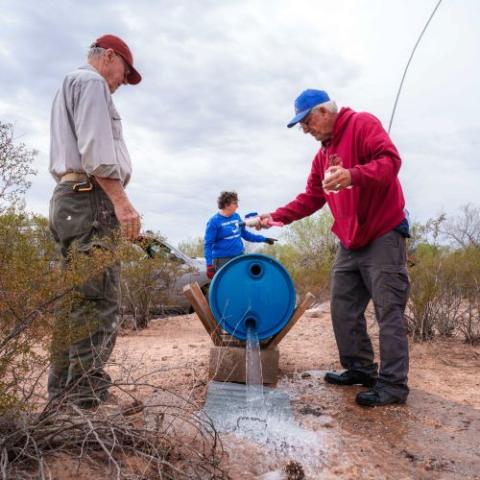
Another 28 of the original 40 stations still operate on private, local or state government land. Each station features one or more bright blue 55-gallon plastic water barrels and carries a compass, a solar-powered nightlight and the image of the Virgin of Guadalupe — the patron saint of Mexico. A 30-foot pole with a blue flag ensures each station is visible from afar.
Other nonprofit groups also store caches of bottled water, food and other supplies in remote areas for passing migrants.
Still, the bodies or skeletons of more than 100 suspected border crossers have been found in remote areas of the Arizona borderlands every year since 2010, according to a statistical summary from the Pima County Medical Examiner's Office in Tucson, which tracks the deaths in a mapping partnership with Humane Borders. Some 4,500 presumed migrants have died near Arizona's border with Mexico since 2000.
"Taking away water in the desert where deaths have occurred historically is a level of cruelty that is inhumane," Fuentes said.
A collection of water bottles, many painted black by migrants to avoid detection in remote areas, hang on a wall in Tucson on Nov. 4 after being picked up in the desert by Humane Borders volunteers. (Anita Snow)
Dr. Greg Hess said it has been the same story since he became Pima County's medical examiner more than two decades ago.
The remains are taken to his office for death investigations, then the staff works with foreign consulates to identify them and return them to their families, The medical examiner's office keeps in long-term storage hundreds of sets of unidentified skeletal remains, the majority believed to belong to migrants, in hopes they will eventually be identified as forensic techniques improve.
During the first 10 months of this year, 101 sets of human remains were discovered in the Arizona borderlands, the group said. That compares with 77 during the same period in 2025, during the initial push of the Trump administration's immigration crackdown that saw fewer people trying to come over the border.
The U.S. Border Patrol's Tucson Sector, which includes most of Arizona's border with Mexico, reported its agents encountered only about 16,000 migrants during the fiscal year that ended Sept. 30, a 96% drop from more than 460,000 encountered during the previous 12 months.
"You get years that are higher and years that are lower," Hess said of the deaths. "But the reasons that people come have not changed."
Advertisement
Fuentes said Humane Borders is looking into whether there are additional locations on private and local government land where some of the stations that were removed can be placed. The organization also plans to apply for permits at the original sites in the future.
"We are not out of the game," he said. "We continue to adapt and overcome."
Fuentes blames the desert deaths on decades-old U.S. immigration policies that use heavy-handed enforcement that aims to deter people from crossing, but simply pushes them to cross in more remote and dangerous areas.
"If you want the deaths to end, you have to deal with it at a policy level," Fuentes said. "Members of both parties, regardless of who sits in the executive and the legislature, continue to apply the policies that cause at least 100 deaths annually in Arizona alone."
"How has this been OK for decades?" he asked. "How are we OK with people dying in the desert?"