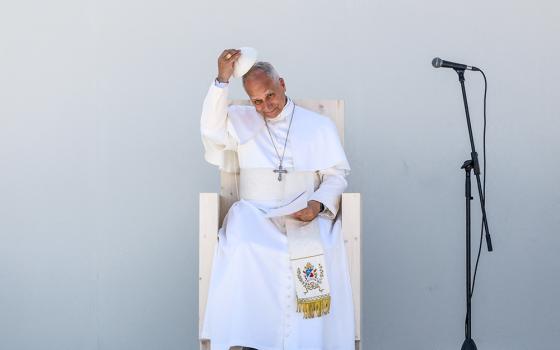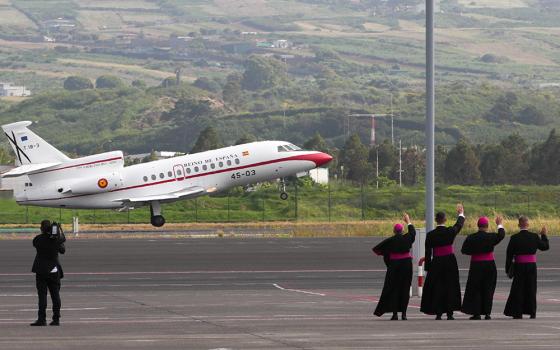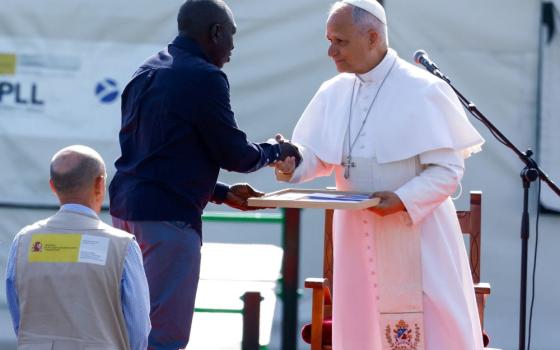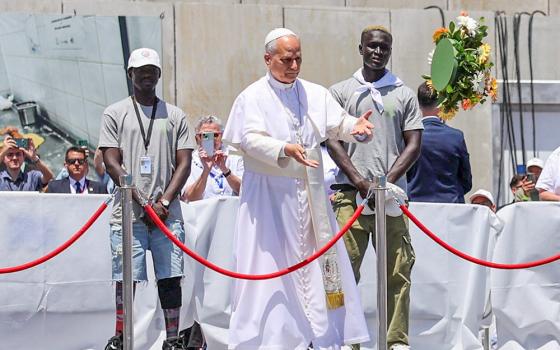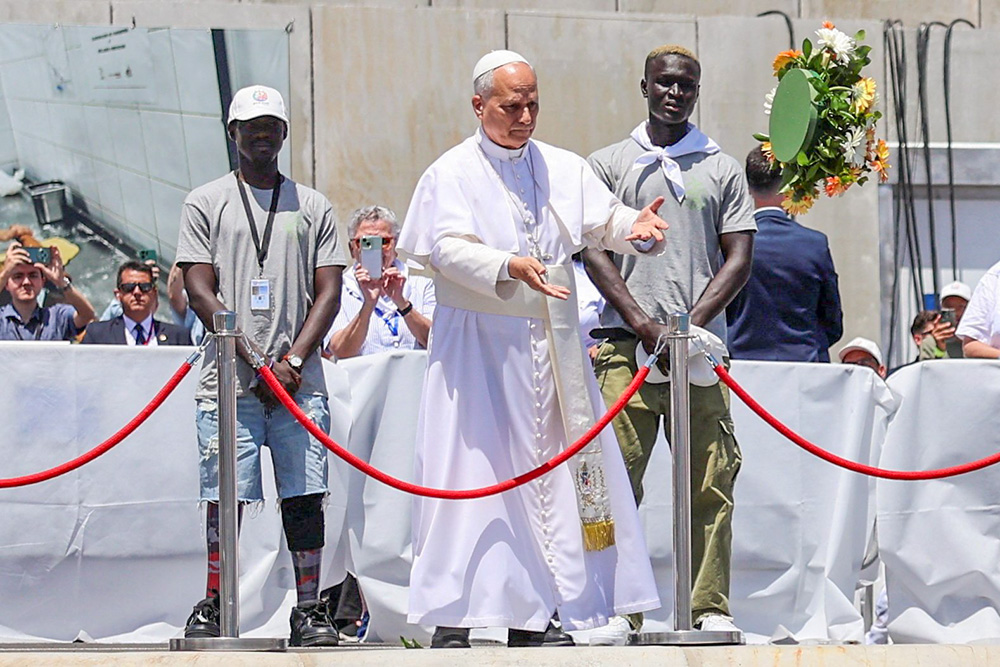
Pope Leo XIV makes a floral offering to migrants lost at sea at the dock of the Port of Arguineguin in Gran Canaria, Spain, June 11, 2026. (OSV News/Reuters/Yara Nardi)

Join the Conversation
Send your thoughts to Letters to the Editor. Learn more
Before a blue cross made from the wood of a shipwrecked boat, Pope Leo XIV stood at the port of one of Europe's deadliest migrant destinations and said the Catholic Church "cannot remain silent about those who are abandoned to its waters," condemning widespread indifference toward the plight of migrants.
The message of the Gospel "pulls us out of our comfortable position as spectators" and "asks us if we have recognized Christ in those who disembark, marked by fear, hunger and violence, after enduring the desert, the night and the sea," Leo said on the penultimate day of his trip through Spain during a visit to the island of Gran Canaria, realizing the long-desired dream of Pope Francis to visit the Canary Islands.
Leo spoke from the port of Arguineguín, dubbed the "dock of shame" by the Spanish press after some 2,700 migrants arrived there over three months in 2020 and were forced into squalid living conditions. There, the pope said the surrounding ocean's waters remain marked by "mafias that profit from despair, traffickers who enslave women and children, and those whose indifference allows the poor to be swallowed up by exploitation or forgetfulness."
In the first five months of this year, 1,317 people have lost their lives sailing toward Spain, according to a report from the Spanish nongovernmental organization Caminando Fronteras (Walking Borders), which tracks migration data. Of them, 635 perished en route to the Canary Islands, making the Atlantic route the most deadly for migrants seeking entry into Spain.
Recalling the scene of his predecessor's visit to the Italian island of Lampedusa in 2013, Leo, alongside two migrants, threw a bouquet of flowers into the port's water, which was followed by a minute of silence.
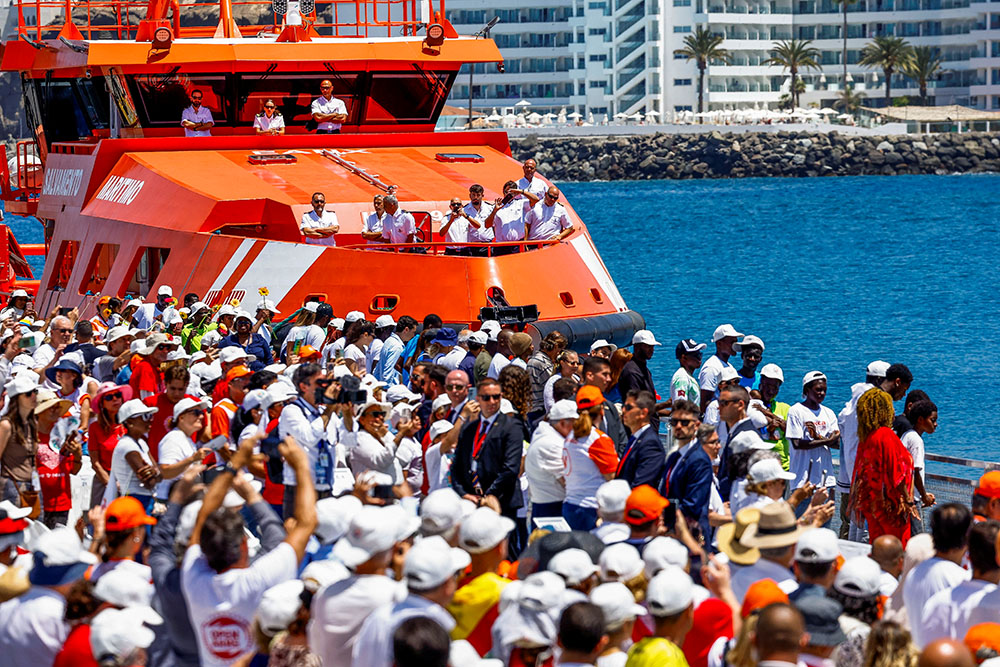
People gather as Pope Leo XIV (not pictured) makes a floral offering to migrants lost at sea at the dock of the Port of Arguineguin in Gran Canaria, Spain, June 11, 2026. (OSV News/Reuters/Borja Suarez)
Since Francis' Lampedusa moment in 2013, the number of international migrants has increased by 31%, totaling 304 million people in mid-2024, according to the latest available U.N. data. Yet governments across Europe and the United States have responded to that reality by enacting increasingly anti-immigrant policies.
Migrants have been the primary target of the Trump administration, which has touted mass deportation as the cornerstone of its political agenda and put up hurdles for foreigners to legally migrate and stay in the United States — policies that Leo has criticized as "inhuman."
It was against that backdrop that Leo opted to travel to the port of Canary Islands for the most forceful event of his pontificate dedicated to the topic of migration.
"It is not enough to manage arrivals, distribute statistics, reinforce borders or lament deaths after they have occurred," the pope said to applause from volunteers standing on a rescue boat docked in the port's harbor. "We cannot grow accustomed to counting the dead. Human dignity has no passport and does not lose its value when crossing a border."
Seated in the front row was Spanish Prime Minister Pedro Sánchez, who has bucked the trend among European leaders by publicly backing pro-immigrant policies.
Leo said that the tragedy of migrant deaths must appeal to the consciences of political leaders in migrants' countries of origins, transit nations and the governments of Europe, "which cannot claim to uphold human dignity while growing accustomed to the Mediterranean and the Atlantic becoming unmarked graves."
Advertisement
The pope also heard from people working with migrants on the islands, as well as the testimony of a Nigerian woman who could not attend for security reasons. In a statement read aloud, she described being brought to Spain by a mafia network, impregnated during the journey, separated from her child after giving birth and forced into prostitution to repay her debt.
Speaking directly to migrants, Leo said to "not surrender your lives to those who trade with them."
"You are not just numbers or files. You are people who have left behind families and homes. You have dreams that no one has the right to despise," he said.
The pope stressed that the church has a particular role to play in welcoming migrants, which he said "cannot be a secondary matter that is left to a few volunteers."
"The church cannot ignore these waters or any place where hunger, thirst, violence, fear or exile continue to wound human dignity," Leo said. "Jesus' disciples cannot dismiss the cries of those who call out in the night."
While Leo has spoken forcefully on immigration, his visit to Arguineguín is the first time he has visited a migration hotspot, and in Spain, which has become deeply polarized on the topic of migration, his words took on a special significance.
Leo will continue that theme on the final day of his seven-day trip, meeting organizations working to integrate migrants on the nearby island of Tenerife. In July, he will follow in the footsteps of Francis by visiting Lampedusa, the island that became synonymous with the late pope's outreach to migrants.
The National Catholic Reporter's Rome Bureau is made possible in part by the generosity of Joan and Bob McGrath.