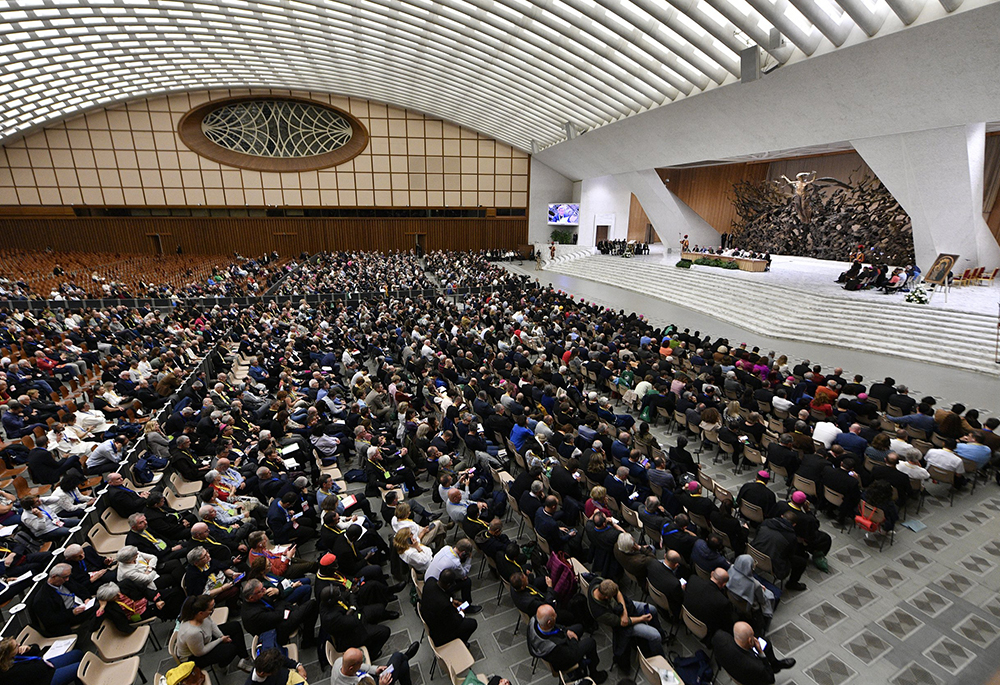
Pope Leo XIV, with regional representatives of synod teams, listens to and answers questions from participants in the Jubilee of Synodal Teams and Participatory Bodies in the Vatican audience hall Oct. 24, 2025. (CNS/Vatican Media)

by Michael J. O'Loughlin
NCR executive editor
Join the Conversation
Send your thoughts to Letters to the Editor. Learn more
Pope Leo XIV used his first speech the night of his election to state clearly that he intended to continue the synodal efforts initiated by his predecessor, Pope Francis. "We want to be a synodal church, a church that moves forward," Leo said to the crowd gathered in St. Peter's Square. Synodality, an effort at dialogue and co-responsibility between bishops and the laity, has become an integral part of Leo's papacy and the process will be on the front burner for at least another couple of years.
This style of consultative dialogue feels novel, a style of leading the church that received a jolt of energy from Pope Francis, who revitalized the synodal process back in 2014, when he encouraged Catholics to speak candidly about some of the most pressing issues facing families.
But the roots of synodality go back much further and even the issues that Francis highlighted weren't all that novel. A gathering that took place in Detroit 50 years ago this month was something of an antecedent to this moment, a moment in history when bishops, Catholic activists and ordinary laypeople engaged in dialogue about what today might still be considered some of the most fractious issues in the church.
Representatives from 150 U.S. Catholic dioceses and a number of Catholic advocacy groups met in Detroit in October 1976 for a conference meant to capture the mood of the church in the United States, called "A Call to Action: An Agenda for the Catholic Community." (This was distinct from the church reform group, Call to Action, which drew inspiration from the conference.) NCR reported on the conference, calling it "the first time lay persons of all types sat down with scholars, bishops and theologians to plan for the U.S. church's future."
According to another report from the Associated Press, about 849,000 Catholics took part in a consultative process ahead of the gathering, which coincided with the U.S. bicentennial. Francis J. Butler, then the executive director of National Conference of Catholic Bishops ad hoc committee for the bicentennial, told the AP ahead of the gathering that "concerns dealing with family life in America were dominant" in the consultations — as were issues that 50 years later still rise to the top in terms of concerns for many lay Catholics in the United States.
"Another concern deals with communication and decision-making in the church," said Butler to the AP at the time, who today is co-vice chair of NCR's board of directors. "They want to have a voice in the church. They want the church to be more responsive to their needs."
Advertisement
According to organizers, the yearslong effort sought to capture the "mind of the church" and to develop a five-year plan to guide bishops on issues related to social justice. "Subjects were church, ethnicity and race, family, humankind, nationhood, neighborhood, personhood and work," NCR reported.
Following days of deliberation and debate, attendees voted to recommend a number of changes in how the church conducted itself and seemingly nothing was off the table.
Mark Winiarski, who covered the event for NCR, wrote that attendees wanted "ordination of women, married priests, remarried divorced Catholics spared excommunication, determination of conscience in birth control, a national arbitration board to control the bishops, civil rights for gays." A separate report in The New York Times called the resolutions "controversial."
Many of the recommendations dovetailed nicely with existing priorities of the bishops, especially those around social justice. But delegates were unafraid to push the envelope.
On homosexuality, they recommended, "that the Church actively seek to serve the pastoral needs of those persons with a homosexual orientation, to root out those structures and attitudes which discriminate against homosexuals as persons and to join the struggle by homosexual men and women for their basic constitutional rights to employment, housing and immigration."
On women's ordination, that bishops create "a process which facilitates the formation of a more fully developed position on the ordination of women to sacred orders" and that the study of the topic include "lay and religious women, especially women who believe themselves called to the priesthood."
On contraception, that bishops "use their present pastoral leadership to affirm more clearly the right and responsibility of married people to form their own consciences and to discern what is morally appropriate within the context of their marriage."
And on divorce and remarriage, "that the Church leaders publicly address the request of the divorced who have remarried to receive, under certain conditions, the sacraments of the Church."
Cardinal John Dearden of Detroit chaired the project and at the conclusion of the conference, he seemed to understand that even if the recommendations were not taken up by bishops, simply holding the dialogue was an important step in responding to the needs of the laity.
"This process in which we have been engaged has been a marked success as a speaking and listening process," Dearden said. "We must struggle to continue this process of speaking and listening and find even more effective mechanisms for deliberation, decision, collaborative action."
The following May, as the Times reported, bishops established a goal for a five-year "plan of action" at their national gathering. They assigned the recommendations to a committee for further study and action. The more controversial recommendations were largely ignored and the following year, the socially conservative Pope John Paul II was elected to the papacy.
Fifty years later, Catholics are still engaged in similar debates about human sexuality, the role of women in the church and collaborative leadership, only this time on the heels of a papacy that encouraged these dialogues. It appears that Pope Leo, in his embrace of the synodal process, feels comfortable taking up Dearden's commendation for the church to continue seeking ways to listen, to deliberate and to collaborate. The next few years may offer clues as to whether A Call to Action has been revived and exists as more than an historical footnote in the life of the church.