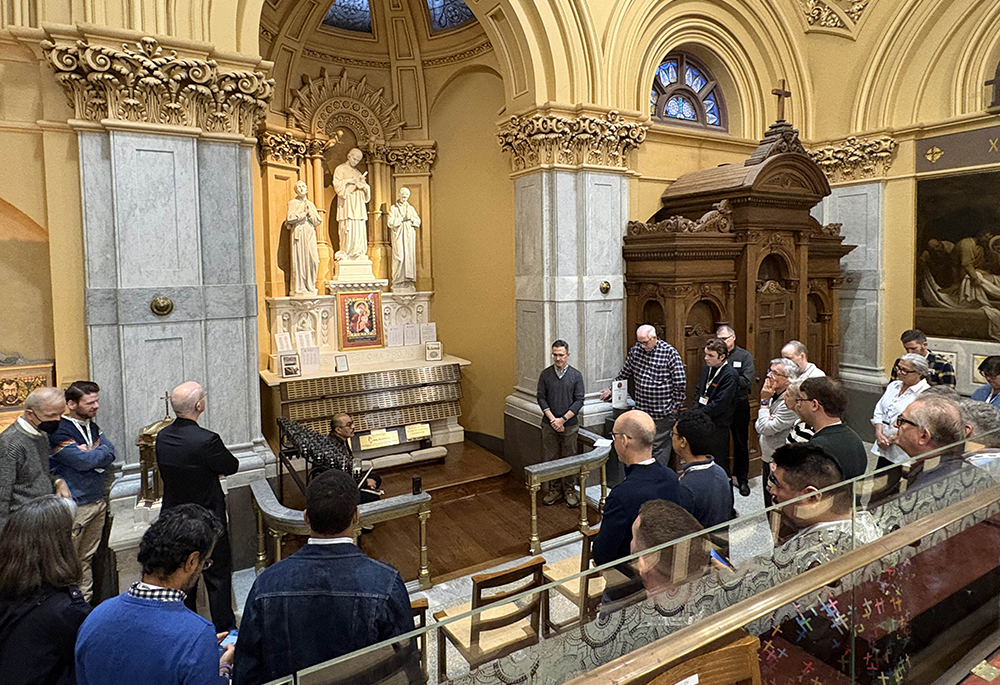
LGBTQ Catholics, clergy, religious, family members and other Catholic pilgrims pray at the altar dedicated to victims of HIV/AIDS at St. Francis Xavier Church in New York City, Sept. 26. (NCR photo/Camillo Barone)

Join the Conversation
Send your thoughts to Letters to the Editor. Learn more
For three days, a group of LGBTQ Catholics, clergy, religious, family members and others walked through New York City as pilgrims, tracing a history marked by suffering, ministry, exclusion and perseverance.
Organized by Outreach, the Catholic LGBTQ ministry founded by Jesuit Fr. James Martin, the Sept. 25-27 pilgrimage drew on the structure of the Easter triduum to reflect on the experience of LGBTQ Catholics in New York, with particular attention to the history of the HIV/AIDS crisis and the Catholic response to it.
The weekend began Friday with a welcome Mass, followed by a talk from Martin on the meaning of pilgrimage. On Saturday, participants gathered at the Church of St. Francis Xavier for a reflection on "Good Friday: The church in mourning," before walking a "Camino of LGBTQ sites" that included St. Veronica's Church with the Missionaries of Charity's center, the New York City AIDS Memorial at the former site of St. Vincent's Hospital and the historic Stonewall Inn.
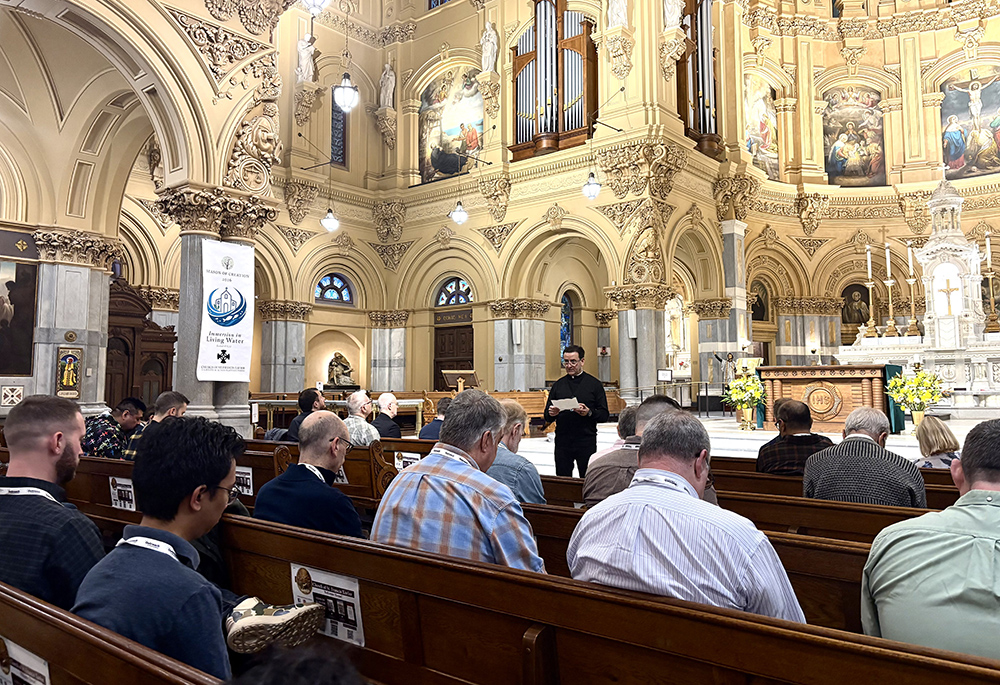
Catholic pilgrims, including LGBTQ Catholics, clergy, religious, family members and others, share a moment of reflection with St. Francis Xavier Church's pastor Jesuit Fr. Phil Florio in New York City, Sept. 26. (NCR photo/Camillo Barone)
Sr. Karen Helfenstein, a Sister of Charity who worked at St. Vincent's Hospital from 1983-2000, spoke during a session framed as "Holy Saturday: The church expectant." The day concluded at the Church of St. Paul the Apostle with an Outreach regional gathering centered on "Easter Sunday: The church triumphant."
Conor Reidy, Outreach's executive director, said the pilgrimage grew out of the organization's efforts to expand beyond its national conference and offer regional events around the country.
"There were just so many wonderful partners that we wanted to explore and elevate and lift up," Reidy said, explaining that the idea was to highlight "the incredible history of LGBTQ Catholic ministry in New York City throughout time, with an especial focus on the HIV/AIDS crisis."
That history became tangible during the Saturday walk.
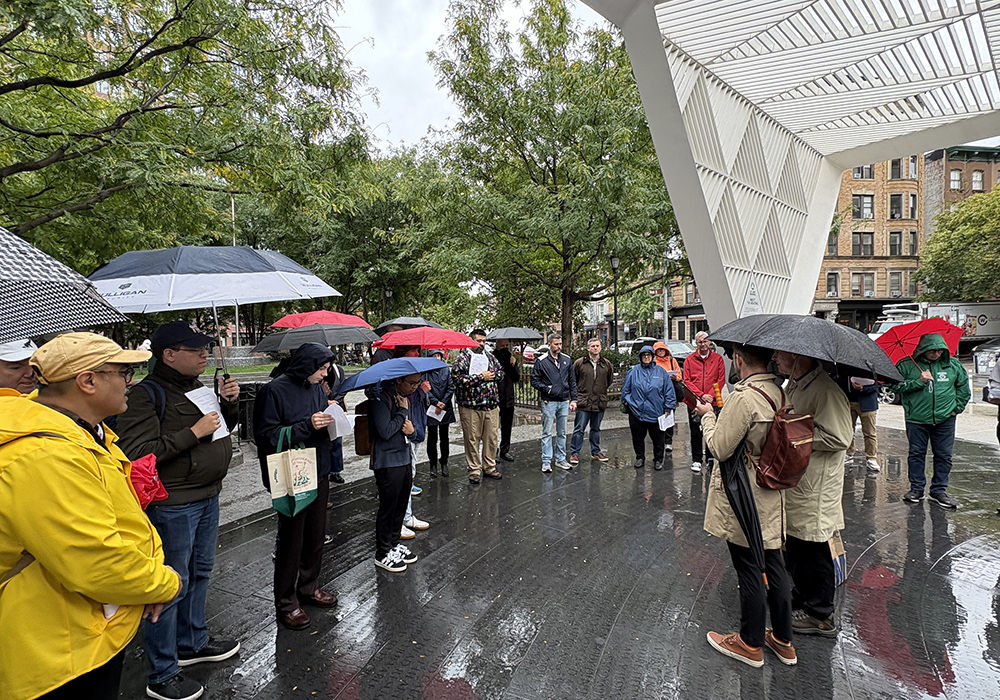
LGBTQ Catholics, clergy, religious, family members and other Catholic pilgrims pray at the New York City AIDS Memorial by the site of St. Vincent's Hospital run by the Sisters of Charity of New York, which was New York's first Catholic hospital and epicenter of HIV/AIDS treatment in the area, Sept. 26. (NCR photo/Camillo Barone)
At St. Francis Xavier, pilgrims heard about the parish's LGBTQ ministry and the history of Dignity, the Catholic LGBTQ organization whose local chapter once met there. At the AIDS Memorial, they reflected on the legacy of St. Vincent's Hospital, which became a major center of HIV/AIDS treatment in New York. And at Stonewall, they encountered another strand of LGBTQ history, outside the institutional church but only blocks away from the Catholic sites they had just visited.
For Ursuline Sr. Jeannie Humphries, the experience exposed how much of that history she had never known.
"As the time went on, I became very aware of how little knowledge I had had of the history in the '80s and early '90s," she said. "So, hearing how our brothers and sisters have suffered was very hard, but also hearing how many people have had to overcome such adversity and really be true to themselves and get in touch with who they were."
The pilgrimage brought together Catholics of different generations whose experiences of that history varied sharply. Kris Estrada, 21, a Filipino American Catholic who identifies as queer, was born long after the height of the AIDS crisis, but he told NCR that for him the weekend created a connection between a history he had not personally lived and the faith he is still learning how to inhabit.
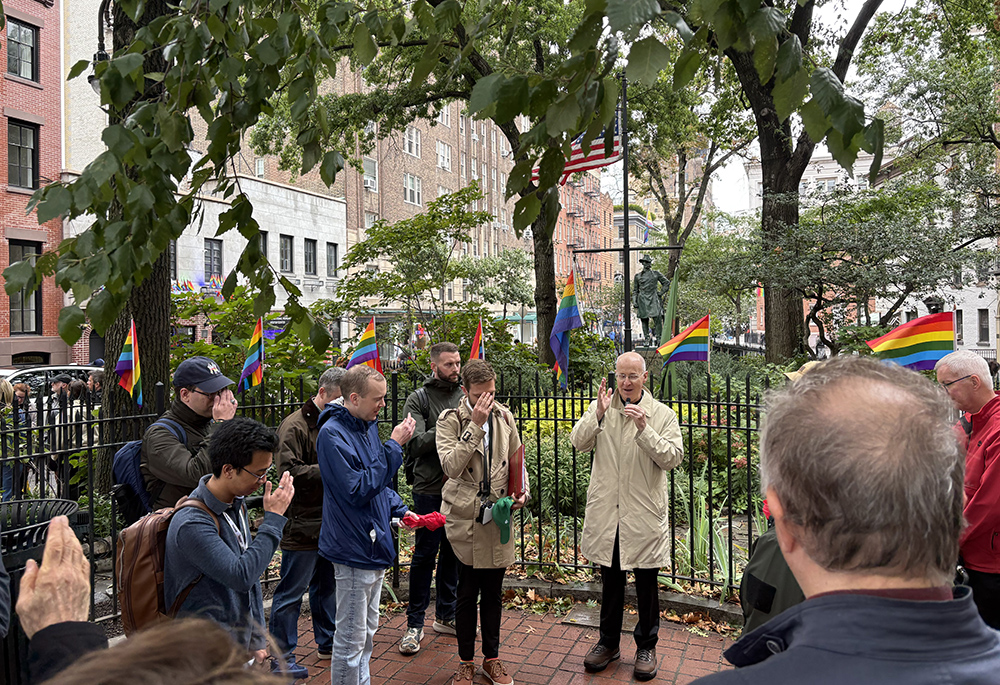
Jesuit Fr. James Martin blesses LGBTQ Catholics and other Catholic pilgrims during a moment of prayer and reflection Sept. 26 outside the Stonewall Inn, the historic bar considered the site of the start of the LGBTQ rights movement after riots in 1969. (NCR photo/Camillo Barone)
"What resonated with me the most in New York was learning the suffering of gay Catholics in New York City through the HIV/AIDS crisis, and how they persevered through that, just as how Jesus persevered through his passion," Estrada said.
Gene Cavallo, 61, came with a different memory. He was in college in the mid-1980s and remembers living through a period when AIDS and official Catholic teaching about homosexuality deeply shaped the lives of gay Catholics.
"I felt like this was a way to connect some parts of my life that were never really connected before," he said. "I dealt with a lot of that alone or with my partner."
Advertisement
For Fr. Daniel Serbicki, a priest of the Diocese of Buffalo, joining the pilgrimage was an opportunity to listen more closely to the Catholics in his parish.
"LGBTQ ministry is a very important part of the parish that I'm at right now, and so for me as a pastor, always trying to grow an understanding, trying to understand the people that I am serving, the people that I'm with, and try to be with them," he said. "This is just one way for me to be with the people that I'm serving."
Reidy said the weekend also held a deeply personal meaning. His work at Outreach, he said, has accompanied his own process of becoming more public about being part of the LGBTQ Catholic community.
"I think so much of my personal experience of being executive director here has been like a real faithful awakening," he said. Walking alongside parents of LGBTQ Catholics, he added, gives him a particular sense of connection to his own late parents.
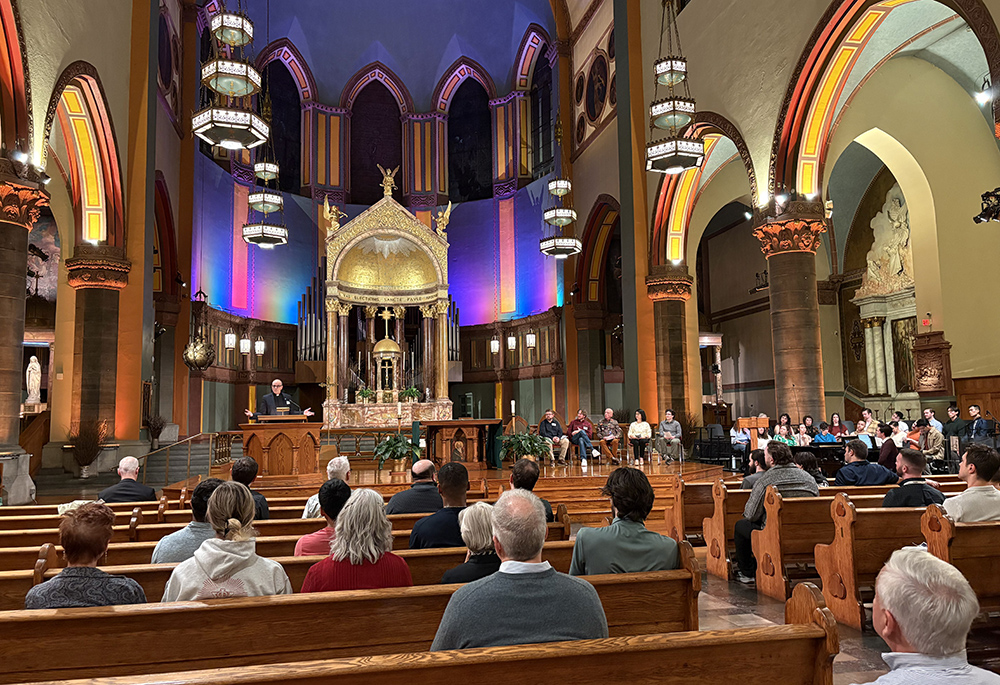
LGBTQ Catholics, clergy, religious, family members and other Catholic pilgrims gather for a final prayer and reflection vigil at the Church of Saint Paul the Apostle in New York City, Sept. 26. (NCR photo/Camillo Barone)
For Reidy, however, the pilgrimage was ultimately about emphasizing how LGBTQ Catholics have never been absent from the life of their church.
"LGBTQ Catholics have been a part of this church since its very inception 2,000 years ago," he said.
By Sunday, the pilgrims moved from the memory of Good Friday and the waiting of Holy Saturday to a final Mass at the Church of St. Ignatius Loyola, closing a weekend that had intentionally framed Catholic LGBTQ history through suffering, hope and resurrection.
For Humphries, after three days of listening to stories that she acknowledged she had largely not known, the lesson she carried away was a simple one, she said. "Everyone is a human being, and everyone deserves to be treated with dignity and love."