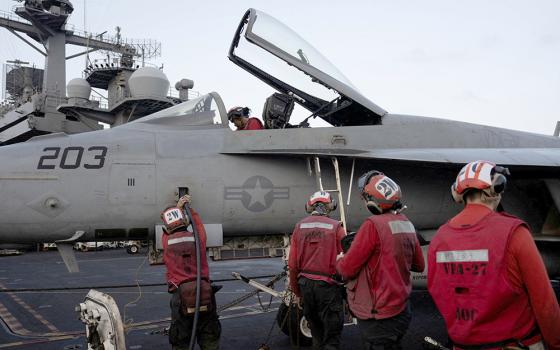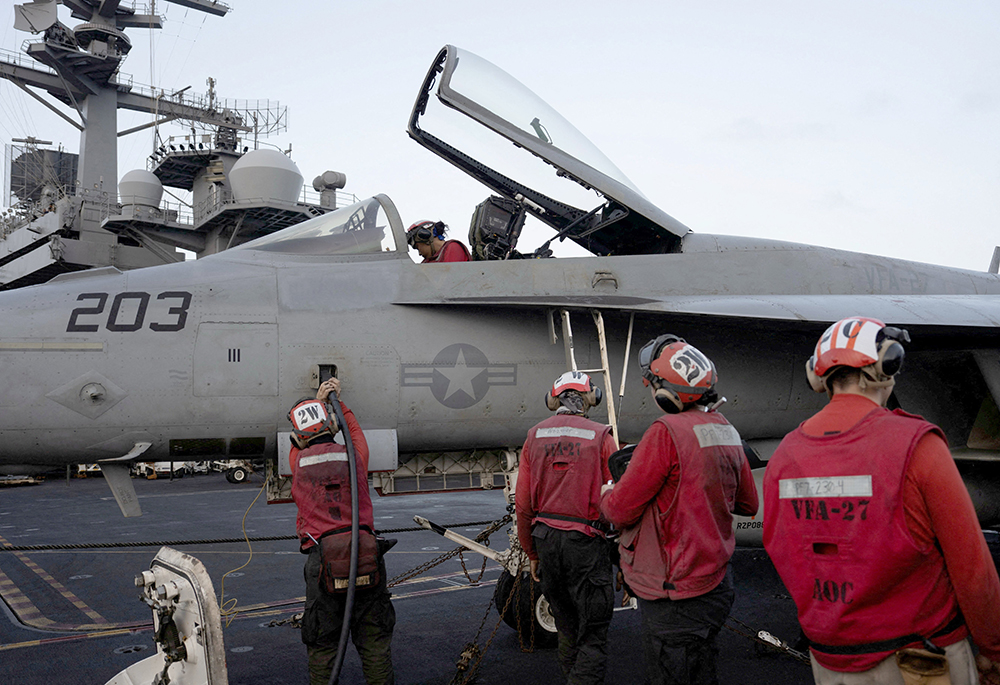
U.S. Navy sailors tend to a fighter jet on the flight deck of the USS George Washington in the Arabian Sea, Sept. 11, 2026. The aircraft carrier was enforcing a U.S. naval blockade against Iran and providing cover for commercial vessels transiting the Strait of Hormuz. (OSV News/Reuters/Ed Ou)

Join the Conversation
Send your thoughts to Letters to the Editor. Learn more
As U.S. Catholic bishops prepare for their November meeting in Baltimore, 83 Catholic theologians and educators are urging them to take a stronger, more unified public stand against the war with Iran and to promote Gospel nonviolence.
In a letter to members of the U.S. Conference of Catholic Bishops, the scholars ask the hierarchy to oppose renewed or expanded military operations, advocate diplomacy and humanitarian relief and help Catholics translate the church's teaching on peace into concrete action.
"More than seven months into this de-humanizing war, we respectfully ask you and your brother bishops to speak with still greater clarity, urgency, and unity against further warfare," the letter says, calling for "a compelling public witness to the nonviolence of the Gospels and ways of just peace."
The initiative was spearheaded by Kevin Ahern, professor and chair of religious studies at Manhattan University, and Eli McCarthy, a theologian at Georgetown University. Signatories come from Catholic institutions in the U.S. and abroad.
Ahern said the idea emerged from conversations among theologians associated with Pax Christi and the Catholic Nonviolence Initiative. As the conflict continued, he worried that public attention had shifted toward economic concerns while the human costs of war receded from view.
"We wanted to remind the church and remind our fellow academics that war is happening," Ahern told the National Catholic Reporter. The letter also shows gratitude and support to bishops who have already spoken out, he said.
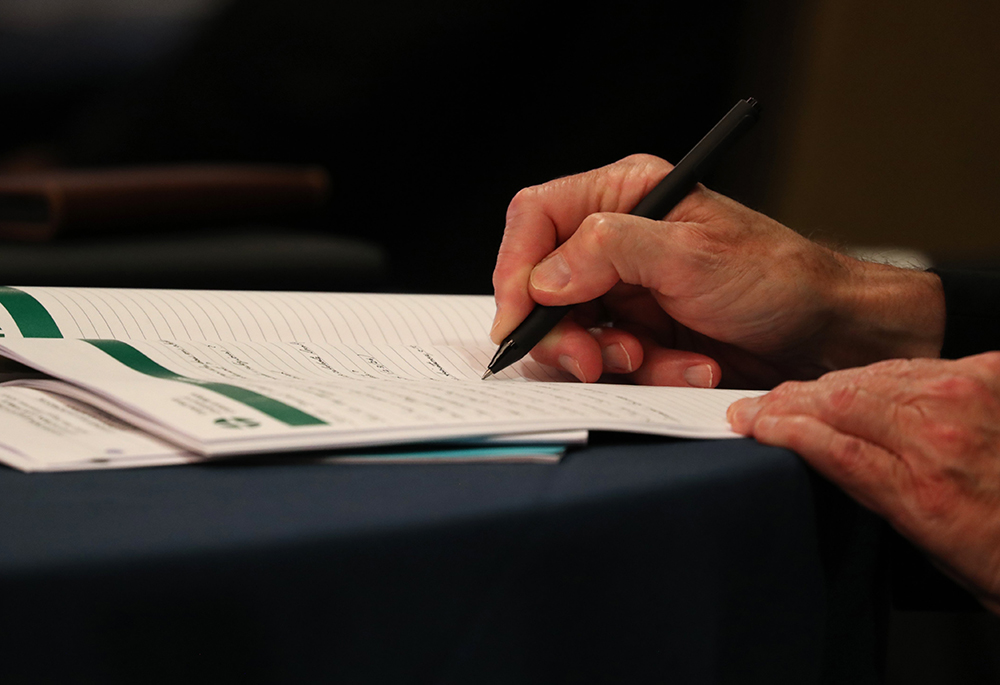
A bishop takes notes during a June 11, 2026, session of the annual spring meeting of the U.S. Conference of Catholic Bishops in Orlando, Florida. During their fall 2026 plenary assembly Nov. 16-19 in Baltimore, the U.S. bishops will vote for a new secretary and chairmen for six standing committees. (OSV News/Bob Roller)
The appeal comes ahead of the bishops' Nov. 16-19 fall plenary assembly in Baltimore. According to the bishops' preliminary release on the assembly, the bishops plan to discuss immigration, artificial intelligence and signs of renewed interest in Catholicism, alongside leadership elections and other conference business.
The bishops' assembly preview does not specifically identify Iran as a discussion item, although the conference has said it remains subject to change.
The theologians' letter expresses gratitude for prelates who opposed the war in its early stages and invokes Pope Leo XIV's condemnation of violence. It quotes the pope saying that a disciple of Christ "is never on the side of those who once wielded the sword and today drop bombs."
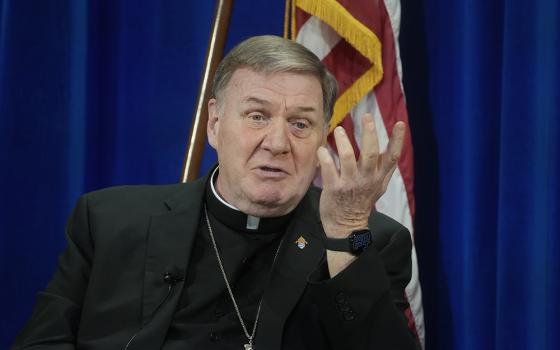
Oklahoma City Archbishop Paul Coakley, who is president of the U.S. bishops' conference, has appealed for de-escalation of the war. In April, responding to threats of intensified U.S. attacks on Iran, he called on President Donald Trump to "step back from the precipice of war and negotiate a just settlement for the sake of peace and before more lives are lost."
But the theologians want the bishops to go further. Their letter lays out 10 proposals, beginning with public opposition to any renewal or expansion of military action against Iran and to an expanded Pentagon budget. The letter urges the bishops to reject nuclear threats, insist on protection for all people and unrestricted access to humanitarian aid, and press elected officials to favor diplomacy, reconciliation and nuclear disarmament over arms sales and military escalation.
The scholars also ask bishops to challenge language that demonizes entire peoples and said they should promote the nonviolent example of Catholic Worker co-founder Dorothy Day, as well as strengthen education in restorative justice and unarmed civilian protection. The letter also calls for greater formation and attention on conscientious objection, including support for Catholics serving in the military as they discern whether orders violate their consciences.
One of the signers, Kathleen Bonnette of Georgetown University's Center on Faith and Justice, said the letter is fundamentally about the church's responsibility to teach what peacemaking requires.
Jesus' call, she told NCR, demands "not a bystander who avoids conflict, but actively resisting injustice through means that exemplify and embody the peace that we hope to achieve."
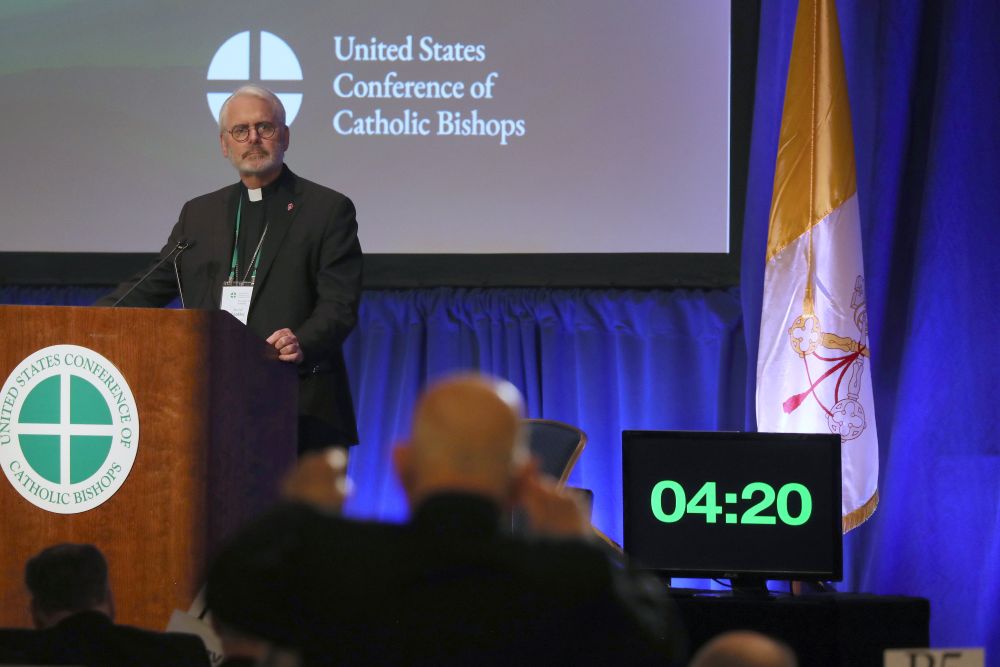
Archbishop Paul Coakley of Oklahoma City, now president of the U.S. Conference of Catholic Bishops, speaks during a Nov. 12, 2024, session of the fall general assembly of the USCCB in Baltimore. The bishops meet Nov. 16-19 in Baltimore. (OSV News/Bob Roller)
Bonnette said bishops must cultivate peacemakers, helping Catholics practice nonviolence rather than merely calling for an end to hostilities. "It's really about shifting the paradigm so that power and violence are no longer conflated," she said.
Kathryn Getek Soltis, director of Villanova University's Center for Peace and Justice Education, similarly sees the letter as an opportunity to amplify bishops' voices that have already challenged the war. She told NCR she hopes the bishops will give a clear voice to the "Gospel of nonviolence that we're called to enact."
Although the bishops' public statements may reach political leaders, Getek Soltis said her chief concern is not a particular negotiating strategy with Washington, but their capacity as pastors to mobilize ordinary Catholics to pray, fast, speak publicly and act in solidarity with those affected by violence.
"I hope that their position is very visible to the government," she said.
Ahern said even a broader discussion of Iran, military spending, Gospel nonviolence and the just war tradition at the Baltimore meeting would be meaningful. The scholars said they offer to assist with theological reflection, prayer and advocacy, positioning their letter as an invitation to collaboration.
The theologians and educators are not alone in pressing the bishops on the human toll of Middle East conflicts. In a separate Nov. 5 letter which was not shared with the press, Priests Against Genocide USA invited Coakley and members of the bishops' conference to support three days of prayer, advocacy and solidarity in Washington, D.C., Nov. 14-16, immediately before the Baltimore assembly.
The program includes an interfaith procession and vigil involving Christians, Muslims, Jews and Doctors Against Genocide; a Catholic gathering with Fr. Bashar Fawadleh, pastor of Taybeh, one of the last Christian villages left in the West Bank; and a press conference featuring clergy from the Holy Land and the United States. The group also asked the bishops to send a representative to welcome Fawadleh during his special New York and Washington, D.C. tour.
The priests' letter says U.S.-supplied weapons are being used in Gaza, the West Bank and southern Lebanon, arguing that such support conflicts with the Leahy law, which restricts assistance to foreign security forces implicated in serious human rights violations. The organization says its international network includes more than 2,700 priests, bishops and cardinals.
"At this critical moment, we believe the church is called not merely to lament suffering but to stand visibly alongside those who suffer," said Fr. John Heagle, the group's steering committee coordinator and also a signatory to the theologians' letter.
"Such a witness is always pastoral before it is political. Yet genuine pastoral care cannot remain detached from the policies that shape human lives."
This article is supported by The Bertlesen Fund for Excellence in Catholic Journalism.
Advertisement