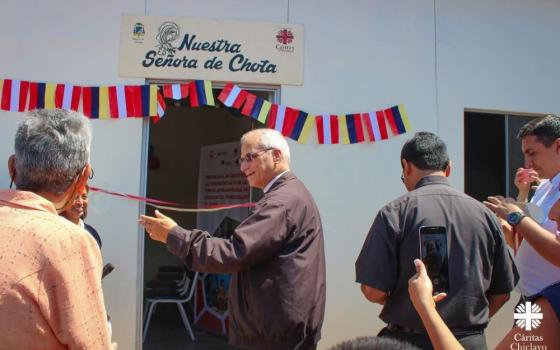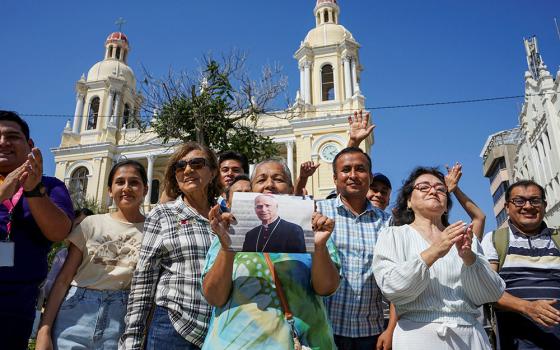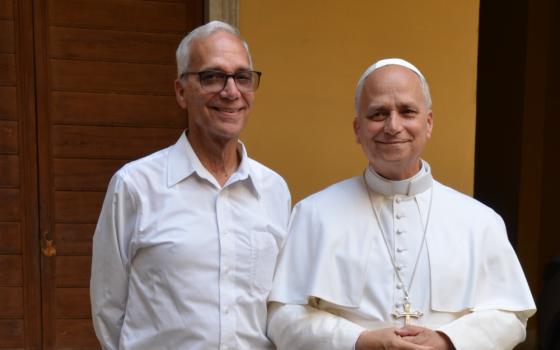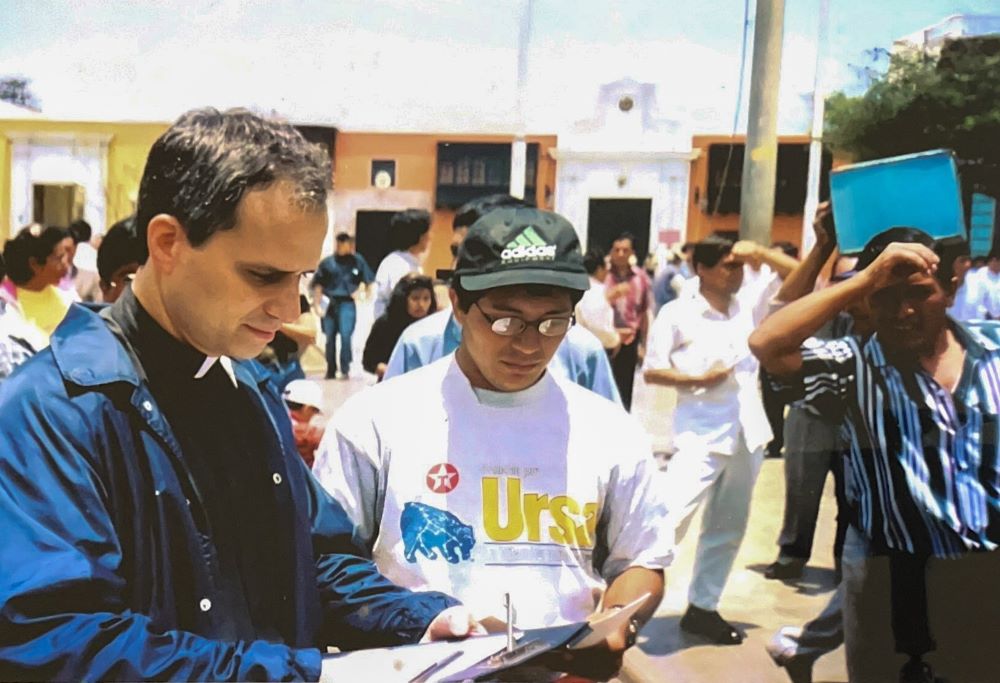
Augustinian Fr. Robert Prevost gathers signatures during a march in Trujillo, Peru, in an undated photo. The future Pope Leo XIV lived in the Augustinian formation house in Trujillo for nearly 10 years beginning in 1990. (Courtesy St. Thomas of Villanova convent)
Join the Conversation
Send your thoughts to Letters to the Editor. Learn more
When the young Augustinian Fr. Robert Prevost landed in Lima in 1985, sent after advanced studies in Rome to assist his religious order's mission in northern Peru, the country was convulsing.
Peru was in the grips of an economic crisis and guerrilla groups were terrorizing the countryside; the army's counteroffensives left thousands of civilians dead. By the time the violence subsided, Peru's Truth and Reconciliation Commission would count nearly 70,000 victims.
At the same time, the Catholic Church in Latin America was living its own revolution. After the Second Vatican Council, Latin American grassroots activists, theologians and bishops were reading the signs of the times and beginning to articulate what became the region's theological hallmark throughout the late 20th-century: "the preferential option for the poor."
Less than six months into the pontificate of Pope Leo XIV, a Chicago native who spent more than two decades as a missionary in Peru, that language has already been proven to be a guiding force in the pope's vision for the church.
"I am convinced that the preferential choice for the poor is a source of extraordinary renewal both for the church and for society," the pope wrote in his first major document, Dilexi Te, an apostolic exhortation centered on the needs of the poor that draws heavily from the Latin American bishops' conferences that spurred the development of liberation theology.
'Placing yourself alongside the people condemns you to be a liberation theologian.
—Emilce Cuda
Although Prevost has never been explicitly linked to the development of liberation theology in Latin America, his experience as a missionary has painted the first U.S.-born pope's perception of the poor and pastoral care in a Latin American, and distinctly Peruvian, way.
'Signs of the times' in Latin America
"Liberation theology cannot be understood as a theological current that emerges out of nowhere," Emilce Cuda, secretary of the Pontifical Commission for Latin America, told the National Catholic Reporter in an interview on Leo's Latin American background. "Liberation theology is the expression of a culture, of a continent."
When Prevost arrived in Latin America in the 1980s, the continent was marked by deep inequality and social unrest. At the same time, church leaders were being challenged to read their realities in light of the Second Vatican Council and to discern how its vision could take root in their own contexts.
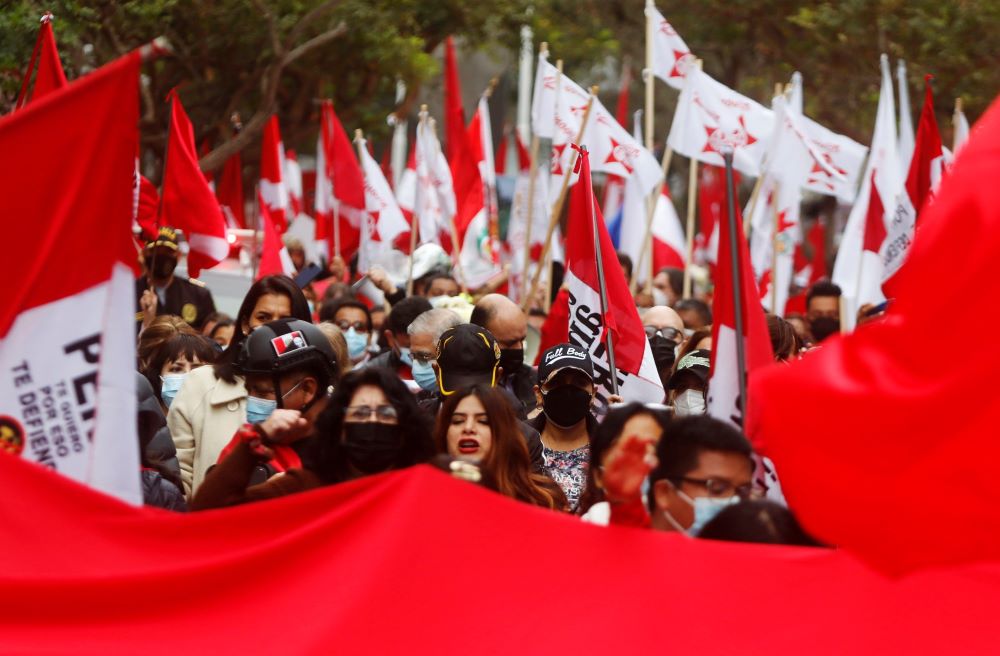
People gather Sept. 12, 2021, in Lima, Peru, to commemorate the 29th anniversary of the capture of Abimael Guzmán, founder of Peruvian rebel group Sendero Luminoso (Shining Path). The Shining Path began its violent campaign to topple Peru's government and ignite a peasant revolution in 1980. (CNS/Sebastian Castaneda, Reuters)
Introducing the Pastoral Constitution on the Church in the Modern World (Gaudium et Spes), the fathers of the Second Vatican Council declared that the church "has always had the duty of scrutinizing the signs of the times and of interpreting them in the light of the Gospel."
"Reading the signs of the times" became the key principle to understanding the council's teaching, and nowhere was it applied more concretely than in Latin America.
"On the one hand [Latin America] is very marked by the Gospel. It has a people that very much identifies as Catholic; at the same time it is a continent where there is great poverty and injustice," Carmen Lora, director of Páginas, a Peruvian journal of theology and social sciences, said in an interview in Lima. "That contradiction was very important in reflecting on what the Second Vatican Council meant for Latin America in terms of the church's mission."
Born out of the social upheavals of post-Vatican II Latin America, liberation theology took shape through a series of landmark church gatherings and the work of one Peruvian priest.
At the Medellín meeting in 1968, Latin American bishops applied the council's call for renewal to a continent marked by crushing inequality, calling in its final document for a church to "give effective preference to the poorest and most needy." A decade later, the Puebla meeting wrestled with the movement's growing influence. By 2007's Aparecida conference, guided in part by then-Cardinal Jorge Bergoglio of Buenos Aires, the future Pope Francis, the movement's core concern for the marginalized had been reabsorbed into mainstream pastoral life.
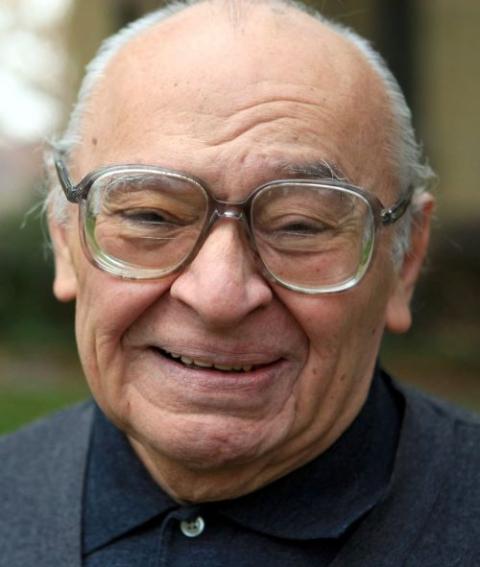
Dominican Fr. Gustavo Gutiérrez is pictured in 2007 on the campus of the University of Notre Dame in Indiana. He died in 2024 at age 96. (OSV News/Matt Cashore, courtesy University of Notre Dame)
Meanwhile, Dominican Fr. Gustavo Gutiérrez's 1971 book A Theology of Liberation gave the movement its intellectual framework, grounding faith in the lived experience of the poor.
"It is not that a completely new path opened up. Rather a new methodology emerged, and this methodology puts theology as a secondary act," said Carlos Piccone Camere, a church historian at the Pontifical Catholic University of Peru. "The first act is more about praxis, living out one's faith, and then sitting down at one's desk and systematizing what one has experienced. The first step is to approach those who are suffering and see their needs with your own eyes."
Theological tensions
Despite the speed and depth with which liberation theology penetrated the Latin American ecclesial landscape, "the reception of liberation theology was not unanimous," Piccone said. "There was suspicion on the part of the church, because it was feared that Marxist communism would infiltrate liberation theology and, by extension, Catholic doctrine."
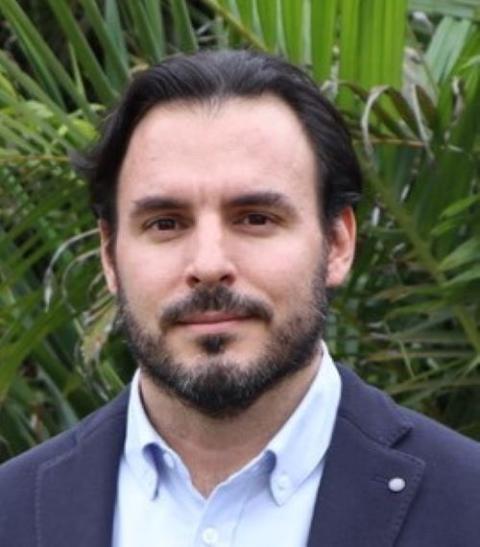
Carlos Piccone Camere is a church historian at the Pontifical Catholic University of Peru. (Courtesy Carlos Piccone Camere)
Cardinal Joseph Ratzinger, the future Pope Benedict XVI, issued two Vatican instructions as the church's doctrine chief warning against Marxist analysis and violent revolution entering into liberation theology.
Across Latin America, bishops reevaluated the line between faith and ideology, and Peru quickly became the flash point.
Lima Archbishop Juan Luis Cipriani, a member of Opus Dei, was named a cardinal by John Paul II in 2001. Cipriani was the second Opus Dei member to become a cardinal, part of a trend of elevating conservative bishops wary of liberation theology's ideas.
"Opus Dei gave an imprint of a certain type of church, because it had a lot of power," Piccone said. "Unlike anywhere else in the world Peru was a stronghold for Opus Dei bishops."
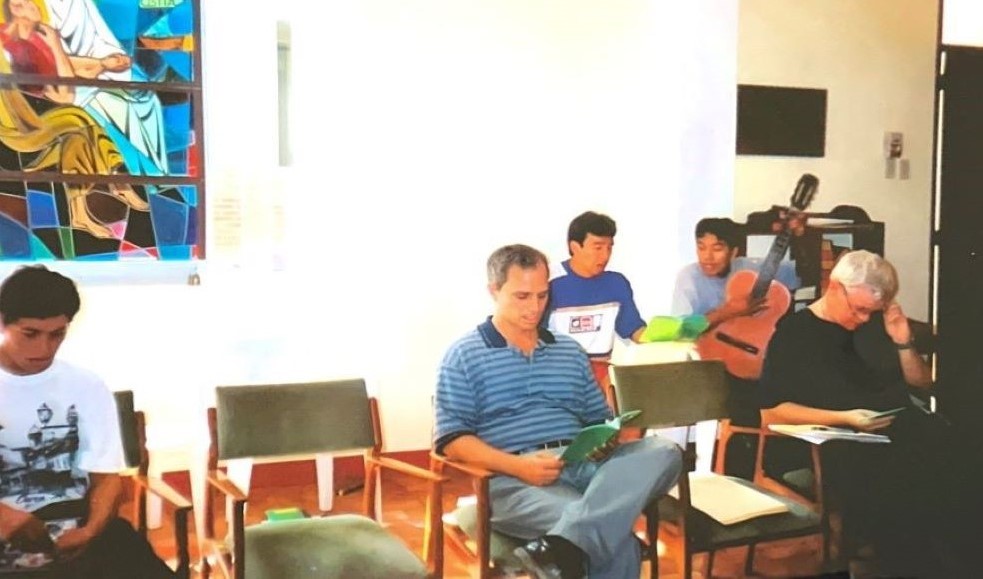
Augustinian Fr. Robert Prevost prays in the chapel of St. Thomas of Villanova convent in Trujillo, Peru, in an undated photo. Seated front right is Augustinian Fr. John Lydon. (Courtesy St. Thomas of Villanova convent)
John Paul, the pope who had grown up from communist Poland "supported not only Opus Dei, but all the movements that followed what we would today call 'a conservative line,' and which sought at the same time to put a stop to anything that was thought to be leftist or even Marxist, which included liberation theology," Piccone said. "Doctrinally, they were polar opposites to liberation theology."
Chiclayo, Peru, where Prevost would become bishop in 2014 after serving two terms as head of the Augustinian order, had been heavily influenced by Opus Dei. Prevost's predecessors included a bishop who was a formal member of the prelature and another who belonged to the Priestly Society of the Holy Cross, which is closely associated with Opus Dei.
Leo, in an interview for his biography published in Peru, said that liberation theology "does not necessarily mean that you are promoting Marxist ideology, even though some have labeled it as such."
'Liberation theology, from the perspective of Gustavo Gutiérrez, for example, is to begin to see through the eyes of the poor and with the poor in order to understand how God is in and among us.'
—Pope Leo XIV
"The way people look back on what we label liberation theology is often mistaken and incomplete, because the Gospel preaches liberation, calling us all to freedom," he said. "So liberation theology, from the perspective of Gustavo Gutiérrez, for example, is to begin to see through the eyes of the poor and with the poor in order to understand how God is in and among us."
Living liberation through the 'time of the cross'
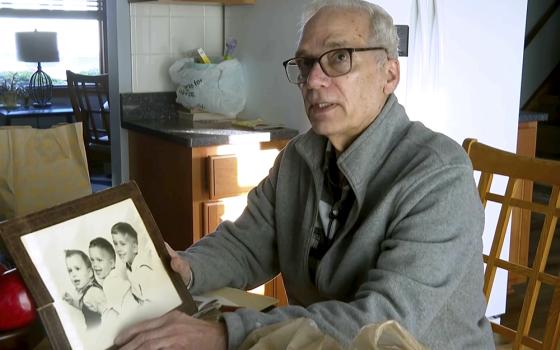
Augustinian Fr. John Lydon, a native of Canada who served in the Augustinian mission in northern Peru for some 40 years, said when stepping into Peru from a North American context, "you are immersed in disaster and the poverty of the people."
"It's kind of overwhelming coming from the reality of our country and then going to a place where there's nothing, there's no hospital, everything is very rudimentary," Lydon said in an interview from the Augustianian formation house in Chicago.
Lydon spent one year with Prevost in Chulucanas, where the pope first served as a missionary, and the two lived together in the Augustinian formation house in Trujillo for nearly 10 years beginning in 1990.
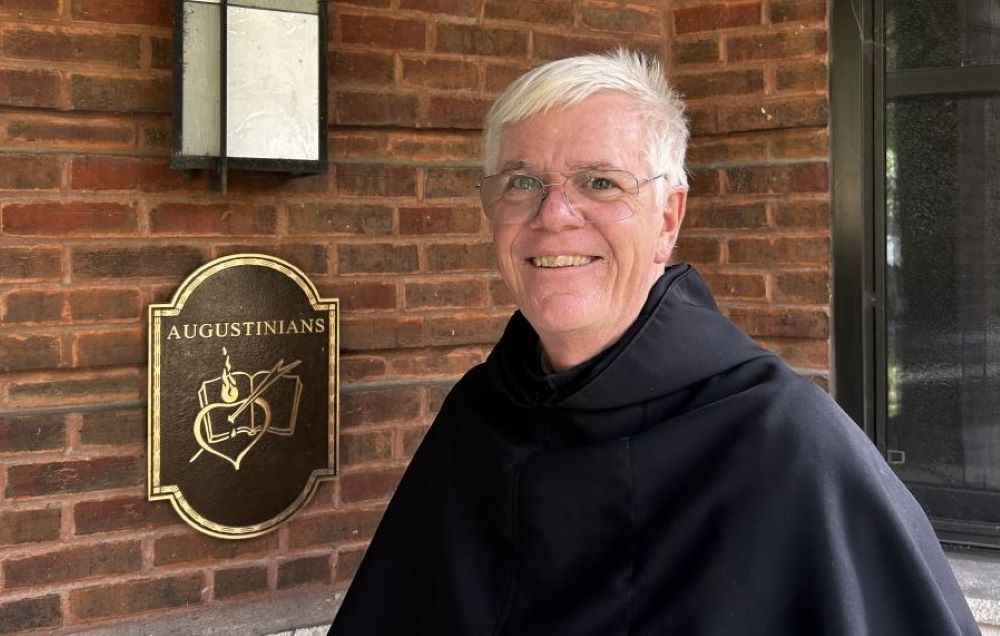
Augustinian Fr. John Lydon, who lived with the future Pope Leo XIV for nearly 10 years in Peru, poses for a photo outside the Augustinian friary in Chicago Oct. 21, 2025. (NCR photo/Justin McLellan)
Reflecting on his first experience in Peru, Leo said in an interview for his biography that he "was not aware, even within Peru, that in other parts of the country there was obviously a very different perspective on the theological vision and ways of being of the church."
"My first year was there in Chulucanas, so the church I knew was that, along with the Augustinians who were there," Leo said.
By that time, the Shining Path militant group had begun its violent campaign to topple Peru's government and ignite a peasant revolution. A rival group, the Túpac Amaru Revolutionary Movement, soon joined the fight, targeting symbols of state power and foreign influence. The government's military response was swift and often indiscriminate, devastating rural and Indigenous communities across the Andes.
In Trujillo, Lydon recalled, there were frequent power outages due to guerilla groups blowing up the power lines, nighttime curfews and the constant fear of violence. In 1991, three foreign priests were killed by the Shining Path militant group about 70 miles south of Trujillo.
The Augustinians stateside had directed those in Peru to develop an exit plan should they need to leave the country, for the U.S. Augustinians to return stateside and determine where the Peruvian Augustinians could go safely.
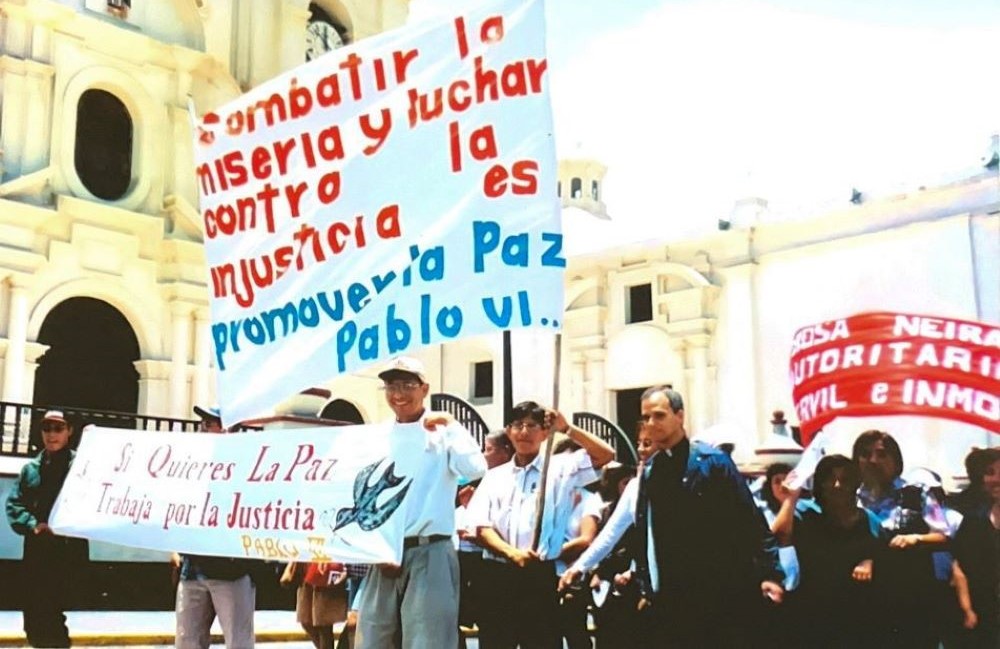
Augustinian Fr. Robert Prevost participates in a march for peace in Trujillo, Peru, in an undated photo. (Courtesy St. Thomas of Villanova convent)
Lydon was charged with developing the plan, "but it was a decision of us all that we requested not to develop an exit plan, but to develop a plan on how to accompany the people of God in the time of the cross," he said.
Prevost recalled being offered a bodyguard during that period due to his role as judicial vicar for the Trujillo Archdiocese, but ultimately turning it down since "it made it too obvious who I was."
The 1992 capture of the Shining Path's founder, Abimael Guzmán, led to a decline in the militant group's activity. What followed was an increasingly authoritarian government led by President Alberto Fujimori, who dissolved the Peruvian legislature and judiciary that same year.
It was in that context in which the Augustinians became actively engaged in educating people about human rights. In 1998, the 50th anniversary of the Universal Declaration of Human Rights, human rights groups in Peru started gathering signatures to support the declaration "as a countermeasure to Fujimori's denial of human rights," Lydon said.
The Augustinian parishes in Trujillo began gathering signatures to support a campaign of respecting human rights in Peru. Photos in the Augustinian formation house in Trujillo show Prevost participating in marches and gathering signatures in support of human rights.
Advertisement
"Our two parishes got more signatures than any other organization in the country," Lydon said. "So (Prevost) was part of leading that because he was the administrator of the parishes."
"That was our real experience of church and the poor," he said. "We were very strong about defending human rights, speaking up about it, organizing marches with our people in Trujillo against the Fujimori authoritarian government. All of that just made us aware of how to accompany the people during the darker times back then."
Lora, the journal director, explained that the push for human rights in Peru was fundamental during the Fujimori years after longstanding neglect for the rights of marginalized groups.
"For the state at that time, poor people, farmers, didn't have rights, just as they didn't for the (Shining Path group), which killed many farmers," Lora said. "So this notion that people have rights was very hard to understand in Peru."
"I think that fighting for that understanding of the value of rights, independent of a person's status or defects, greatly marked Cardinal Prevost, and now the pope," she said.
The pope reflected on the period in his biography: "It was very important to remain alongside the people that we were serving and to be with them, and that is what we did."

Emilce Cuda, seen in a Jan. 10, 2025, photo, is secretary of the Pontifical Commission for Latin America. (CNS/Lola Gomez)
Theology born of reality
Prevost had no formal ties to the development of liberation theology, yet his missionary experience in Peru formed what Cuda called a distinctly Latin American way of doing theology: one rooted in the concrete realities of suffering communities and animated by a deep theological intuition that faith must begin with lived experience.
"Placing yourself alongside the people condemns you to be a liberation theologian," Cuda said, reflecting on Leo's theological trajectory. "He taught the people in his communities that theory cannot determine reality, rather that reality comes first, then it is thought about, reasoned with, and then we can talk about a theory.""That's where you can see that this pope is Latin American," she said. "Not because he has a passport that says he was naturalized or because he lived in Peru for 20 years, or because he eats Peruvian food; he is Latin American because of the methodology and the great contribution of Latin America," namely, "that the starting point is reality — that is the methodology that the Latin American church offers to the whole world."
Leo reflected in his biography on the need for the church to reconsider how it engages with people and the image it presents to the world in response to trends of secularization and growing disaffection from institutional religion in some parts of the world.
"I believe that some of the insights I have personally gained, and which the Latin American experience of church and community has long lived, continue to be a great contribution to the universal church," he said.
The National Catholic Reporter's Rome Bureau is made possible in part by the generosity of Joan and Bob McGrath.