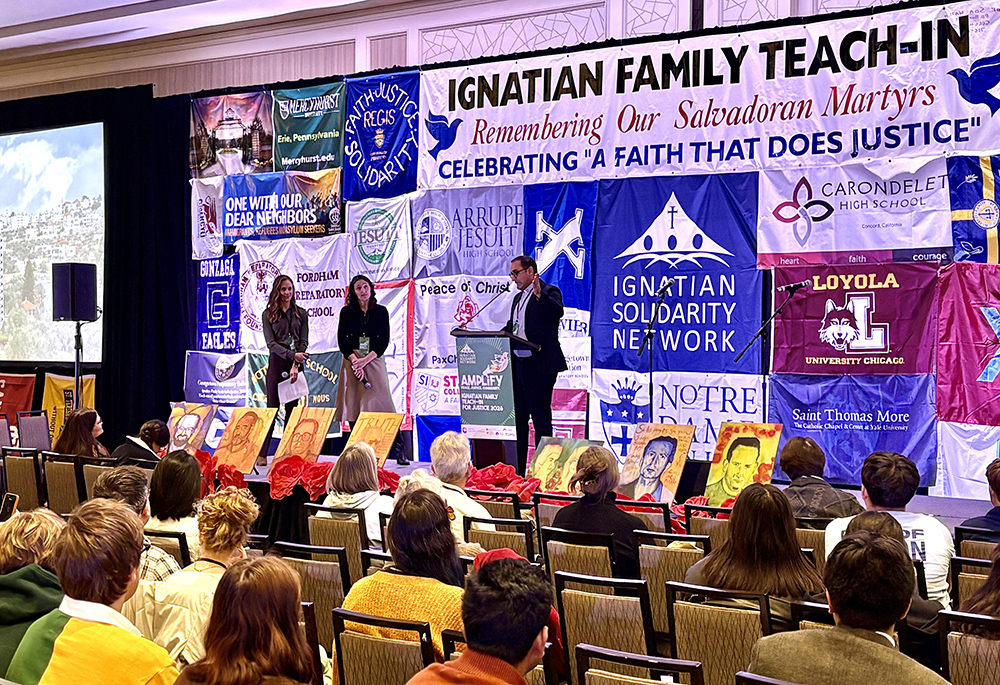
Fr. Bashar Fawadleh, a priest from the West Bank visiting the U.S. to advocate for Christian Palestinians, speaks at the Ignatian Family Teach-In for Justice to more than 200 students from Jesuit schools and colleges gathered in Washington, Nov. 15. (NCR/Camillo Barone)
Join the Conversation
Send your thoughts to Letters to the Editor. Learn more
"Keep hope!" Fr. Bashar Fawadleh called out to an audience of more than 200 students from Jesuit schools and colleges gathered in Washington Nov. 15.
"Alive!" they shouted back.
It was a refrain the Palestinian priest would return to throughout his address at the Ignatian Family Teach-In for Justice, even as he described the unsettling questions he often hears from young people in his parish: Will they be safe? Will they find work? Will they be able to raise a family in the land where they were born?
For Fawadleh, the Latin Catholic parish priest of Taybeh, the last predominantly Christian village in the West Bank, those questions have become increasingly urgent. His Nov. 11-17 tour to New York and Washington, which included more than 10 public appearances and meetings, sought to bring the realities of Palestinian Christians before U.S. audiences and enlist the support of churches, civic leaders and policymakers.
From New York's City Hall to a gathering of Catholic peace organizations in Washington, Fawadleh spoke about the future of Christianity in the land of its birth.
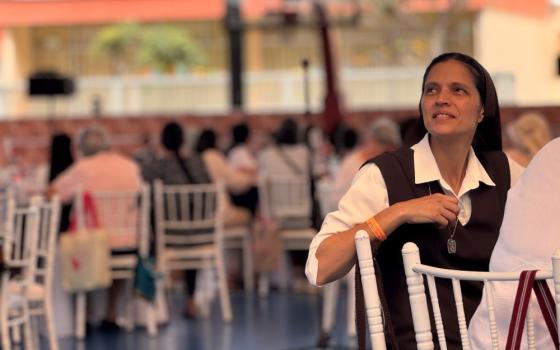
"We are still here," he told an audience at New York's Fordham University, where he spoke alongside Greek Orthodox nun Mother Agapia Stephanopoulos. "We don't want to become refugees in our land."
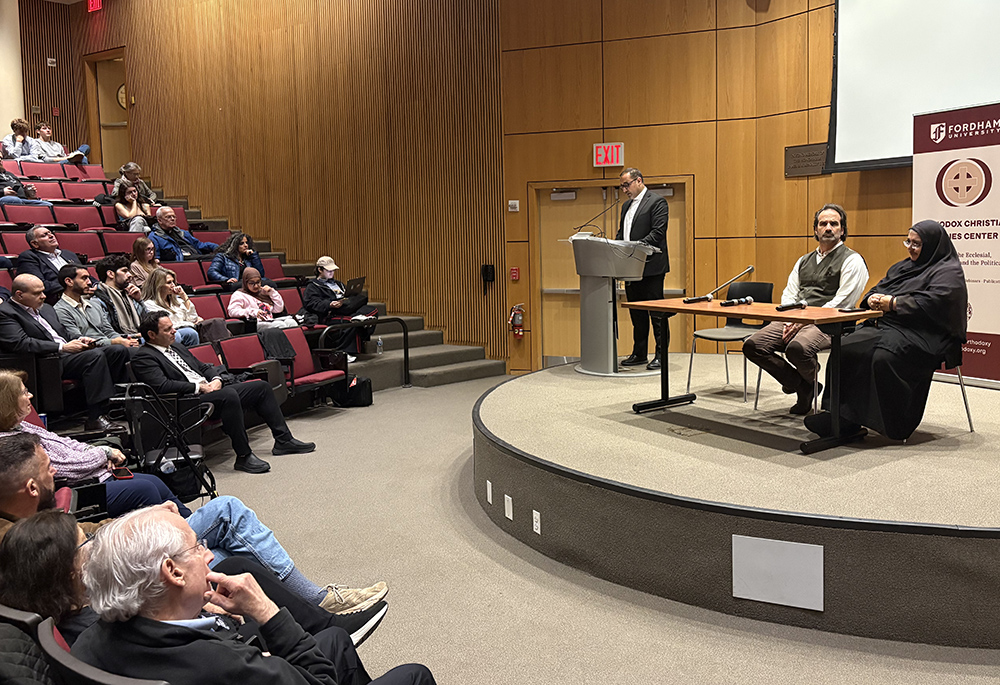
West Bank priest Fr. Bashar Fawadleh speaks at an event on Palestinian and Israeli Christians at Fordham University in New York, Nov. 11. He spoke alongside Greek Orthodox nun Mother Agapia Stephanopoulos, seated far right. (NCR/Camillo Barone)
A community under pressure
Perched in the hills northeast of Jerusalem, Taybeh is traditionally identified with the biblical town of Ephraim, where, according to the Gospel of John, Jesus withdrew with his disciples before his Passion. Today its approximately 1,200 residents belong to three Christian traditions: Latin Catholic, Melkite Greek Catholic and Greek Orthodox.
But the village's ancient Christian heritage offers little protection against the settlers' violence, restrictions on movement by Israeli Defense Force's checkpoints and economic hardship increasingly defining daily life there.
At Fordham, Fawadleh recalled an Oct. 17 attack on villagers harvesting olives alongside European diplomats who had come to accompany them in solidarity. Masked settlers attacked members of the group, injuring people and damaging a Belgian diplomatic vehicle. Israeli police opened an investigation, and the Israeli military condemned the violence while noting that the visit had not been coordinated with it, according to the Associated Press.
On Oct. 20, Jerusalem's patriarchs and heads of churches denounced the attack as part of a wider pattern of settler violence and called for consistent enforcement of the law.
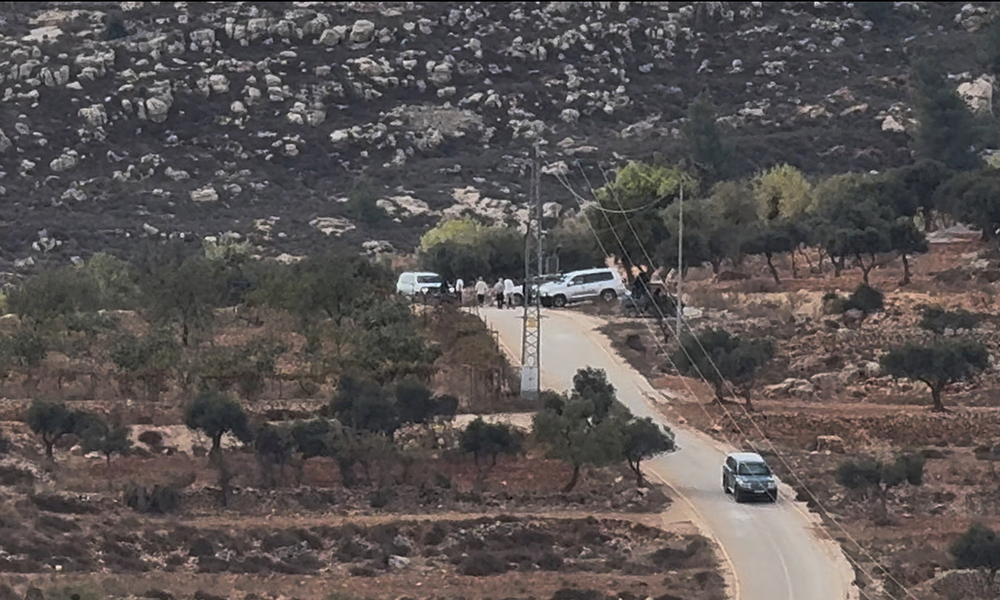
Vehicles drive in Taybeh, in the Israeli-occupied West Bank, Oct. 17, at the site where Belgium's foreign minister says masked settlers in the West Bank attacked Palestinians, Catholic representatives and Western diplomats and officials. (OSV News screenshot/Emad Diab via Reuters)
The priest said the annual gathering of generations beneath the village's olive trees has become an increasingly perilous undertaking.
"If violence can occur even in the presence of international diplomatic representatives, what protection can a farmer expect when he is alone with his children?" he asked.
Even as Fawadleh was in the United States, reports reached him that a vehicle had been set ablaze in Taybeh and threatening graffiti was scrawled on a residential building.
The priest said expanding Israeli settlement outposts and five military gates surrounding the village have increasingly restricted residents' access to farmland, employment and essential services. Journeys that once took minutes can now require hours.
"More than 700,000 Israeli settlers live in the occupied West Bank and east Jerusalem," AP reported in August, saying "the international community overwhelmingly considers Israeli settlements to be illegal and obstacles to peace."
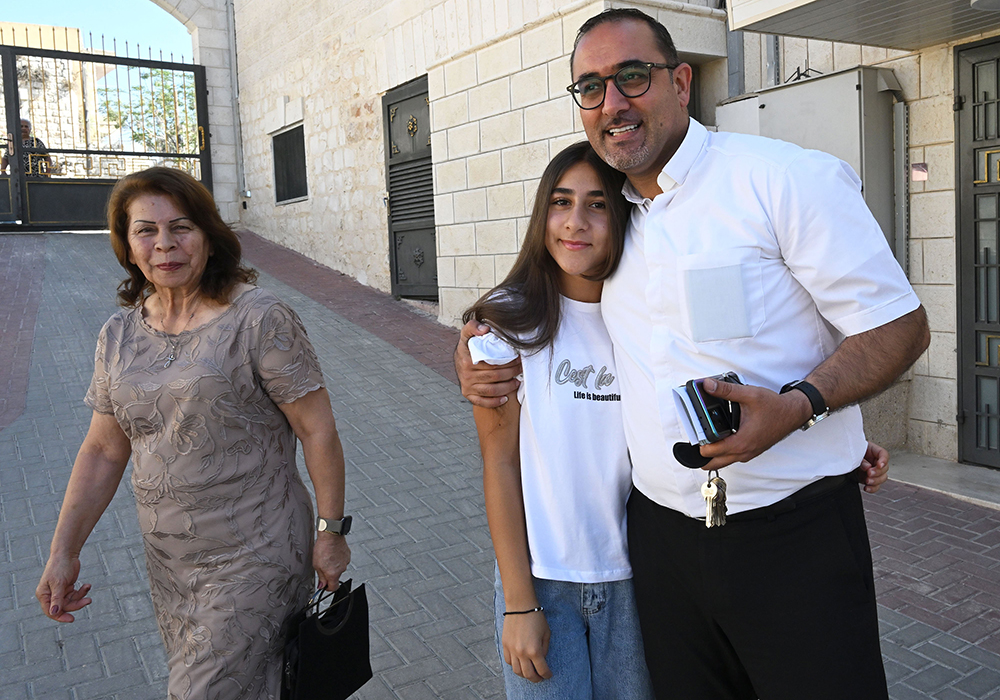
Parish priest Fr. Bashar Fawadleh greets people before Mass in the Christ the Redeemer Church in Taybeh, West Bank, Aug. 16. (OSV News/Debbie Hill)
In an interview with the National Catholic Reporter during his visit, Fawadleh welcomed the growing international attention to Taybeh but worried that diplomatic visits and expressions of solidarity have yet to bring his community lasting security.
More than 15 families have left the village in the past three years, he said. Each departure reverberates through a small community: fewer children in the schools, fewer parishioners in the pews, fewer customers for local businesses and elderly parents separated from their children.
In July 2025, fires near the ancient Church of St. George, known locally as Al-Khader, drew attention to the vulnerability of Taybeh's Christian heritage. The ruins remain a place of prayer for villagers. But Fawadleh warned of an even greater danger, which is that "the possibility that Christian heritage may survive while Christian communities disappear."
From City Hall to Catholic campuses
Fawadleh's first stop in New York included a Nov. 11 meeting with Mayor Zohran Mamdani, with whom he discussed the humanitarian crisis in the Gaza Strip, the need for safe delivery of medical supplies and aid, and the pressures facing Palestinians in the West Bank.
The priest proposed exploring a sister-city relationship between New York and Taybeh, envisioning educational and community initiatives as well as opportunities to promote the village's handicrafts and other local products. According to Fawadleh, Mamdani expressed interest in further discussions.
On Nov. 13, Fawadleh addressed Catholic students at St. Vincent Martyr School in Madison, New Jersey, where Bishop Kevin Sweeney of Paterson celebrated Mass. The priest's itinerary also included planned meetings with Diocese of Brooklyn officials.
Advertisement
Meeting with the students in Washington, however, Fawadleh approached the question of solidarity from a different perspective, asking them to imagine waking up one morning to find the road to school closed, or wondering whether their family would still live in their hometown a year later.
He encouraged them to build friendships with Palestinian students through listening to their stories and resist reducing people living in the Holy Land to headlines.
"Solidarity begins when someone else's suffering is no longer invisible to us," he said.
Fawadleh told the students that Taybeh's three Christian churches help sustain local employment through schools, a nursing home, housing projects and other institutions, while music, sports and traditional Palestinian dance programs give young people space to pursue their interests.
Many students at the church-run schools are Muslim, he noted, emphasizing that Christian institutions serve the wider Palestinian community, including residents of surrounding villages.
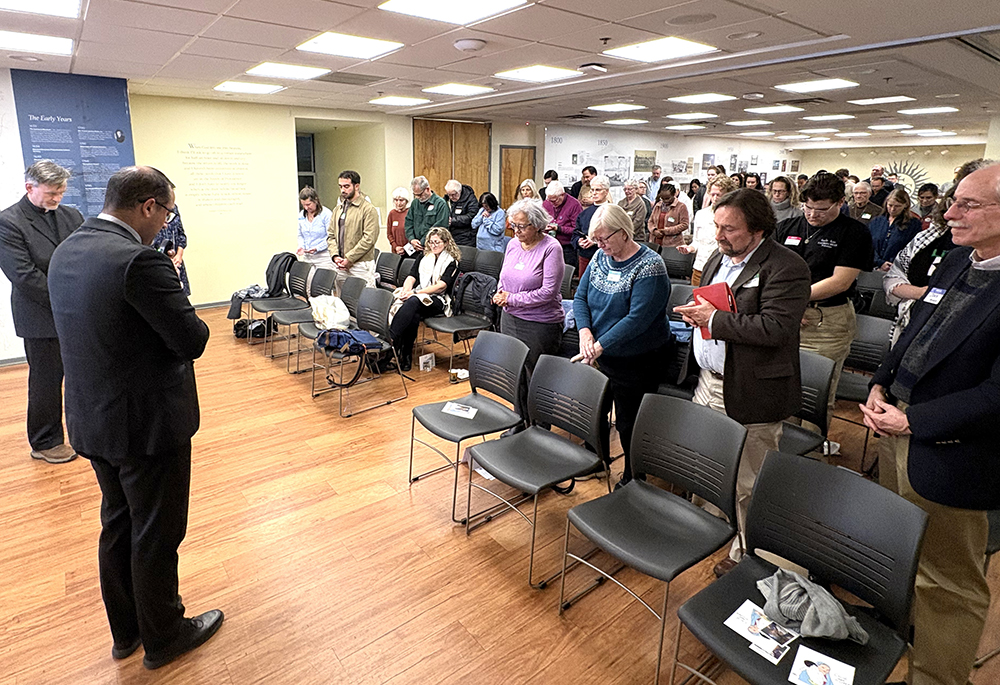
Fr. Bashar Fawadleh blesses and prays with a group of Catholic human rights advocates from more than 10 national and local Catholic organizations at Holy Trinity Parish in Washington, Nov. 15. (NCR/Camillo Barone)
Turning solidarity into action
Hours after addressing the students, Fawadleh joined representatives of Catholic and ecumenical organizations at the Jesuit-run Holy Trinity Parish in Washington for a discussion on concrete ways to advocate for Palestinians.
His testimony there grew particularly personal. Fawadleh, who was born in Jerusalem to Palestinian parents, described how his inability to obtain Jerusalem residency means he needs special permission to enter the city. One Holy Thursday, his permit had expired, preventing him from joining his bishop for the celebrations.
He also recalled responding to a fire threatening homes near Taybeh in June. When Palestinian firefighters were unable to reach the area, he said, he and other villagers tried to contain the blaze themselves. Settlers returned, attacked them and later fired shots as they fled, he said.
After Fawadleh's address, representatives of Pax Christi USA discussed congressional advocacy and public education. Kyle Cristofalo of Churches for Middle East Peace pointed to plans for an April 2027 Christian advocacy summit in Washington. Holy Trinity parishioner Alexandra Tarzikhan spoke about her parish's relationship with St. Catherine's Catholic Church in Bethlehem, including student exchanges, conversations and shared prayer. Other representatives who shared more about their advocacy work included Franciscan Action Network, Catholic Worker chapters, Pax Christi International, the Catholic Nonviolence Initiative and more.
For Fr. John Heagle, coordinator of Priests Against Genocide USA, the organization that helped organize Fawadleh's trip to the U.S., the challenge is also to persuade more American Catholic clergy to address the suffering of Palestinians from the pulpit and confront U.S. military support for Israel.
Heagle told NCR that the international priests' network, which began in Italy in 2025, now counts approximately 2,700 members across 54 countries, including between 170 and 190 in the U.S.
"The call of the Gospel is to stand with those who are suffering most," he said.
The gathering at the church was part of a weekend of Christian witness ahead of the U.S. bishops' meeting in Baltimore. Priests Against Genocide USA had invited the bishops to participate. Another event was a procession on the National Mall featuring the Gaza Children's Shroud, a cloth inscribed with the names of more than 20,000 children killed in Gaza, according to organizers.
Fawadleh joined Palestinian and U.S. church leaders at a Nov. 16 ecumenical press conference on Capitol Hill calling for congressional action against settler violence and an end to U.S. weapons transfers used in attacks on civilians. The group also sought to amplify the voice of Greek Orthodox Fr. Issa Thaljieh of Bethlehem's Church of the Nativity, who had been denied a U.S. visa.
The hope of the third day
Behind Fawadleh's advocacy lies a pastoral question: How can he encourage his parishioners to stay when remaining might place their families in danger?
For him, the answer must involve creating the conditions that make their decision to stay in the West Bank possible.
Asked where he finds the strength to continue ministering to his community, Fawadleh spoke of the sacraments, the Eucharist and his "love for the cross." Yet it is the resurrection that he looks toward most intently, he said.
"We are still awaiting the third day," he said, with a twinkle in his eyes.
His parishioners, he added, often tell him that he gives them courage. He tells them that they give it to him, too.
"The opposite of hope is not fear. Sometimes we are afraid, and we still hope," he said. "The opposite of hope is giving up."
This article is supported by The Bertelsen Fund for Excellence in Catholic Journalism.