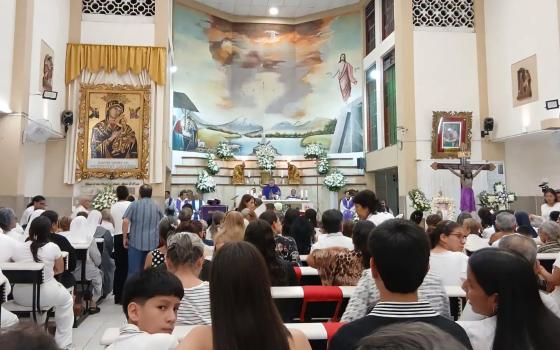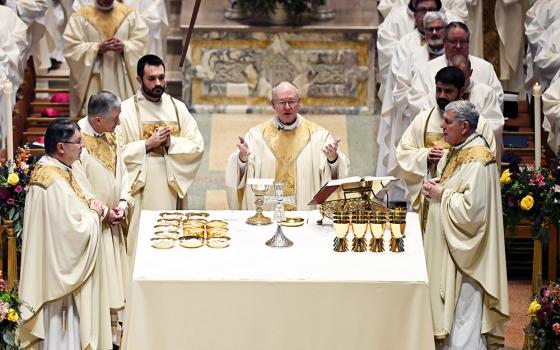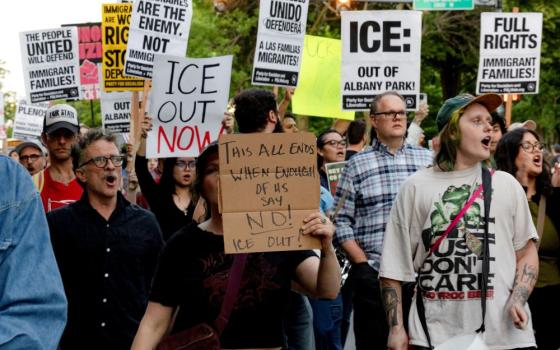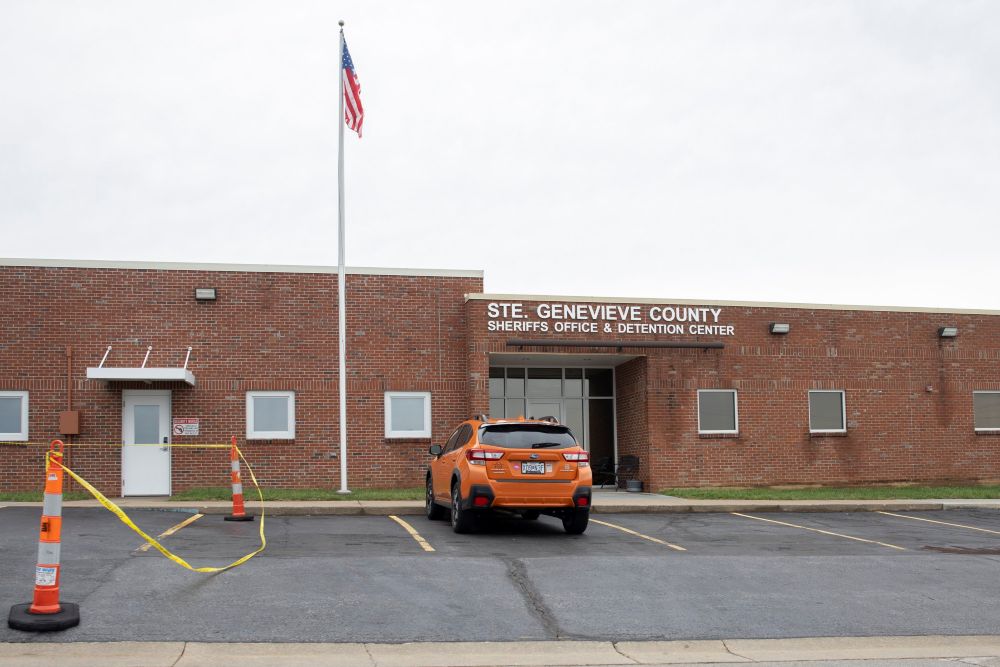
The Ste. Genevieve County Sheriff's Office and Detention Center serves as an ICE detention center. The Archdiocese of St. Louis filed a federal lawsuit Oct. 5, 2026, over a no-contact policy that prohibits priests from distributing holy Communion and hearing confessions there. (OSV News/St. Louis Review/Jacob Wiegand)

Join the Conversation
Send your thoughts to Letters to the Editor. Learn more
The Archdiocese of St. Louis has filed a federal lawsuit against U.S. Immigration and Customs Enforcement and local Missouri officials, challenging restrictions that it says prevent Catholic priests from hearing confessions, distributing Communion and celebrating Mass for immigrants detained at the Ste. Genevieve County Detention Center.
The Oct. 5 lawsuit appears to mark the first time a U.S. Catholic diocese has sued ICE over restrictions on pastoral access to immigration detainees. In October 2025, Catholic priests, religious and lay leaders affiliated with the Coalition for Spiritual and Public Leadership, or CSPL, successfully sued federal officials over access to an ICE facility outside Chicago.
But that lawsuit was brought by the independent Catholic coalition and individual clergy and lay plaintiffs, not the Archdiocese of Chicago.
In the St. Louis lawsuit, filed in the U.S. District Court for the Eastern District of Missouri, the plaintiffs include the archdiocese; St. Louis Archbishop Mitchell Rozanski; and Fr. Christopher Schroeder, pastor at Christ the King and St. Joseph parishes in University City, Missouri, who is one of the priests who makes regular visits to the detention center to offer pastoral care.
The complaint names Ste. Genevieve County officials as well as senior Department of Homeland Security and ICE officials as defendants.
In a statement to NCR, a DHS spokesperson disputed the archdiocese's account, calling its allegations "FALSE" and emphasizing that Ste. Genevieve is a county-run, no-contact jail rather than an ICE facility. The spokesperson said detainees are permitted to practice their religions and that DHS ensures access to Catholic priests, the Eucharist and the sacrament of penance when requested.
"County restrictions on physical contact do not mean religious services are denied," the spokesperson said. "DHS has done its due diligence."
Ste. Genevieve Chief Deputy Maj. Jason Schott has said that the archdiocese could provide an "unopened, individually wrapped Communion wafer" that, after consecration, could be handed to detention center staff to deliver to a detainee.
The archdiocese's complaint rejects that proposal, saying Communion must be given directly by a priest or another minister authorized by the church, rather than passed through an unappointed third party. It says the no-contact barrier prevents priests from administering the Eucharist as required by Catholic practice.
The same conflict exists over confession. Priests at Ste. Genevieve currently communicate with detainees across a glass partition by telephone, according to the complaint. But Catholic confession must be private and in person, the filing says, and cannot be conducted by telephone or under circumstances in which the conversation may be monitored or recorded.
Rozanski told the National Catholic Reporter that the decision to go to court followed unsuccessful attempts to obtain accommodations that would allow priests to provide sacramental ministry.
"This lawsuit was motivated by our commitment to ensuring that all Catholics have access to the sacraments and to priestly care," Rozanski said. "Our priests are committed to Christ's command that we minister to the imprisoned, and we seek to bring the hope of Christ to Catholic detainees who seek pastoral care while in custody."
"These detainees and the priests who serve them have been denied their religious liberties," he added.
The Ste. Genevieve facility began housing ICE detainees under contract in mid-2025. About 3,000 immigrant detainees have passed through the jail since then, with approximately 150 held there at a given time, according to the complaint. ICE pays the jail $103 per detainee per day.
A rotating group of archdiocesan and religious-order priests has made weekly visits to detainees seeking pastoral care. But under the jail's policy, clergy visits take place through a glass partition, with priests and detainees communicating by telephone. Clergy are permitted to visit only during a four-hour period on Mondays, and priests cannot pass religious items through the partition or celebrate Mass.
The archdiocese argues that those conditions effectively make the sacraments impossible.
"We are not seeking special treatment," Rozanski told NCR. "The jail already adopts a more lenient policy for other types of visits, like those by lawyers. We humbly request the same access."
The archdiocese says it attempted for months to resolve the dispute without litigation. In late 2025, Fr. Michael Lydon, an episcopal vicar, asked jail officials to allow face-to-face visits for confession and Communion but was denied.
On May 18, Rozanski wrote directly to jail administrator Lt. Andrew Johnson requesting face-to-face sacramental visits, permission to celebrate Mass and expanded clergy visiting hours. He received no response, according to the complaint. When Lydon renewed the request in August, Chief Deputy Maj. Jason Schott again denied it and said the sheriff's department would not discuss the issue further.
Advertisement
The lawsuit alleges violations of the First Amendment's free exercise clause, the Religious Land Use and Institutionalized Persons Act, the federal Religious Freedom Restoration Act and Missouri's Religious Freedom Restoration Act. It asks the court to stop enforcement of the no-contact policy against priests, expand clergy access to the same terms available to attorneys and consular officials and to permit Mass on reasonable terms.
The St. Louis case comes after two groups of clergy won preliminary relief in similar disputes this year. In Chicago, CSPL and individual Catholic clergy sued after they were denied access to detainees at the Broadview ICE processing facility. A federal judge subsequently ordered ICE to permit pastoral visits, first for Ash Wednesday and Holy Week and later through a broader preliminary injunction.
An ecumenical group of Minnesota clergy, including a Catholic priest, separately sued DHS over access to detainees at the Bishop Henry Whipple Federal Building near Minneapolis and won an injunction requiring a workable clergy-access policy.
The St. Louis' complaint cites both cases as evidence that religious-access disputes have surfaced at multiple ICE facilities.
Rozanski said he hopes the Missouri case will have implications beyond a single detention center.
"We understand that similar violations may be occurring at other detention centers," he said, "and it is our fervent hope that all detainees, wherever detained, can have access to pastoral care."
Rozanski, who has made pastoral visits to jails and prisons during his years as priest and then bishop in Baltimore; Springfield, Massachusetts; and St. Louis, told the St. Louis Review that bringing Mass, confession and other sacraments to incarcerated people had provided some of the "very sacred moments" of his ministry.
Detainees "desire, want and need the solace of the faith as much as or even more than others," he said, adding that their response to the church's presence affirmed that "we are in the right place and where we need to be, where Christ has called us."
Asked by NCR what he would tell other bishops confronting similar restrictions, Rozanski framed the issue around a bishop's responsibility to Catholics in his territory.
"The church charges me with caring for the souls of Catholics within the archdiocese, and that is what I am doing through this lawsuit," he said. "But the concern motivating this lawsuit, the need for religious freedom, is universal."
"Wherever the rights of Catholics are trampled," Rozanski said, "the church should intervene to correct those wrongs."