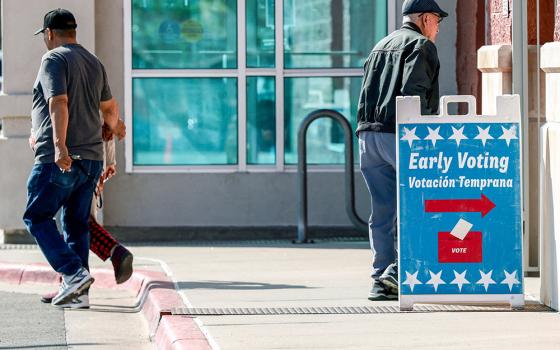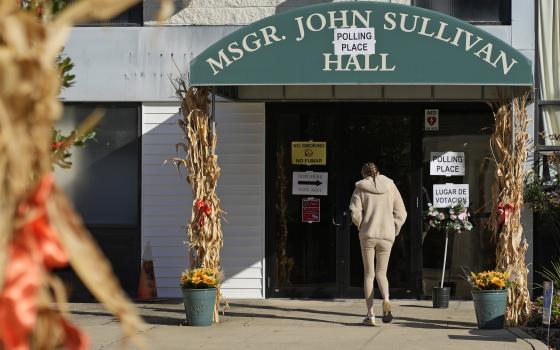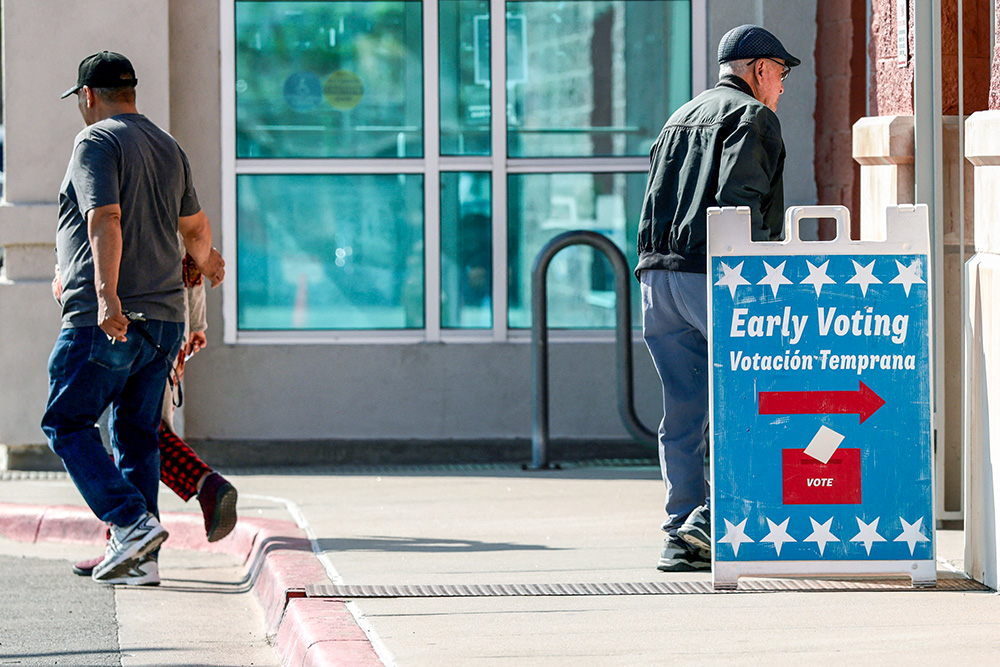
People enter and leave a polling station during in-person early voting for the midterm elections in El Paso, Texas, Oct. 19, 2026. (OSV News/Reuters/Evelyn Hockstein)

Join the Conversation
Send your thoughts to Letters to the Editor. Learn more
For Catholic immigrant advocates, the sweeping Democratic victories in the Nov. 3 midterms offered a moment of hope, but not necessarily relief.
"Last night, the country spoke, and the powerful will not soon forget it," Dylan Corbett, founder and executive director of the Hope Border Institute in El Paso, Texas, said the morning after the election. "But an election is not a resurrection. The people who died in our detention centers are still dead."
His words captured the complicated mood among Catholic organizations and volunteers who have spent the past two years accompanying immigrants to detention centers and immigration appointments while President Donald Trump's administration intensified its deportation campaign.
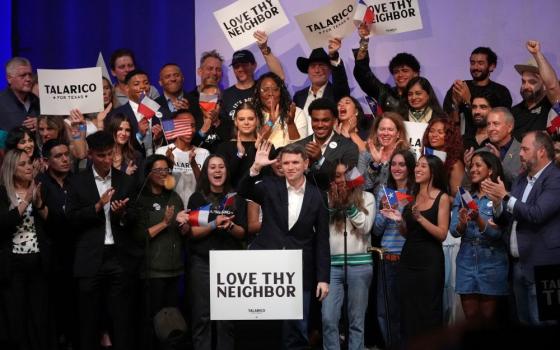
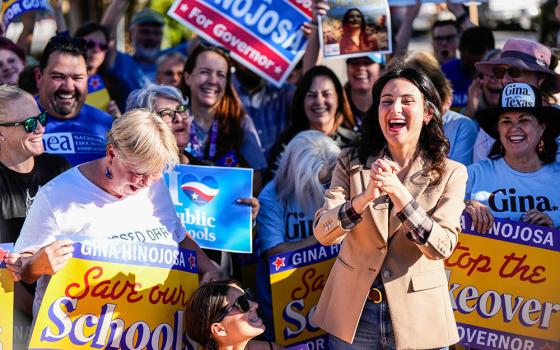
Democrats won control of both chambers of Congress, while capturing governorships in states including Texas and Iowa. In Texas, Gina Hinojosa, a Catholic Democrat, defeated three-term Republican Gov. Greg Abbott. Democrat James Talarico also flipped the state's U.S. Senate seat.
For Corbett, the results signaled an opportunity for politicians to address the concerns of communities directly affected by immigration enforcement.
"Look at who moved: the young, Latino and Asian American families, and Catholics," said Corbett, who is also a member of the Vatican Dicastery for Promoting Integral Human Development. "They are the ones who have paid for the last two years, at the kitchen table and in the courtroom."
The election followed months of evidence that Hispanic Catholics were increasingly dissatisfied with Trump's immigration policies.

An October Pew Research Center survey found that 59% of Hispanic Catholic registered voters preferred Democratic House candidates, compared with 19% who supported Republicans. White Catholics leaned in the opposite direction, favoring Republicans 50% to 32%.
After the election, an Associated Press voter survey found that roughly six in 10 Hispanic voters nationwide had supported Democratic candidates. The survey did not establish how Hispanic Catholics specifically voted.
Corbett believes the enforcement campaign has touched the Catholic Church itself.
"Latino Catholics are not at the edge of the church. They are its beating heart," he told NCR.
"When more than a third of American Catholics are Hispanic, the deportation machine is not running somewhere far away. It is running through our parishes."
Corbett called for an end to Operation Lone Star, a Texas border security initiative, and said there should be stronger federal oversight, protections for asylum seekers, and immigration legislation that offers long-term residents a path out of legal uncertainty. He also warned that the election would not immediately reverse the substantial federal resources already committed to enforcement.
"The money has not moved," he said, referring to multiyear spending for detention and deportation operations. "It has been appropriated, it is flowing, and no election night will turn it off."
Hundreds of miles north, immigrant advocates in Iowa described a similar mixture of optimism and urgency.
David Goodner, executive director of Escucha Mi Voz, an immigrant-led worker justice organization with strong connections to Catholic communities, said the organization conducted an extensive Latino voter outreach campaign during the election.
Advertisement
"We had over 200,000 voter contacts," Goodner said, adding that the group was still analyzing election results. He said organizers had identified two state House districts and two state Senate districts where the number of voters contacted exceeded the winning candidates' margins, and where seats flipped from Republican to Democratic control.
Goodner said Latino residents constitute important parts of the population of several communities in Iowa, a state that had major Democratic breakthroughs.
Rob Sand won the governorship, ending Republican control of the office, while Josh Turek defeated Republican Ashley Hinson in the contest for an open U.S. Senate seat.
But Goodner insisted that electoral victories must be followed by policy changes.
"The incoming governor and the incoming Congress have to do what they promised to do now," he said. "They can't just pull the rug underneath the Hispanic and Catholic voters that voted for them."
One immediate priority, he said, should be ending Iowa's agreement with U.S. Immigration and Customs Enforcement that permits designated state law enforcement cooperation with federal immigration authorities. He also wants Congress to strengthen oversight of the Department of Homeland Security.
The concerns echo those expressed by Catholic volunteers before Election Day.
In an Oct. 20 interview with National Catholic Reporter, Rogelio Lagunas, a Mexican immigrant and Catholic parishioner in Cedar Rapids, Iowa, described how Escucha Mi Voz mobilized more than 300 supporters outside an ICE appointment where he feared detention and deportation. He was not detained and received another year to remain in the country. He said that almost all his fellow Hispanic parishioners were not planning to vote for the Republican Party.
"This is no time for the church to exhale," Corbett said. "Parties win and lose. The church remains, in every district, in both parties, at the gate of the detention center at 6 in the morning."