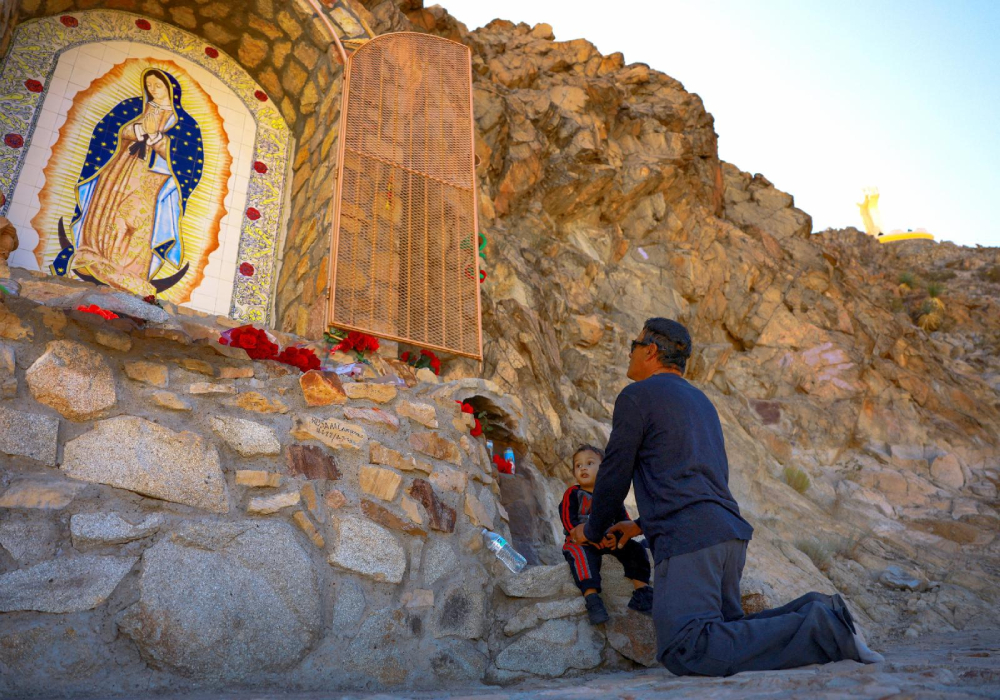
A man prays with a child in front of an image of Our Lady at Mount Cristo Rey in Sunland Park, New Mexico, during a pilgrimage Nov. 23, 2024, for the feast of Christ the King. The Diocese of Las Cruces, New Mexico, called the Trump administration's plans to seize land from the pilgrimage site for building a sector of the U.S.-Mexico border wall an "affront to religious liberty" in a June 19 opposition response filed in U.S. District Court for the District of New Mexico. (OSV News/Reuters/Jose Luis Gonzalez)

Join the Conversation
Send your thoughts to Letters to the Editor. Learn more
U.S. Rep. Veronica Escobar (D-Texas) has introduced legislation that would prevent the federal government from using eminent domain or federal funding to construct border security infrastructure on or near Mount Cristo Rey, a prominent Catholic pilgrimage site overlooking the border region of Texas, New Mexico and Mexico.
The Mount Cristo Rey Protection Act comes after the federal government initiated legal action to obtain approximately 14 acres of land near the base of the mountain in Sunland Park, New Mexico. The land is owned by the Diocese of Las Cruces, and the proposed acquisition is intended to support an extension of the barrier along the U.S.-Mexico border.
Escobar, a Democrat who represents El Paso in Congress, told NCR the bill is one of several efforts her office is pursuing to prevent construction from affecting the mountain and the religious activities that take place there.
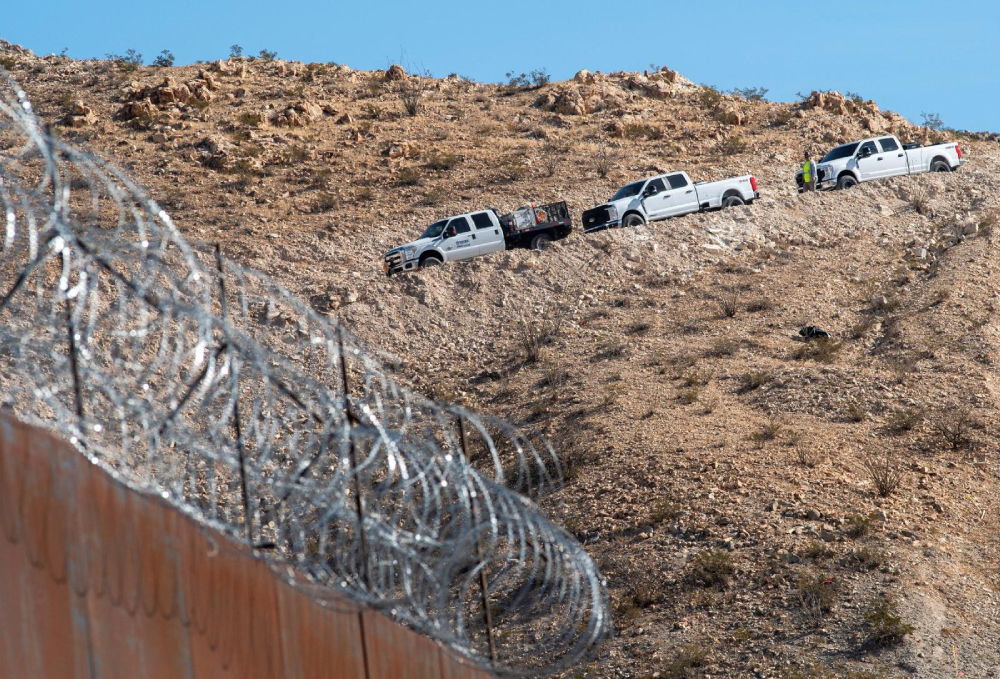
U.S. contractors work in the area where explosives will be used at Mount Cristo Rey in New Mexico as part of border wall construction, as seen from Ciudad Juarez, Mexico, Jan. 20, 2026. The Trump administration continued its efforts to seize the Mount Cristo Rey pilgrimage site, owned by the Diocese of Las Cruces, as a Texas congresswoman introduced a bill to preserve the spiritual landmark. (OSV News/Reuters/David Peinado)
"Mount Cristo Rey is a very special place for my community, for the region, for people of faith, not just in the region, but people of faith who have come to visit and hike to the top," Escobar said in a phone interview. "My constituents have asked me about what I am doing to try to prevent the Department of Homeland Security from, in their eyes and in our eyes, desecrating such a sacred site."
The mountain is topped by a 29-foot limestone statue of Jesus Christ, dedicated in October 1939. More than 40,000 people visit the site annually, according to Escobar's office. Pilgrimages traditionally take place on Good Friday and during the Feast of Christ the King, drawing participants from Texas, New Mexico and the Mexican state of Chihuahua.
Under the proposed legislation, no federal funds could be used to litigate the government's eminent-domain case concerning the 14.259-acre property. The bill would also prohibit federal funding for roads, fencing, vehicle barriers, security lighting, cameras, sensors or related structures on or near the mountain.
The legislation describes Mount Cristo Rey as a holy site of deep religious and cultural significance and argues that a federal attempt to seize surrounding land for border-wall construction would infringe on the religious liberty of the Catholic Church and visitors.
Escobar said her office had previously attempted to address the matter through the congressional appropriations process and through discussions with the Department of Homeland Security.
"We presented amendments during the appropriations process, and we have spoken with the Department of Homeland Security," she said. "But we also wanted to ensure that we had a legislative vehicle to try to prevent Mount Cristo Rey from having a wall built either on it, nearby or in the direct vicinity of people making a pilgrimage."
Advertisement
During consideration of the fiscal year 2027 Homeland Security appropriations bill, Escobar offered an amendment that would have prohibited federal funds from being used to construct a border wall at the site. The amendment was rejected by Republicans on the House Appropriations Committee, according to her office.
The new standalone bill faces significant political obstacles in the Republican-controlled House. Escobar acknowledged that it is unlikely to move through Congress immediately but said introducing it establishes a legislative framework that could be used if political conditions or congressional support change.
"If you're asking me if there's any chance of it passing immediately, there is no chance that it will pass immediately," Escobar said. "But that doesn't mean things couldn't change, rather. One of the things that I have learned during my time in Congress is you have to be ready to make change very quickly if you are able to create a coalition of support."
The proposal has received support from Bishop Peter Baldacchino of Las Cruces, whose diocese owns Mount Cristo Rey, and Bishop Mark J. Seitz of El Paso.
In a statement sent to NCR, Seitz said the site's importance extends across the international border and throughout the surrounding region.
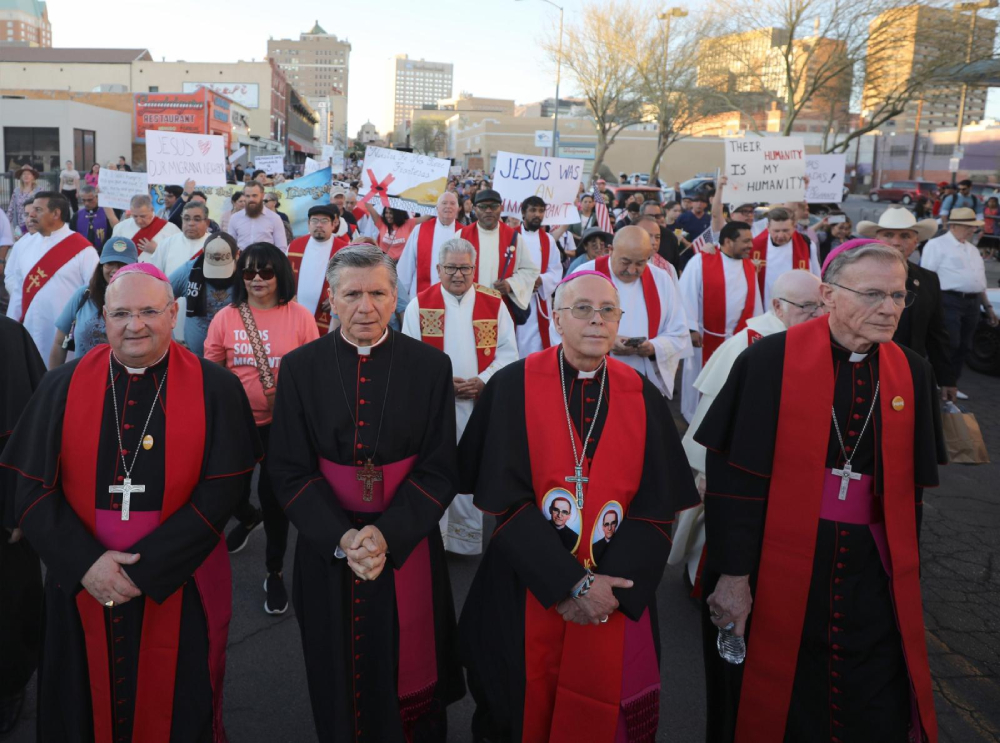
Archbishop John C. Wester of Santa Fe, New Mexico, right, takes part in a demonstration in El Paso, Texas, March 24, 2025, against mass deportation alongside Bishop Peter Baldacchino of Las Cruces, New Mexico; Archbishop Gustavo García-Siller of San Antonio and Bishop Mark J. Seitz of El Paso. On June 23, 2026, Bishop Baldacchino announced that he and Bishop Seitz invited "all the priests and faithful" of their two dioceses and the region "to join in prayer and pilgrimage" June 28 at Mount Cristo Rey, located in Sunland Park, New Mexico. (OSV News/Bob Roller)
"For the federal government to forcefully take this holy ground to build a tall barrier topped with razor wire would represent an overreach on the part of the government and create a sign that speaks, not of mutual respect and love, but of separation and rejection," he said, adding that he is confident that solutions can be found through negotiation.
"As the Bishop of El Paso I support this Bill which would call the federal government to set aside a heavy-handed abuse of power against this sacred place."
Baldacchino described the mountain as a place where residents from across the border region gather as a single religious community.
"In a world fractured by political, racial and economic divisions, Mount Cristo Rey stands out as both a powerful symbol of hope and peace and a literal pathway to unity," Baldacchino said in a statement from Escobar's office. "We are grateful for the actions of Rep. Escobar and other legislators in helping to preserve this important site for generations to come."
Escobar, who is Catholic, said she has visited Mount Cristo Rey and views it as both a place of worship and part of the region’s natural and cultural landscape.
"As a Catholic this is a very important and, as I mentioned, a sacred location for many of us, and it goes beyond a symbol for the faithful," she said. "It is also an active hiking location for people like me who love to go hiking in the area, who appreciate the natural beauty of the region."