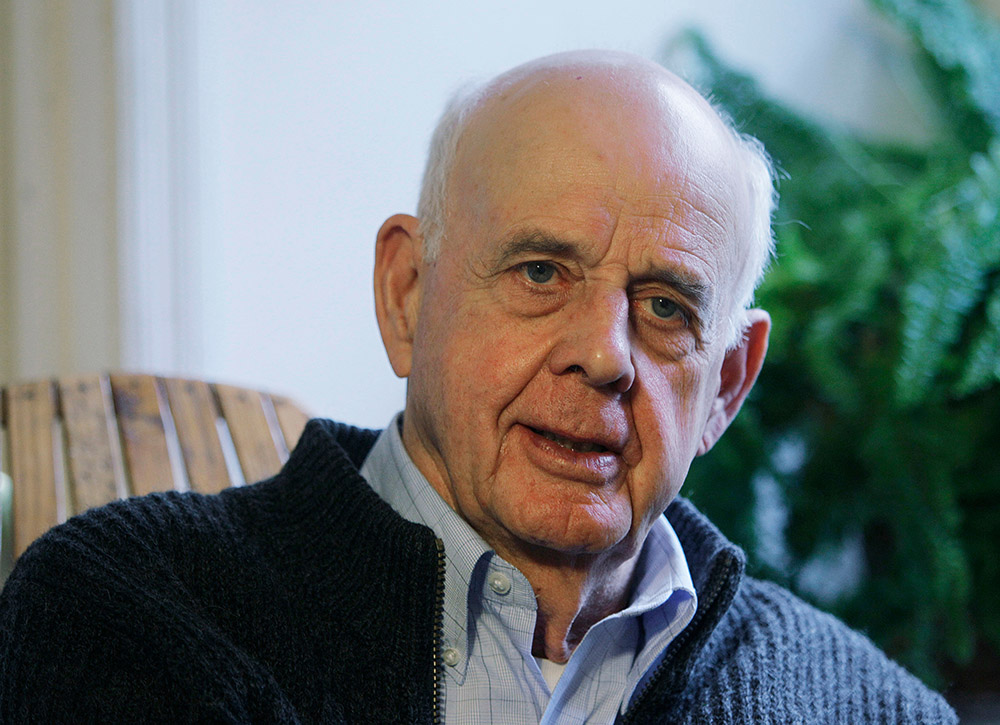
Author Wendell Berry speaks at his home in Port Royal, Ky., March 10, 2011. (RNS/AP/Ed Reinke, File)

Religion News Service
Join the Conversation
Send your thoughts to Letters to the Editor. Learn more
The Baltimore meeting hall was packed in 2013 when, at the annual American Academy of Religion conference, Wendell Berry received the Martin E. Marty Award for the Public Understanding of Religion.
The Kentucky farmer, who wrote lyrical poems, novels and essays about agriculture, small family farms, food and community, was considered something of a prophet by Christian seminarians, theologians and religion scholars.
"As we walked the convention floor, it was like a parting of the sea," said Norman Wirzba, professor of theology, ecology and rural life at Duke Divinity School, who interviewed Berry on the stage. "People wanted to come up and touch him and say, 'You have changed my life.'"
The beloved writer and environmentalist, who died at age 92 on Monday, Aug. 31, in his Kentucky home, was an academic himself but left the ivory tower for his home county of Henry, Kentucky. There, he farmed and wrote for most of his life, mostly with pencil and paper in an old family cabin.
A trenchant critic of industrialization and Big Ag, the sprawling collection of giant, often multinational farming corporations, Berry's principal influence was on the field of environmental studies and agriculture. But because his writings touched on conservation, community and belonging, he acquired legions of fans in other fields, including religion.
"He could help us understand that preservation of land is inseparable from preservation of communities, and then be able to do the really hard, deep work of saying, 'What makes a community thrive?' " Wirzba said. "What are the virtues that communities need to cultivate in their own people so that they can be the kinds of communities that take care of each other, but also take care of their land and the fellow creatures they share life with?"
His work appealed to both liberals and conservatives and was criticized by both, said Jason Peters, a professor of English at Hillsdale College who has written about Berry and plans to pen his biography. One reason, he said, is that Berry resisted easy categorization.
"He was more nuanced than people who simply identify as left or right are, and that was part of the appeal," said Peters.
Advertisement
Berry was born in 1934 and was raised on a farm in north-central Kentucky. He earned two degrees in English at the University of Kentucky and later served as creative writing fellow at Stanford University before taking a job at New York University as a professor of writing and literature. At 30, he decided to move back to Kentucky and take up farming on the land where his ancestors had lived since 1803.
In some 50 books, he wrote about how industrialization had done great damage to the soil, the water and the health of farms and communities. Environmentalists at the time were more concerned with wilderness, and Berry argued that agriculture was as important a focus of environmental thinking, Wirzba said.
Wendell also wrote novels and volumes of short stories set in an invented town called Port William, not unlike his Port Royal, Kentucky, home. His fiction was the setting for tales about townspeople and farmers, bound together by the land and deep bonds of mutual aid.
The idea of membership was important for Berry, who argued that people live well when they understand that they are in community with each other, bound by common loves and common work.
Berry was a lifelong Baptist, but his devotion to Christianity was unconventional. Where his wife, Tanya, played piano at church, he often headed to the woods. He published "Sabbath Poems," spiritual and agrarian verses written during his solitary Sunday walks.
At a 2013 conference on his book The Unsettling of America, Berry spoke to journalist Bill Moyers about his commitment to biblical principles.
"I still consider myself a person who takes the Gospels seriously," Berry said. "A lot of my writing I think has been, when it hasn't been in defense of precious things, has been a giving of thanks for precious things. So that enforces the art."
President Barack Obama presented Berry a medal from the National Endowment for the Humanities in 2011 for his lifetime of work.
When Berry sought to continue his legacy, he chose St. Catharine College, a small Catholic college in Washington County, Kentucky, as the location of the Berry Farming Program.
"It's probably the most unlikely place that the Berry Farming Program could have ended up," Sr. Claire McGowan, an environmental activist and member of the Dominican Sisters of Peace, told Religion & Ethics NewsWeekly in 2016. "We're so small, so rural. We're not famous, but those are the characteristics the Berry family appreciates and promotes."
The school announced in 2017 that it was closing, and the program most recently has been led by The Berry Center, in New Castle, Kentucky, and directed by Berry's daughter, Mary. The center advocates for farmers.
Ellen Davis, a professor of Bible and practical theology at Duke Divinity School, met Berry in the 1990s. She said he was instrumental to her work, which looks at agriculture and the ethics of land use in the Bible.
Berry wrote the foreword to her 2008 book, Scripture, Culture, and Agriculture: An Agrarian Reading of the Bible, in which he described the connections between farmers across the ages.
"The human situation, as understood by both biblical agrarians and contemporary ones, is about as follows," he wrote. "We are, howbeit only in part, earthly creatures. We have been given the earth to live, not on, but with and from, and only on the condition that we care properly for it."
She had been planning to give the annual Wendell Berry Lecture at The Berry Center next week, on Sept. 10, when she heard of his death.
"What Wendell helped us see is that our relation to land, in the broad sense of that term, is a concern for everybody who eats and everybody who lives someplace on the earth," Davis said. "Wendell's point was that we are inextricably bound up with our place. We cannot be separated from the places and the nonhuman communities on which we depend."