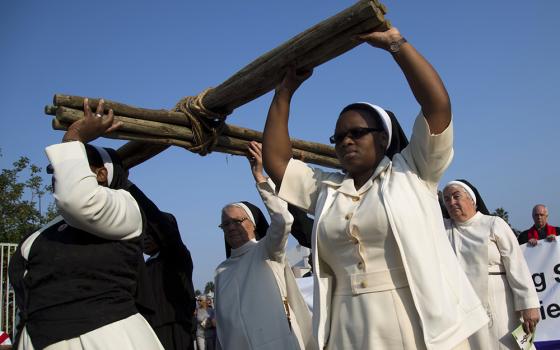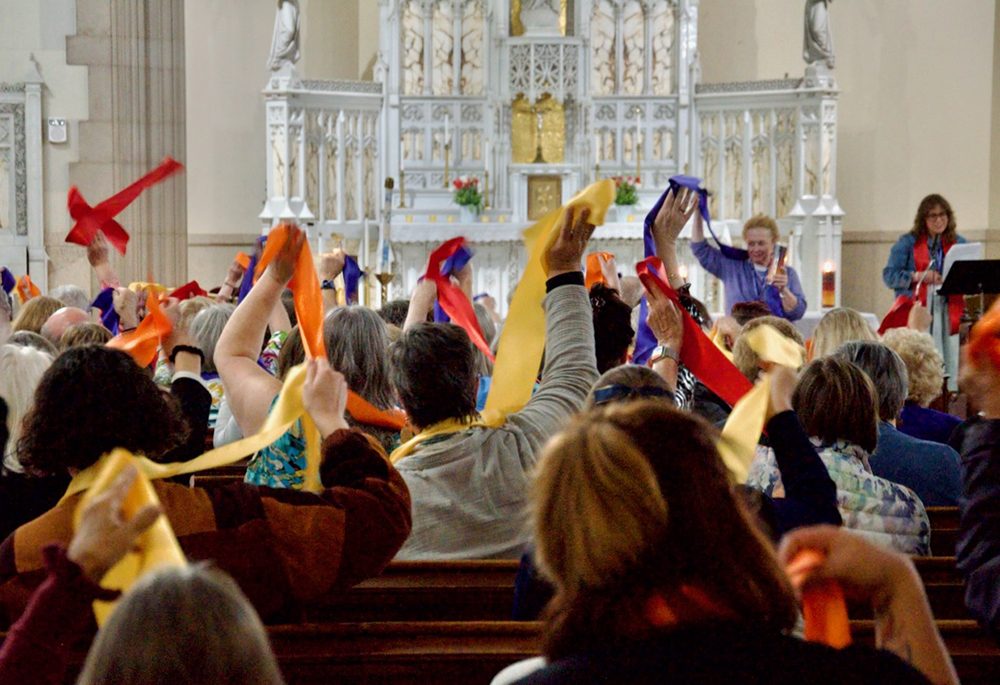
Attendees at the Women's Ordination Conference's 50th anniversary celebration wave multi-colored stoles Friday, May 22, 2026, in Detroit. (NCR photo/Dan Stockman)

Join the Conversation
Send your thoughts to Letters to the Editor. Learn more
It's time to completely rethink what ordination could look like in the Catholic Church, said one keynote speaker at the 50th anniversary celebration of the Women's Ordination Conference.
More than 200 attendees at the May 22-24 Women's Ordination Conference's mourned the members who have died since the first gathering in 1975, examined the first flourishing of the movement in its early years, shook their heads — and sometimes their fists — at the backlash against their efforts that followed, and dared to celebrate the Catholic Church's more recent commitment to synodality and the bit of hope it brings them that women could someday be ordained priests.
Keynote speaker Natalia Imperatori-Lee, an associate professor of systematic theology at Fordham University, said that while the efforts of Pope St. Paul VI, Pope Benedict XVI and especially Pope St. John Paul II to crush the movement are over, the church has been infected by a "masculine Christianity" that casts feminism as "incompatible with the Catholic faith" and embraces "the 'new feminism' promoted by right-wing Catholics, or what we call old-school sexism."
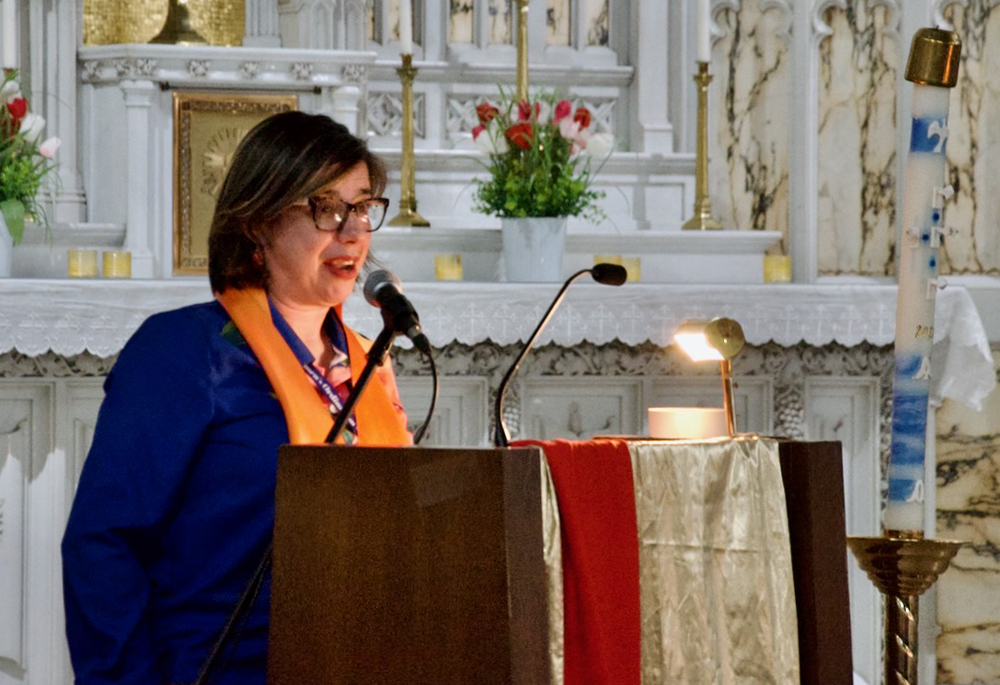
Keynote speaker Natalia Imperatori-Lee speaks Friday, May 22, 2026, at the Women's Ordination Conference's 50th anniversary celebration in Detroit. (NCR photo/Dan Stockman)
And even though Pope Leo XIV appears to be continuing the path of Pope Francis in appointing women to positions of power within the Vatican, he has not yet shown his cards, Imperatori-Lee said, and no one should expect a complete turnaround.
Indeed, keynote speaker Teresa Delgado, dean of the College of Liberal Arts and Sciences at St. John's University, said the push needs to be not just for ordination for women, but a complete rethinking of what ordination and the church's structure means.
"What would it mean to have an apostolicity grounded in mission rather than in maleness?" she asked. "What would it mean to understand ordination not as elevation, but as obligation to a radical stance with those on the margins?"
This would not be a change, but a return, Delgado said.
"This is not a break from tradition, this is a return to tradition at its deepest roots," she said. "The movement has always been about more than ordination — it's about the full humanity and dignity of women in the church and in the world."
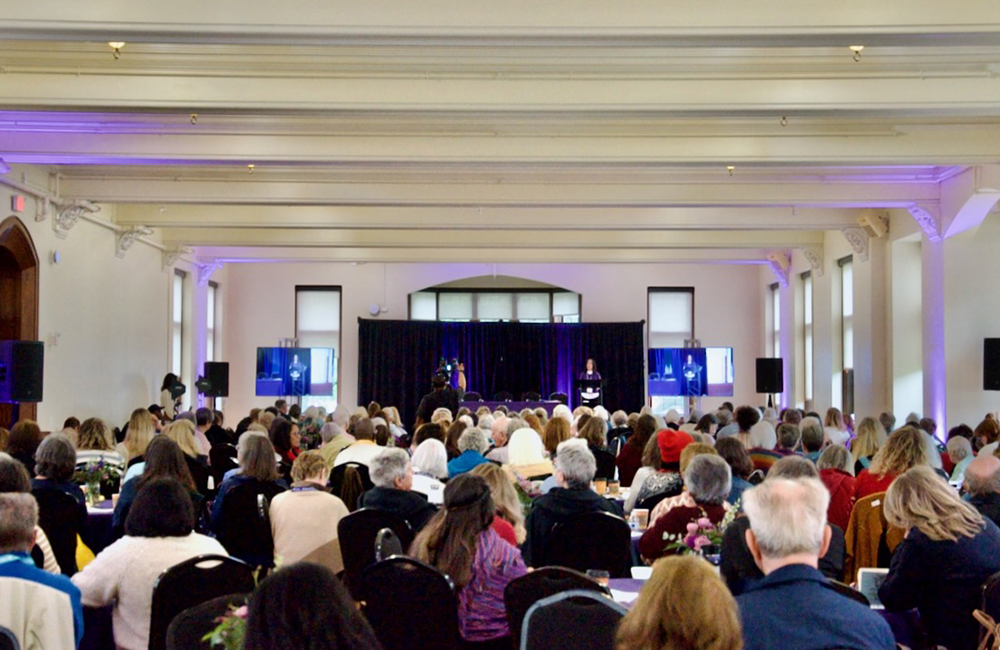
Keynote speaker Teresa Delgado speaks Saturday, May 23, 2026, at the Women's Ordination Conference's 50th anniversary celebration in Detroit. (NCR photo/Dan Stockman)
St. Joseph Sr. Christine Schenk, an NCR board member, said the question of women's ordination is a symbol of how the entire church needs to be reformed. She is a co-founder and founding director of reform group FutureChurch.
"We can't just add to the clerical system as it exists," she said in an interview. "It's not about power — Jesus was all about undoing power structures."
But the power structure of the Catholic Church is showing cracks, Schenk said.
"They tried to silence anyone who didn't think like them," she said, "but these women would not be silenced."
Kate McElwee, executive director of the Women's Ordination Conference, said in an interview that while there is a long way to go, there is also much to celebrate.
"Women are certainly more visible and empowered," she said. "But we're not just looking backward, we're looking forward."
McElwee said some see issues such as ordaining women as deacons as a good first step toward ordaining them as priests, but the conference's founders would not have seen them as separate issues.
"Certainly, we would celebrate and embrace" women deacons, she said, "but we see it as an incomplete step. It can feel like justice delayed for many people, because we're seeking true equality."
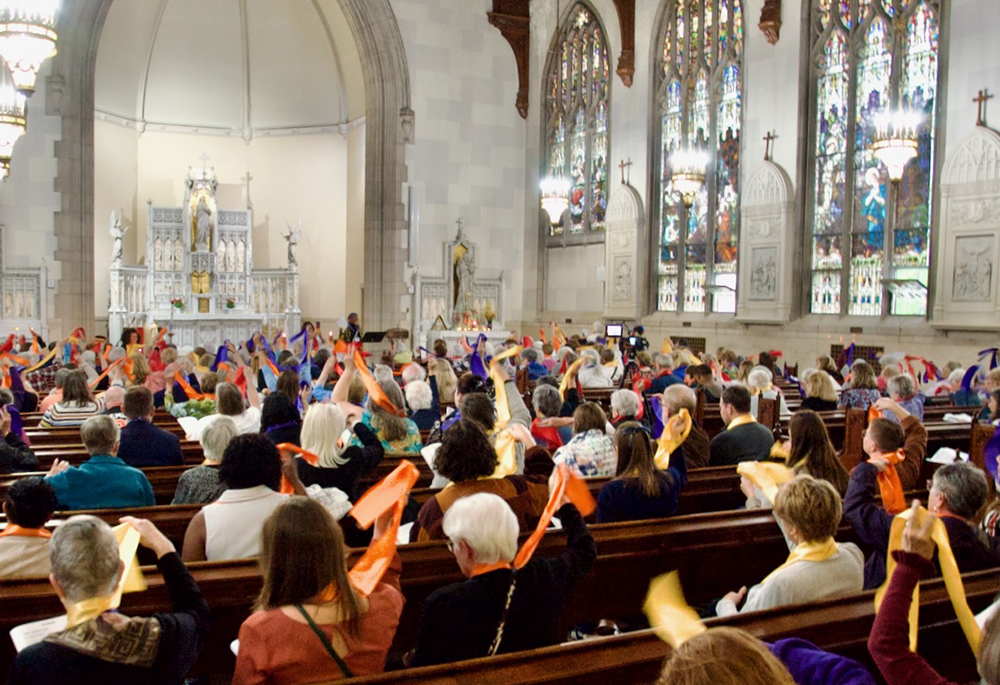
Attendees at the Women's Ordination Conference's 50th anniversary celebration wave multi-colored stoles Friday, May 22, 2026, in Detroit. (NCR photo/Dan Stockman)
Conference board member Stephanie Boccuzzi said she just joined the board a year ago.
"It's been a really cool first-year crash course on the history — or herstory — of the Women's Ordination Conference community," she said in an interview, adding that she hopes the weekend both honors the movement's pioneers and mobilizes its current members.
"What's the theme that's going to come out of this conference?" she asked. "Where are we going to be 50 years later?"
Sr. Jane Herb, a former president of the Leadership Conference of Women Religious and a member of the Sisters, Servants of the Immaculate Heart of Mary in Monroe, Michigan, said in an interview she was there to elevate women's voices.
"I'm probably not on the ordination side, but I'm supportive of those who are and supportive of increasing women's role in the church," she said. "More needs to happen, but I do think the role of women in terms of leadership and Vatican positions" has risen dramatically.
Consolata Missionary Sr. Simona Brambilla was appointed by Francis in January 2025 as prefect of the Dicastery for Institutes of Consecrated Life and Societies of Apostolic Life, making her the first woman religious to oversee religious in the history of the Catholic Church. In May, Pope Leo XIV named Sr. Tiziana Merletti, of the Franciscan Sisters of the Poor, to succeed Brambilla as secretary.
"I don't think people realize the importance of those" appointments, Herb said.
Advertisement
Women religious have been key to the movement from the beginning, McElwee said.
The first gathering in 1975 featured two sisters as speakers, 17 of 21 task force members putting the conference together were sisters, and a survey of attendees showed 676 of 800 were women religious. Twelve congregations of sisters publicly endorsed the 1975 conference.
"We didn't have the papal blocks and decrees against [women's ordination], so people felt free to talk about it and think about it in a theological way," McElwee said. During the backlash years, however, many women religious had to quiet their support or face real consequences. Today, that is no longer the case, and eight congregations of sisters sponsored this year's gathering.
"We're seeing more religious communities publicly stand true to their values," she said. "We're grateful for those who have been bold and support the conference publicly, and we know many others are praying for us."