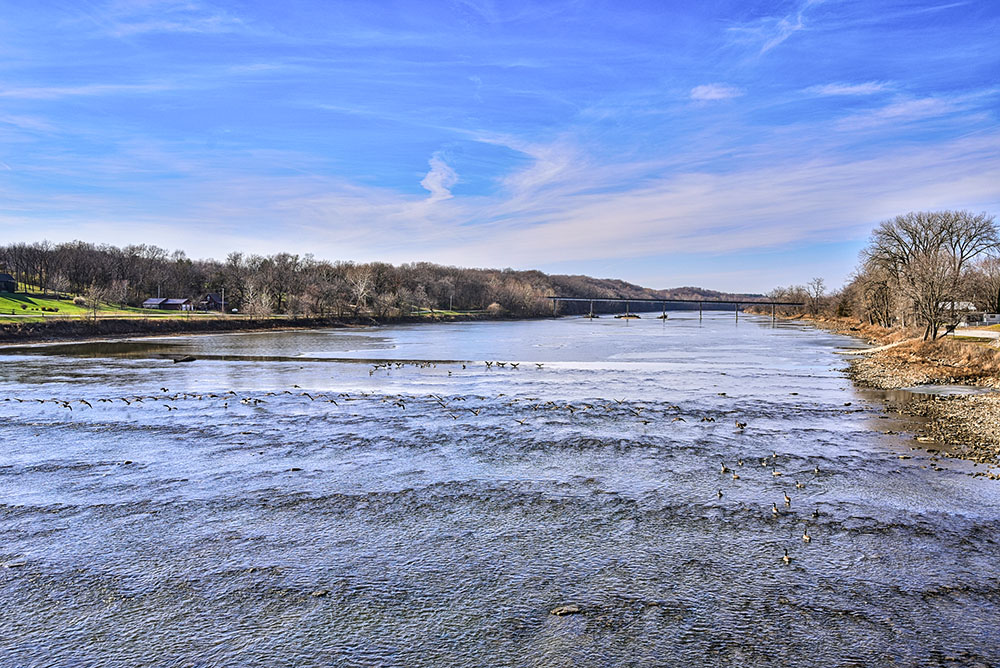
The Des Moines River is seen at Bentonsport, Iowa. (Dreamstime/Adam Wineke)

by Joyce Rupp
Join the Conversation
Send your thoughts to Letters to the Editor. Learn more
In The Sage's Tao Te Ching, William Martin suggests, "Sit by a riverbank sometime and watch attentively as the river tells you of your life." How much I've learned by following that wise counsel.
For over two decades I walked on a bike path along the Des Moines River. Since then, I've spent 10 years going weekly and plunking down on the riverbank, sitting for hours in a tattered blue canvas chair, opening my mind and heart to the river's available teachings.
It took awhile for me to hear what the river had to say. I thought I could read a book or check emails on my phone. I soon realized that learning from a sage means keeping my interior and exterior antennae fully alert while I saunter in place. ("Sauntering happens without rushing, allowing you to deeply listen and pay attention," writes Victoria Loorz in Church of the Wild.)
Some might consider it strange to have a relationship with a river. I gain confirmation from Barry Lopez, well-known nature writer with no qualms about his rapport with the McKenzie. Lopez lived beside her in western Oregon for 50 years. He grew to love that river, knew her many sounds and dispositions.
Lopez explained, " … over the years, the river opened up for me. I began to feel toward it as I would a person. I learned that it had emotions and moods as subtle as any animal's. I learned that, in some strange way, the river had become a part of me."
You'll notice I refer to the Des Moines River as "she" rather than "it." In Braiding Sweetgrass, author Robin Wall Kimmerer explains, "Imagine your grandmother standing at the stove in her apron and then saying of her, 'Look, it is making soup. It has gray hair.' We might snicker at such a mistake, but we also recoil from it. In English, we never refer to a member of our family, or indeed to any person as it. ... in Potawatomi and most other indigenous languages, we use the same words to address the living world as we use for our family. Because they are our family."
The river is an alive presence. Her energy continually moves water, changes course when she decides to or is forced into it. She teaches me about facing obstacles that cannot be removed or controlled. She's creative. If her way is blocked or thwarted, she'll carve out another path, curve a little or a lot, take a detour and keep going. She swirls around an exposed sandbar with the finesse of a skilled ballerina, easily glides over a jagged tree trunk poking a brown nose into her waters. She's not allowing those hindrances to stall her onward flowing.
The river reminds me to accept impermanence. She shows me how life is replete with transitions. No two days are the same with a river. Water today will be far downstream tomorrow. The rainy and drought seasons affect her currents and quantity. As the river constantly adjusts to change, she tells me to do the same.
A river benefits from other watercourses expanding her contents. If I am to be fully alive I'll welcome the presence of other people enhancing my growth. Whether knowingly or unknowingly, they affect my life by their beliefs and behaviors. Their contributions, like small rivulets or large creeks, nourish and influence who I become and how I go about daily interactions. Too much rain or inflow and the river overruns her boundaries. Too little input from other waterways has the opposite effect, slowing her movement and limiting healthiness. In observing this, I understand the value of maintaining a balance for my wellbeing.
Advertisement
The greatest lesson I’ve learned from the Des Moines involves the necessity of yielding to a greater source. Consider: "All rivers go to the sea, yet never does the sea become full. To the place where they go, the rivers keep on going" (Ecclesiastes 1:7). The place of entry where one flowing body of water intermingles and is absorbed by another is known as the confluence. Before I knew the name for this self-giving, I felt the specialness of the conceding.
From her birth in southern Minnesota, the Des Moines has been intent on moving toward the sea during her route of 525 miles. Something within her senses this destination. Not long ago I stood in awe at the confluence where she joins the great Mississippi. I mused, How does she do that? How does this river readily release all she's garnered along her route? It's obvious that once this river enters the larger waterway, she loses her particular identity by releasing her embraced contents for the sake of fuller unity.
I'm touched by this union, the blessedness of giving one's life over to a larger presence. The fusion of two bodies of water becoming one and moving forward with purpose speaks to me of what spiritual growth entails. I'm on a journey taking me to where the goodness I've gathered fuses with the Ocean of Love. In every good deed, in each decision to live wisely and with integrity, I continually release and join my love in a confluence with this Source.
The letting go of one river into a larger body of water serves as a metaphor for the paradox Jesus taught: "For those who want to save their life will lose it, and those who lose their life for my sake will find it" (Luke 9:24). This ancient yet ever-relevant teaching prompts me to be open to the surrendering that spiritual growth insists as essential. Like a river joining another river, this isn't a one-time event, but a daily, moment-by-moment movement, encouraged by that consistent longing for merging, a river determined to reach the sea.
Ram Dass, founder of Love Serve Remember Foundation, encapsulates this awesome, spiritual confluence in one succinct sentence: "Once you have set out on the river of love, all you have to do is to let it carry you to the ocean."