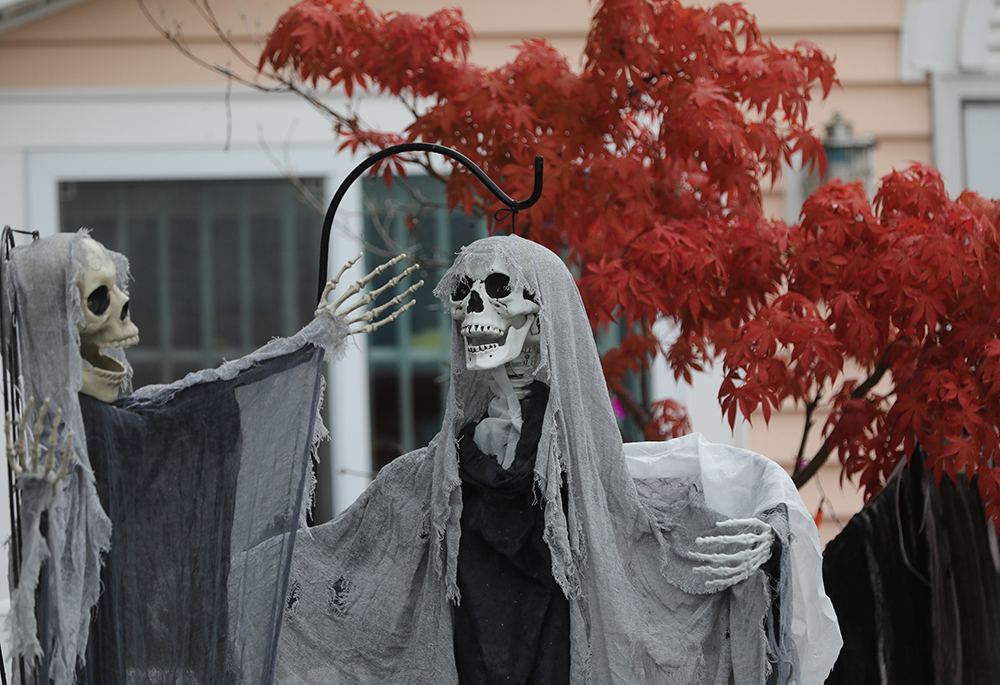
A Halloween display is pictured outside a home in North Beach, Maryland, Oct. 13, 2022. (OSV News/Bob Roller)

Join the Conversation
Send your thoughts to Letters to the Editor. Learn more
On Labor Day, Halloween candy replaced the summer seasonal items in the grocery stores. (Sunday morning, Christmas items will replace the candy.) In the past few weeks, most houses have put out displays of varying elaborateness, with air-filled demons and fake gravestones and skeletons seemingly everywhere. Tomorrow night, children across the country will don costumes and head out in search of treats from their neighbors.
The increasing attention to, and money spent on, Halloween could be harmless. Maybe it is good for kids, and their parents, to exercise their sense of fantasy a bit. Getting dressed up as someone different from who one is has a long history, especially during the pre-Lenten season of carnival. Apart from the dentists' concern about future cavities from all those sweets, surely Halloween is not something to worry about. Or is it? Maybe it really is spooky, just not in the way the companies selling inflatable ghosts intend.
In our all-consuming consumer society, Halloween has become, even more than Christmas, unmoored from its religious roots. Who celebrates it as the eve of the feast of All Saints? Halloween is now about buying stuff. People buy candy, and outfits and lawn decorations to mark the occasion. The famous High Heel race on 17th Street in Washington, which began as a wager among drag queens racing from bar to bar, now "showcases the District's diversity while supporting local businesses and driving economic activity in our neighborhoods," according to Lamont Carey, director of the Mayor's Office of Community Affairs. You can't just have fun anymore. Now you must "drive economic activity."
At Christmas, for all its commercialism, there are still many traditions of no economic significance. One friend gets together with her mom and sister for a weekend of baking cookies. Families decide what to bring to the Christmas dinner, and at whose house it will be held. Decorating the tree usually entails dusting off ornaments that have been handed down from a previous generation. Caroling, on-key or off-key, is an integral part of the season.
Advertisement
More importantly, for most Catholics at least, Christmas still entails a trip to church. For some, it is the kiddie Mass on Christmas Eve while others insist on going to Midnight Mass. Others prefer the relative quiet of Christmas morning liturgy, to say nothing of the beautiful Gospel reading from the Prologue to John's Gospel. At the heart of the holiday is the birth of a child who is also a savior. All of us remember Linus' monologue when he tells Charlie Brown what Christmas is all about.
Does anyone know what the contemporary celebration of Halloween is about? Can Linus help us here? Clearly, Halloween is about death, but not the reality of death, only a fantasy of death, all ghosts and goblins, things that are not real. I prefer not to psychologize this or any issue but surely one of the principal deficits in our contemporary culture is its inability to wrestle with the reality of death. From the doomsday preparations of the superrich to the emergence of a grief-counseling industry that can only handle the symptoms of grief, not the reality of grief itself, we moderns tend to avert our gaze from death. Even among Catholics, the habit of calling funerals "celebrations of the life of …" evidences a certain denial of death's brutal loneliness. The crass commercialization of Halloween paints a veneer of superficiality over the denialism of the ambient culture.
As Catholics, we know what we believe about death, that death is a door, not a wall. Our desire to live forever in God's love with those we have loved in this life is no mere psychological projection but a perfectly reasonable expectation. If every other desire has a corresponding reality which satisfies it, if food satiates hunger and drink slakes thirst, why should our desire for the Infinite be the one and only desire with no corresponding reality to satisfy it? "Our yearnings anticipate landfall," wrote Augustine. The burden of proof should rest with the skeptics, not the believers.
Just as it is not possible to have a correct understanding of grace without a robust understanding of sin, one cannot have a proper understanding of the afterlife without a robust understanding of death. I remember sitting at my mother's funeral and realizing that the most decisive truth claims of our faith were suddenly not the least abstract, that my mother's body in that coffin was the test of those claims. Did I believe that body in that casket would be raised on the last day — or not? Had my Mom really been baptized into Christ's death so that she would rise with him in glory?
As your children walk past fake caskets to get their Snickers bars this weekend, remind yourself to teach them at some point that death is not the stuff of make-believe. It is the most inescapable part of life. And that, as Catholic Christians, we do not avert our eyes or our hearts from its often painful reality. We do not entertain fantasies about death. We just do not give death the last word.