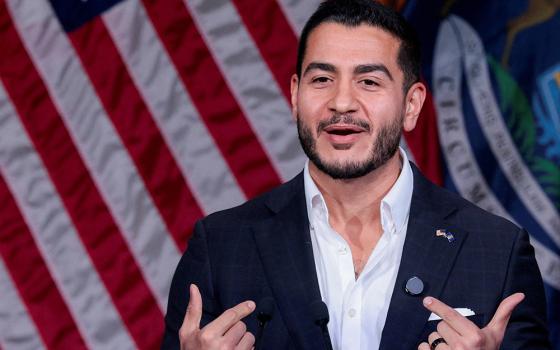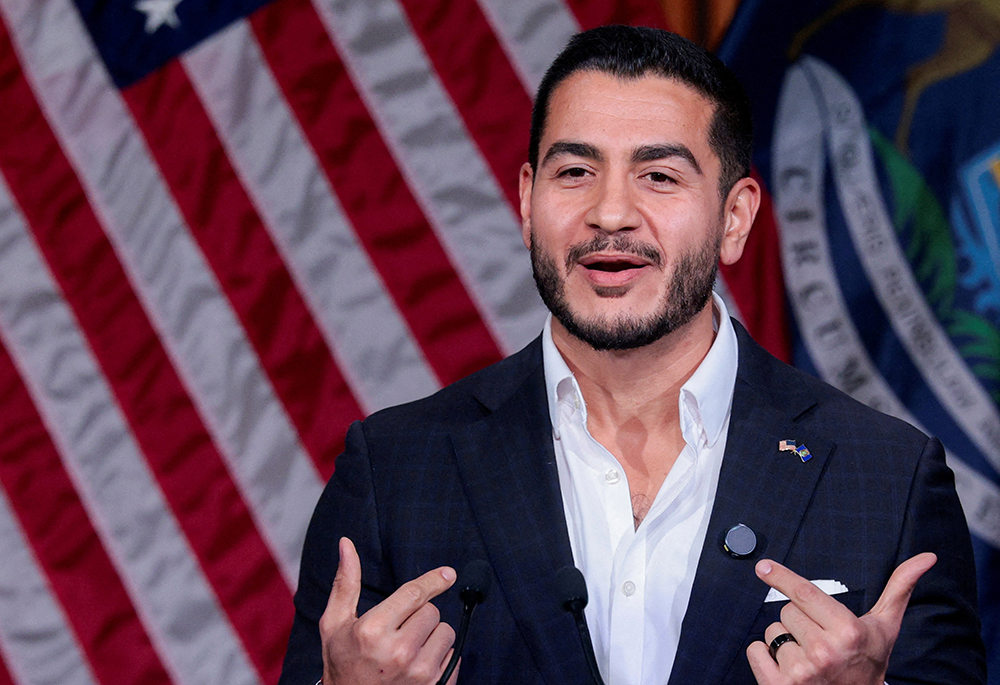
Democratic U.S. Senate candidate Abdul El-Sayed smiles after his victory in the U.S. midterm elections, during an Election Night rally in Detroit, Nov. 4, 2026. (OSV News/Reuters/Brian Snyder)
by Karen E. Park
Join the Conversation
Send your thoughts to Letters to the Editor. Learn more
"Michigan! We did it! My name is Abdulrahman Mohamed El-Sayed. And I am so proud and honored to stand here as your senator-elect from the great state of Michigan. Up until right about now, you might have noticed I always say, "Inshallah," or "God willing," whenever the outcome of this race was mentioned. But today, tonight, we can turn that "inshallah" into an "alhamdulillah."
With those words, the first Muslim United States senator opened his victory speech Tuesday night (Nov. 3) in Detroit. The crowd cheered joyfully, finishing his words with him as he transitioned from inshallah, "God willing," to alhamdulillah, "praise be to God." The knowing applause was in part an acknowledgment of the fact that throughout his campaign for Senate, Dr. El-Sayed's Muslim faith, along with his common Arabic name, and the ordinary Arabic words he used to speak about God, much as an American Christian might say "amen" or "hallelujah," had been treated as somehow disqualifying, dangerous and sinister.
Back in August, following El-Sayed's Michigan Democratic Senate primary victory, right-wing commentator Benny Johnson circulated a clip of El-Sayed saying inshallah, identifying him as a "Muslim Socialist Candidate." The implication was that the simple expression inshallah ought to be self-evidently alarming. Of course nothing about expressing humility and acknowledging that human plans, hopes and desires — even the desire to become a U.S. senator — always remain subject to the will of God, ought to be alarming. The assumption behind the post was that Arabic was itself something to be feared, along with El-Sayed's Muslim faith.
Trump repeatedly mocked Dr. El-Sayed's name, saying at a rally on Oct. 16 that "His name is actually Abdula-some-dalala. It's Adulabababababa Mohammed Al-Sayed. So his middle name is Mohammed. So I was right. … He's a jihadist. He's a radical left person, hates our country. He's a member of the Muslim Brotherhood."
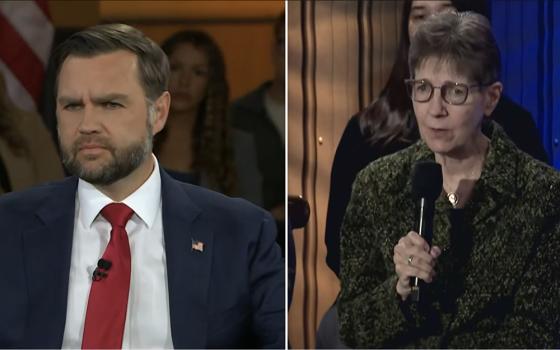
At a Michigan town hall in October, a heckler named Tommy (later identified as Tommy Teepell, son of Republican strategist Timothy Teepell) challenged El-Sayed to disavow the Muslim Brotherhood. El-Sayed did so instantly, but then engaged with Tommy for nearly five minutes asking him why the young man would assume he had dual loyalties just because he was Muslim. He compared his own situation to that of the Catholic presidential candidate John F. Kennedy in 1960, who had to repeatedly assure non-Catholic voters skeptical of his Catholic loyalties that he was indeed a true American, and if elected would not be a pawn of the Vatican. When asked about that exchange, Vice President JD Vance, himself a Catholic convert, called the comparison "absurd."
Advertisement
Over the last few months I have been thinking a great deal about what these attacks on both the Muslim faith and the Arabic language mean, in part because Arabic has long been a significant part of my family's life. My husband, who is Catholic, a professor of religious studies, and a specialist in Islam, speaks the language fluently. One of our sons also studied Arabic for four years in college, including a semester-long immersion program in Morocco. And last year our eldest daughter married into an Arabic-speaking Christian family whose origins are in Syria and Lebanon. At their wedding, my husband welcomed our new relatives in Arabic, telling them, iḥna kullna 'ailah dilwa 'ti ( إحنا كلنا عيلة دلوقتي): "We are all family now."
Arabic is a beautiful, nuanced and ancient language of prayer and praise. It is also, like all languages, full of terms for conveying affection, humor and the ordinary complexities of everyday life. For over a millennium, Christians like my daughter's in-laws have worshipped, preached, translated Scripture and written theology in Arabic. Arabic-speaking Christians say inshallah. They say alhamdulillah. And they call God Allah. But that is only part of the reason why for Catholics, the widespread failure to recognize both El-Sayed's language, and his faith tradition, ought to be especially troubling.
In 1965, the Second Vatican Council promulgated Nostra Aetate, its Declaration on the Relation of the Church to Non-Christian Religions. The third section includes this remarkable affirmation:
The Church regards with esteem also the Moslems. They adore the one God, living and subsisting in Himself; merciful and all-powerful, the Creator of heaven and earth, who has spoken to men; they take pains to submit wholeheartedly to even His inscrutable decrees, just as Abraham, with whom the faith of Islam takes pleasure in linking itself, submitted to God. Though they do not acknowledge Jesus as God, they revere Him as a prophet. They also honor Mary, His virgin Mother; at times they even call on her with devotion. In addition, they await the day of judgment when God will render their deserts to all those who have been raised up from the dead. Finally, they value the moral life and worship God especially through prayer, almsgiving and fasting.
Note that the Council Fathers were not simply declaring that Muslims ought to be permitted to practice their religion, or that Catholics should be polite and tolerant to their Muslim neighbors. They were instead making a theological statement about the God whom Muslims worship — an argument that had been clarified a year earlier, in Lumen Gentium, the Dogmatic Constitution on the Church. That document affirmed that God's "plan of salvation also includes those who acknowledge the Creator. In the first place amongst these there are the Muslims, who, professing to hold the faith of Abraham, along with us adore the one and merciful God."
The three words "along with us" are the key. The council was not describing a foreign deity or a religious tradition so fundamentally alien to Christianity that its worship could only be regarded with suspicion. It was not saying, as did Cardinal Raymond Leo Burke in his 2016 book Hope For The World: To Unite All Things In Christ, that "If you really understand Islam, then you understand that the Church really should be afraid of it." On the contrary, the Catholic Church esteems the faith of Muslims and affirms that this faith is along with us in the one and merciful God.
Esteeming the faith of the Muslim people does not mean that it is identical to the Christian faith. It is not. Unlike Muslims, Catholics profess both the Trinity and the Incarnation. For Muslims, Jesus was a great prophet, but he was not God, differences the Council Fathers understood perfectly well while still affirming their shared worship of the one true God.
Of course Article VI of the Constitution expressly forbids any religious test for public office, but Catholic teaching asks much more of us than basic respect for constitutionally protected religious liberty. Our own church teaches that treating Islam as an inherently alien or sinister religion is in opposition to the church's own theological account of who God is.
Given these authoritative teachings, which have been affirmed by Pope St. John Paul II and every pontiff since, it is discouraging that so many of the high profile attacks on El-Sayed came directly from our Catholic vice president, who went so far as to claim that "there's something about Abdul El-Sayed that is very, very, evil."
During his victory speech, El-Sayed briefly addressed Vice President Vance directly, calling him "JD. Habibi."
Habibi is of course an extraordinarily common Arabic expression of affection which can mean anything from "my beloved," to "buddy." And just like "buddy" it can also be used sarcastically.
Dr. Abdul El-Sayed's Arabic name, his Muslim identity and his religious vocabulary were too often treated this campaign season as if he, and by extension Muslims and Arabic speakers, do not belong in American public life. But the Catholic Church has spent more than 60 years teaching us to recognize something profound in the faith of our Muslim neighbors. We do not have to pretend that Christianity and Islam are the same religion. But we are called to recognize the dignity of Muslim religious life, the God whom Muslims worship along with us, and the obligations of justice and peace that bind us together.
When Dr. El-Sayed calls the vice president habibi, he refuses to surrender his language, with all its humor, and delicious nuances, to those who would make it an object of fear. When he says alhamdulillah, he is praising the same God whom Vice President Vance and all Catholics worship. Now that the election is over, there is much work to be done: the work of justice, forgiveness, and building a country where, inshallah, we can all belong.