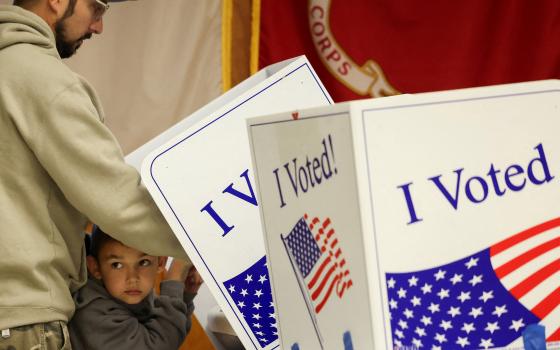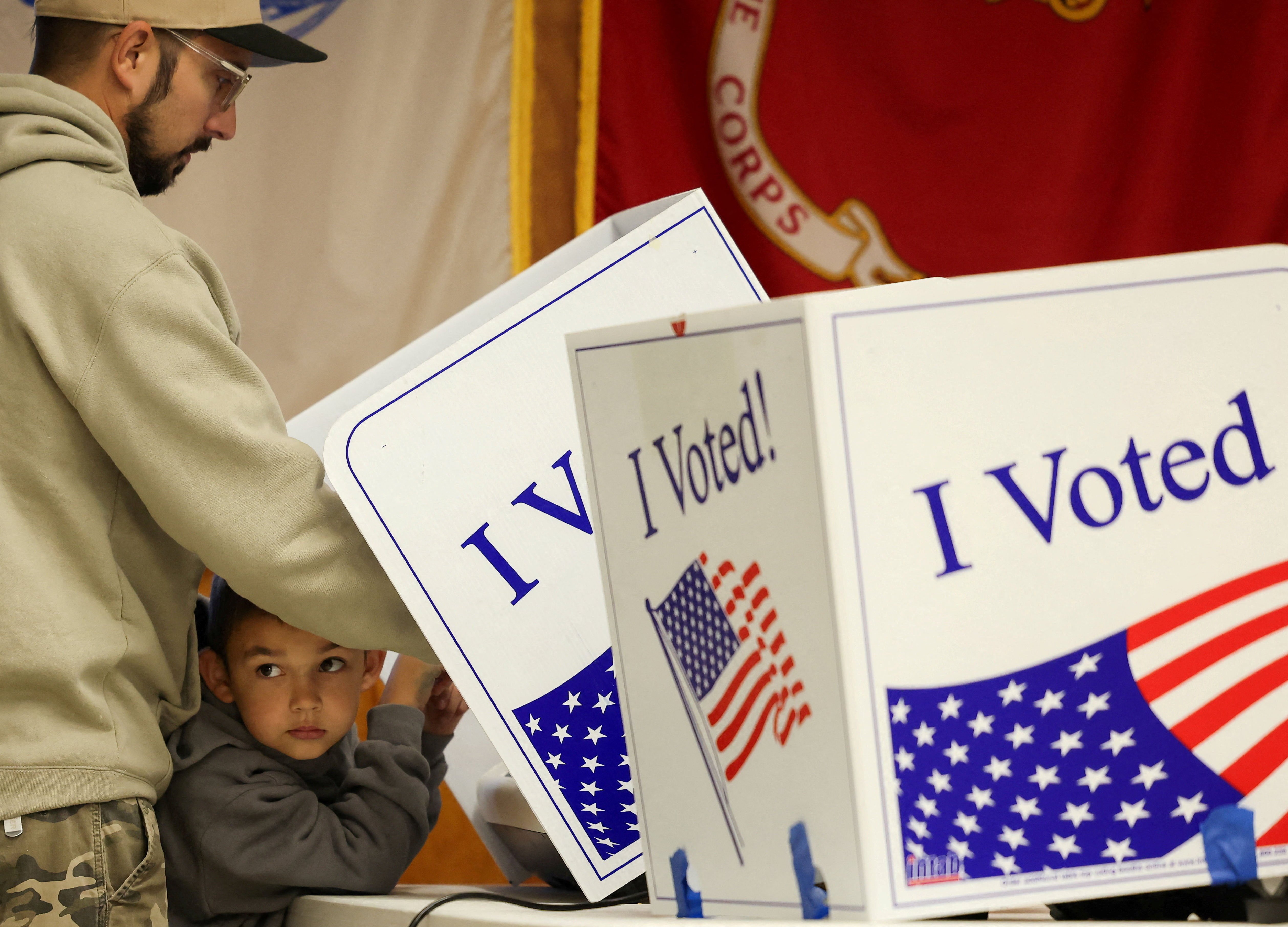
A child looks from under a booth as a man casts his ballot at a polling station on Election Day in West Columbia, S.C., Nov. 3, 2026. (OSV News photo/Sam Wolfe, Reuters)

Join the Conversation
Send your thoughts to Letters to the Editor. Learn more
It is impossible to interpret the results of yesterday’s midterm elections as anything other than a massive vote of no confidence in President Donald Trump. The blue wave turned into a tsunami, sweeping Democrats into control of both houses of Congress last night. And Catholic voters were part of the reason.
In Pennsylvania’s 8th congressional district, Democratic candidate Paige Cognetti defeated incumbent Republican Rob Bresnahan by 54% to 46%. [All vote totals from New York Times.] The district is centered on Scranton and Catholics constitute 29% of the population in the diocese of Scranton.
The neighboring 7th district, centered on Allentown which is now 50% Latino, also saw the Democratic candidate Bob Brooks win back a seat from the GOP, defeating incumbent Rep. Ryan Mackenzie by a margin of 56% to 44%.
That early result from Allentown prefigured the results in the heavily Hispanic, overwhelmingly Catholic counties in the Rio Grande Valley of Texas. In Webb County, home to Laredo, Democratic Senate candidate James Talarico was beating Ken Paxton by a margin of 3-1. Cameron County, home of Brownsville, broke for Talarico by 68% to 30%. Talarico did well throughout the state, but the heavily Latino counties in the Rio Grande that Trump won in 2024 all broke for Talarico last night. They also helped carry Democratic gubernatorial candidate Gina Hinojosa to a surprising victory over incumbent Gov. Greg Abbott.
Elon Musk dumped almost half a billion dollars on the midterms, much of it in Texas. Don’t you wish he had spent even more!
Last month, I noted that the two Catholic dioceses in North Carolina, Charlotte and Raleigh, both now have more than 500,000 Catholics. The first Senate flip to be called last night was in North Carolina where Democrat Roy Cooper defeated Republican Michael Whatley by 59% to 39%.
Whatley was one of several Republican candidates who were hand-picked by Donald Trump. Paxton in Texas, Mike Collins in Georgia and Darline Graham in South Carolina were all picked by Trump in the primaries and all went down to defeat. Each was more extreme than other Republican options which provides a lesson for both parties: Voters in general elections prefer moderate candidates.
Each race is different. While the economic focus of the election had nationwide effects, some contests had powerful, local dynamics shaping the contest. Holding on to the Senate seat in Michigan should have been easy for the Democrats this year, but when Dr. Abdul El-Sayed won the Democratic primary in August, the race became as much about him as about Trump. Progressives had won primaries in districts that were already deep blue, but El-Sayed was the one progressive to win a primary in a swing state. While almost every Democrat was overperforming the polls, El-Sayed barely made it across the finish line.
On the other hand, in Kansas, pastor Adam Hamilton —who breathed moderation and like Talarico called for a more humane and decent politics — became the first Democrat to win a Senate contest there since 1932. The Democratic base is decidedly secular, but they should recognize that a pastor won Kansas and a seminarian won Texas. Religion not only matters to millions of Americans, but it may hold the keys to fashioning a better and more effective kind of politics.
Advertisement
The Republican effort to gerrymander their way to a victory in the House failed utterly. In Florida, of the four districts where lines were redrawn to ensure a Republican victory, three had been called for the Democrats before 10 p.m. and Democratic Rep. Darren Soto was maintaining a narrow lead in the fourth, though the AP had not called the race as of this writing.
How will the president respond? The standard political analysis is unequal to answer this question. Psychologists might provide as much insight as political scientists. But the results were so overwhelming, it is almost impossible for him to challenge them in any meaningful way. Just as I was finishing this column, he called into Fox News and all he could do was place the blame for the defeat on others. In his first term, there were still grown-ups in the White House, but they have been replaced by acolytes. What advice will they give? What experiences do they bring to the challenges of divided government?
The Democrats should not overinterpret the results. This was a rejection of Trump more than it was an endorsement of the Democrats. But the Democrats in Congress need to use the next two years intelligently to not only rein in Trump’s authoritarianism but also to legislate a set of policies which, even if vetoed, display the party’s values and priorities to the electorate. More on this Friday.
A midterm election never yields a cohesive set of policy preferences for the party that does not control the White House but which won the midterms. That will come in 2028 when the party selects a presidential candidate whose personal attributes and policy positions propel him or her to the front of the pack. That person will have to balance the energy on the extremes which tends to overperform in primaries with the moderation sought by voters in the center of the electorate who actually decide a general election.
Advertisement