

Michel Chambon is a French Catholic theologian and a cultural anthropologist at the National University of Singapore and is coordinator of the Initiative for the Study of Asian Catholics (ISAC).
Najon Saina Tuiolemotu is a Master of Divinity Student at Pacific School of Religion studying Pastoral Care. She has an undergraduate degree from CSU, Sacramento in social work with a core passion to work with the youth as she sees the youth as future pioneers of change. Her family is from Samoa and she now resides in Marina, CA.
Kim Lawton is a freelance journalist in Washington, D.C. She is the former managing editor of the highly-acclaimed PBS program "Religion & Ethics Newsweekly." She produced this video as part of "Spiritual Exemplars: A Global Project on Engaged Spirituality" at the USC Center for Religion and Civic Culture, with support from the John Templeton Foundation and Templeton Religion Trust.
<h2><a style="color: #04619d; text-decoration: none;" href="https://www.ncronline.org/spirituality/scripture-life/fifth-sunday-east… Sunday of Easter: A culture of encounter</a></h2><div style="font-weight: bold; font-size: 15px; font-family: Arial, sans-serif;" class="byline">by Mary M.
<h2><a style="color: #04619d; text-decoration: none;" href="https://www.ncronline.org/culture/book-reviews/12-modern-disciples-foll… modern disciples follow the subversiveness of Jesus in 'People Get Ready' </a></h2><div style="font-weight: bold; font-size: 15px; font-family: Arial, sans-serif;" class="byline">by Shannon Wimp Schmidt</div><div style="font-size: 19px; fon
Shannon Wimp Schmidt is a parish vitality coordinator for the Chicago Archdiocese, co-host of the "Plaid Skirts and Basic Black" podcast, and author of the book Fat Luther, Slim Pickin's (Ave Maria Press, 2022). She lives in Chicagoland with her husband Eric and their four children. Follow her on Instagram @teamquarterblack and Twitter @teamquarterblk.
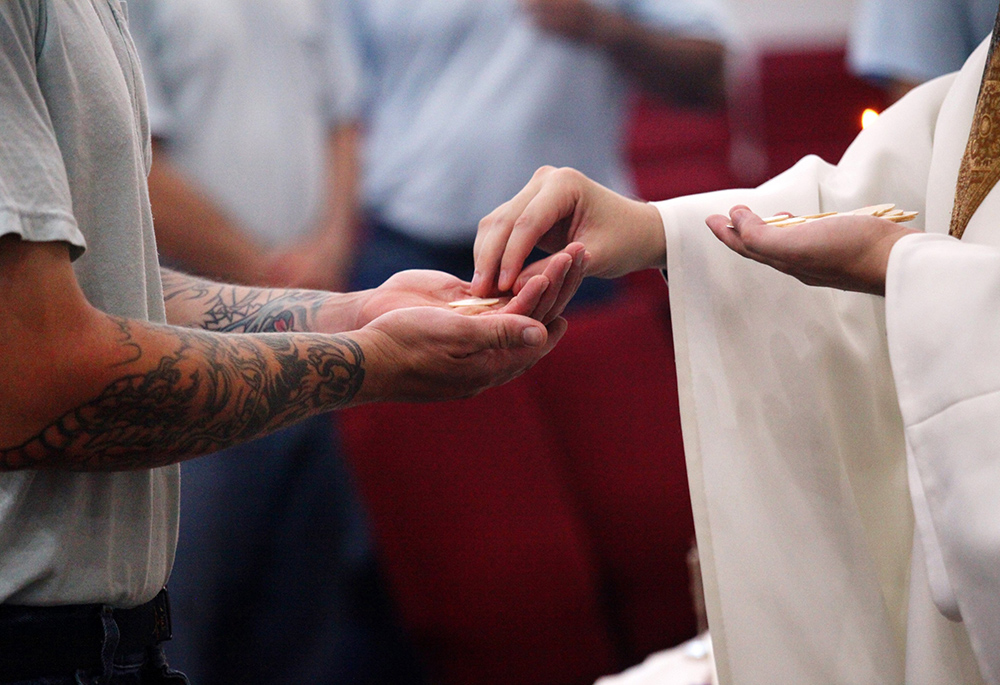
A file photo shows an inmate receiving Communion at the Ellsworth Correctional Facility in Kansas. (OSV News/CNS file/The Register/Karen Bonar)

by Mary M. McGlone
Join the Conversation
Send your thoughts to Letters to the Editor. Learn more
"Get ready for a trip!" That could well be our call to worship as we begin the celebration of this "Solemnity of the Body and Blood of Christ."
We start this journey remembering the long trek of our Israelite ancestors in the desert. As we think of them, it's helpful to be aware that the scriptural sense of remembering implies reliving an event ourselves, entering into the story and being transformed by it in our day and our way, getting our own taste of the original participants' experience.
This is precisely what Moses calls for in our reading from Deuteronomy. Moses tells them, "Remember how … Remember how God let you be tested so that you would learn just how faithful you were willing to be. Remember how in your hunger you were ready to give up on God until desperation helped you recognize God's care for you in ways you had never expected. Remember what happened to you as you journeyed with God for all those years. Remember, you were slaves. Now, if you are willing, you can be free." Moses invited the people to remember so that they could continue discovering God's love and care in ever-new ways. With that start, we can approach Chapter 6 of John's Gospel as a long meditation on God's new way of giving life through Jesus.
The Gospel of John, written about 60 years after Jesus' resurrection, is more a theological reflection than a historical or biographical document. At the risk of oversimplification, one might suggest that the Gospels of Matthew, Mark and Luke can be experienced as invitations to contemplate of the life of Jesus while John invites us into mysticism, the experience of word of God drawing us into union with Christ in ways that go beyond words.
Very often in John, Jesus says things that people understand on the most mundane level possible. He then invites them to think more profoundly until they become caught up in unexpected depths of insight which lead to union with him. (Remember the ideas of being born again in Chapter 3, the living water in Chapter 4, etc.) The move from the superficial to the depths is the very process through which Jesus has tried to lead disciples from the day of their/our calling through his ascension, and on through today.
Our selection from John 6 is a small excerpt from a long story and discourse which includes the miraculous sharing of bread and fish, Jesus' walking on the water, and a full discourse that includes the summary selection we hear today. Jesus' core idea here is: "Whoever eats my flesh and drinks my blood dwells in me and I in her/him." This teaching can be taken in such a literal way that it sounds disgusting and/or impossible. Remembering John's literary techniques, we know we need to look deeper. What was Jesus trying to say?
Advertisement
When we consider the experience of eating and drinking, we become aware of two things: eating and drinking are absolutely necessary for life and what we eat becomes a part of us — it literally becomes our flesh and blood. Although we rarely consider it, the most intimate connection we have in life is with what we eat. By comparing our reception of himself to food, Jesus reveals his desire for such an intimate connection with us that it can only be expressed by saying, "I dwell in you." Astoundingly, he adds, "and you dwell in me." With these words, Jesus explains that he is inviting us into the profound mutuality we call communion.
When we meditate on this, another idea draws our attention. Jesus gives us an additional explanation saying, "Just as I have life because of the father, so also the one who feeds on me will have life because of me." As we also hear in John 17:22-23, Jesus is inviting his disciples to take him in as the bread of life, to become one in him and share in his own life and relationship with the father. Paul summarizes this for the Corinthians that by saying that as they share the bread and cup, they become one body in Christ.
Where does this feast invite us to go? Like the entire Gospel of John, it invites us to venture beyond what we see and to imbibe Christ's invitation to communion. As we do so, we remember that although each of us must accept the invitation personally, we are invited into this communion with God in Christ as members of the body of Christ, a people who share the same mission to bring and be communion for all the world.
This becomes the trip of a lifetime.
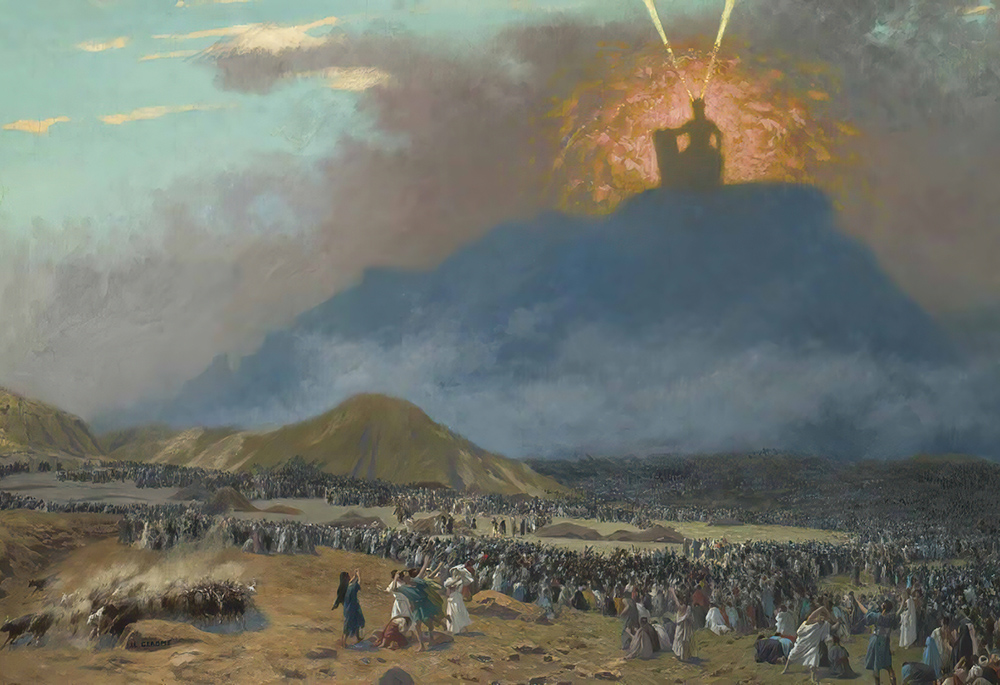
"Moses On Mount Sinai" by Jean-Léon Gérome (Artvee)
by Mary M. McGlone
Join the Conversation
Send your thoughts to Letters to the Editor. Learn more
How to approach the unapproachable? How to imagine the unimaginable? The Solemnity of the Most Holy Trinity raises questions like these. The Scriptures offer tremendous help in our search to know what God is like, not because they give us a clear answer, but precisely because they do not.
The Hebrew and Christian Scriptures offer us images of God as omnipotent creator and as an artisan who fashions creatures from river mud; God dwells in unapproachable light and walks and talks with Abraham. God appears in cloud and fire, and is heard in thunder and the gentlest breeze. God speaks in the direst warnings of the prophets and the consoling words of a stranger on the road to Emmaus.
Today, Exodus reveals more than we might realize as Moses leads us up the mountain. One of the first things to notice here is the name, "Lord." That word replaced the sacred Tetragrammaton, the four-letter Hebrew word, YHWH, the divine name. From earliest times, the Jewish people regarded that name as too sacred to even attempt to pronounce. Wherever it was written they circumvented it, usually saying Adonai ("my Lord") to refer to God. The early Christians respected that reverence, translating the name as Kyrios or Dominus. In 2008, the Vatican Congregation for Divine Worship reminded Catholics to continue that practice. The first thing Exodus tells us today is that God's name is immeasurably sacred. We cannot define God.
As we read this Exodus passage, we realize that only God pronounces the sacred name and follows it with a self-description. According to this auto portrayal, God is "merciful and gracious, slow to anger and rich in kindness and fidelity." Those interrelated words create a litany that portrays the gentle and loving ways the Lord relates to humanity. No wonder Moses begged God to come along with his unruly flock!
Today's Gospel enlarges our sense of the divine image in two ways. First, while we are accustomed to encountering John 3:16 ("God so loved the world") on billboards or at sports events, scholars offer a slightly different translation from the slogan we ordinarily hear. According to Scripture scholar Edward Klink, this passage is best translated as, "For in this way God loved the world." That subtly nuances the idea, not measuring how much, but rather how God loves, telling us that God loves through the "unique son." Secondly, this passage from John elaborates on Exodus and the whole of the Hebrew Scriptures as it explains that God's love is always demonstrated in action: Every moment of Jesus' life demonstrated how God loves the world.
Today's Scriptures insist that the God of Christianity is a God who loves real people in real time. Anyone who understands this would, like Moses, invite this God to accompany them along the road of life. That's a bit of what we can derive from our selections from Exodus and John.
Advertisement
Today's selection from the end of Paul's Second Letter to the Corinthians was chosen because it is one of the few passages in Scripture that clearly speaks of God as Father, Son, and Holy Spirit. Speaking of the Trinity, it draws us into what is the most mysterious of Christianity's beliefs.
While the New Testament does not really develop a Trinitarian concept of God, Jesus subtly introduced the concept of the Trinity by referring to his relationship to his father and in his promise to send his Spirit. Paul's letters are more specific when they refer to God under the three distinct names of Father, Son and Spirit. Over a period of nearly 400 years, these references, combined with prayer and theologizing, came to fruition in what we now pray as the Nicene Creed.
What then, does this feast day mean for us? What are we celebrating? Based on today's Scriptures, we can say that this feast focuses our attention on God's self-revelation as loving and deeply involved with humanity from the moment of human consciousness. More specifically, this feast invites us to contemplate the depth of God's love and God's desire to draw all into divine life. It celebrates the love of God revealed in Jesus and our invitation for God's Spirit to be active in and among us.
We cannot adequately name God, yet we experience the unapproachable mystery inviting us to awe and drawing us close. Through creation and revelation, we can experience uncountable ways in which the unimaginable one lures us to share divine life. Now, we can bask in miniature glimpses of God. We await the day when "we will be like Christ because we will see him face to face" (1 John 3:2).