

Matthew Blanton is a Ph.D. Candidate in Sociology and Demography at the University of Texas at Austin.
<div style="text-align: center;"><div style="margin-bottom: 10px; padding-bottom: 10px; border-bottom: 1px dotted #ccc;" class="full_width_image"><img style="width: 624px; max-width: 100%;" src="https://www.ncronline.org/files/styles/email_newsletter_full_width/publ… style="color: #04619d; text-decoration: none;" href="

<h2><a style="color: #04619d; text-decoration: none;" href="https://www.ncronline.org/opinion/ncr-voices/parsing-supreme-court-argu… Supreme Court arguments in crisis pregnancy centers case</a></h2><div style="font-weight: bold; font-size: 15px; font-family: Arial, sans-serif;" class="byline">by Michael Sean Winters</div><div style="font-size: 19px; font-family: 'Georgia'
<div style="text-align: center;"><div style="margin-bottom: 10px; padding-bottom: 10px; border-bottom: 1px dotted #ccc;" class="full_width_image"><img style="width: 624px; max-width: 100%;" src="https://www.ncronline.org/files/styles/email_newsletter_full_width/publ… style="color: #04619d; text-decoration: none;" href="

Secondary 550 Ad
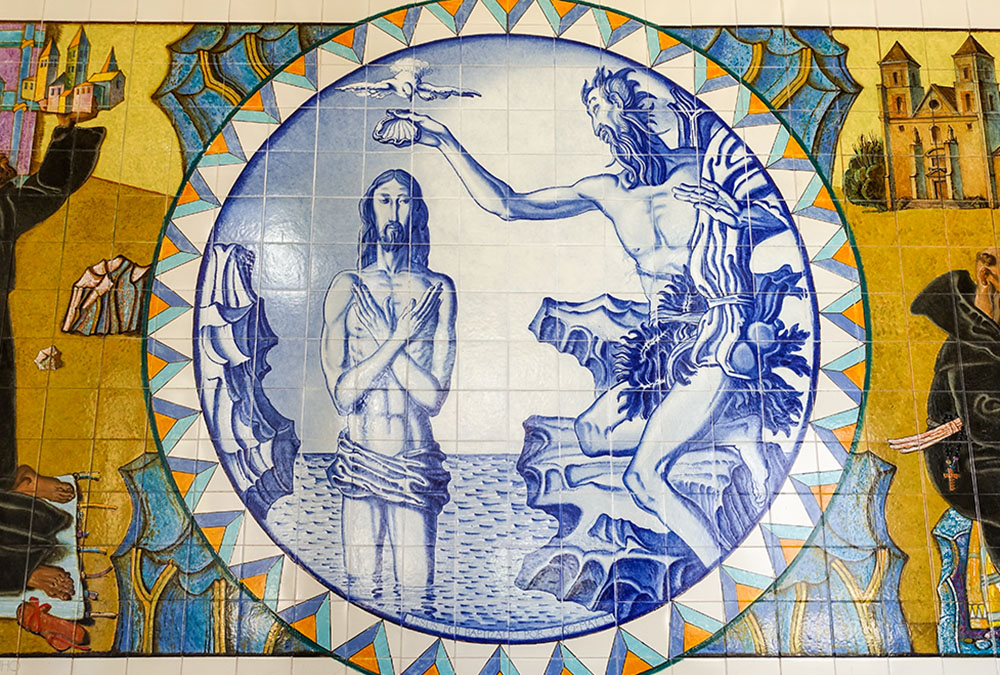
The baptism of Jesus is depicted in azulejos at the Santuário de São Bento da Porta Aberta in Rio Caldo, Portugal. (Wikimedia Commons/Jose Goncalves)

by Mary M. McGlone
Join the Conversation
Send your thoughts to Letters to the Editor. Learn more
One of the things we know for certain about Jesus is that he was baptized by John. We're sure of it because it embarrassed the early church, making Jesus appear as John's disciple, yet it was too well-known to skip over.
Mark (1:9-11) recounted it as a simple fact. Luke (3:21-22) refers to it only indirectly and John (1:32) simply mentions that the Baptist saw the Spirit of God descend on Jesus. Matthew's version minimizes the implication that Jesus followed John, claiming that when Jesus came for baptism, John protested that it should be the other way around because he was not worthy.
All of that indicates that Jesus really did turn to John and his ritual as a sign of commitment to what God was doing in their midst.
If Jesus' disciples were so worried about the implications of his baptism, we might ask, "Why did Jesus do it, and what did it mean for him?"
Jesus himself insisted that there had never been anyone like John (Matthew 11:7-14). It wasn't just his countercultural appearance or even his fiery message. Most striking of all, John attracted crowds and moved them to undergo a baptism that signified their promise to live like people happily aware that the reign of God was at hand. John awakened people to possibilities in ways the Pharisees, Sadducees and even the Essenes were unable to do.
Jesus began his public ministry in John's heyday. By asking for John's baptism, Jesus declared himself to be of a common mind with John.
Scholars and disciples have long wondered what Jesus was doing before his baptism. What direction did he see for his life? How did he use the Scriptures as a guide to discover his own vocation? The fact that Jesus' followers used so much of Isaiah's writings to interpret Jesus' vocation hints that Jesus himself may have done so and shared that vision with them.
Today's selection from the prophet Isaiah describes the vocation of a servant of God in ways that Jesus could well have incorporated into his own self-concept. He could conceive of God calling him "my servant," one who would perceive God's glory. Just as all of us are conceived in mystery and formed even before we are born, Jesus surely must have understood himself as chosen by God to carry forth a mission as unique as his own person.
The psalm we sing today could also have been core to Jesus' prayer. Like his mother who said, "Behold the servant of the Lord," Jesus could pray, "Here am I, Lord, I come to do your will." As he lived his vocation, he fulfilled the song's intent to focus on obedient listening rather than sacrifice. Jesus proclaimed the law of God as a law of the heart.
The fact that Jesus joined the circle of John the Baptist and then branched out in an alternative direction gives us the idea that, like us, Jesus needed to discover his vocation day by day. He, too, needed to listen to the call of God in his heart and discern how to collaborate with what God was working among the people. Jesus was humble enough to identify with John's followers and courageous enough to move in new ways as his prayer and love of his people led him to do.
Advertisement
We can imagine that Jesus began his mission in a posture of discernment and continued to allow himself to be led by God's Spirit for the rest of his life. Rather than having a plan and sticking to it, he grasped the freedom to respond to the needs of the moment as a sign of God's love with no other agenda.
With all of that in mind, we can interpret Jesus' baptism as a sign of his deep identification with us in all that is human — including in his desire to discern and carry out God's design in unforeseeable circumstances. We can perceive how he looked to his tradition (Isaiah) and to the prophets of his moment of time (John) and how he combined those into his prayer for guidance about how to carry out his vocation.
Jesus' baptism reminds us that he was one of us. He revealed that we humans must allow ourselves to be fragile, seeking and willing to change course when love calls for it.
As we recall Jesus' baptism, let us remember that we are baptized into him, to share the grace of his approach to life. The Spirit may not descend on us like a dove, but that Spirit enables us to share Jesus' freedom and to love in the ways our moment calls forth. We should not forget that we, like him, are beloved and well pleasing to God.

A star named TYC 3203-450-1 outshines a more distant galaxy, NGC 7250, in this Hubble Space Telescope image. (ESA/Hubble & NASA)
by Mary M. McGlone
Join the Conversation
Send your thoughts to Letters to the Editor. Learn more
"Rise in splendor, your light has come!"
"When King Herod heard this, he was greatly troubled."
Isaiah and Matthew spoke about the same reality and opposing reactions from people who heard of it. Ignatius of Loyola would explain that when good people hear the Gospel, the "good spirit" gives them peace and consolation; the "evil spirit" causes the same news to bring dreadful consternation to those whose purposes run counter to God's designs.
First, let's look at the evil side. According to Matthew's narrative, the news of a newborn king so disturbed King Herod that he ordered a massacre of all boy children born around the time of the Magi's travels. This story is probably less factual than symbolic: It creates a parallel between Jesus and Moses who was saved from Pharoah's slaughter of the Hebrews (Exodus 1:15-22). Yet even if Herod didn't order the massacre, he was cruel enough to order the death of his own sons, whom he saw as rivals.
Typical of Jesus' enemies, Herod couldn't tolerate the danger Jesus posed to the evil powers that propped him up. To Herod, as to the pharaoh, the good news posed a lethal threat.
Now to the good spirits. Isaiah proclaims that the very glory of God will shine on and through the people. The darkness they experienced stood in stark contrast to what God was working among them. Isaiah teaches that knowing God's glory causes people's hearts to throb and overflow such that their very faces reflect divine glory. According to Isaiah, knowing God's glory makes people so attractive that the whole world will be drawn to them.
In Matthew's narrative, the Magi symbolize all people who seek the glory of God and who, when they see signs of it, are willing to journey beyond their own horizons, seeking God's yet-unknown grace and wonders.
Paul, in his own way, reflects the Magi's spirit through his life-changing discovery of the mystery of Christ's love. In contrast to the murdering Herod, when Paul encountered Christ, he became the apostle who proclaimed the good news to Gentiles, insisting that Christ came for all Earth's people.
This year, we will hear the Gospel of Matthew. The story of the Magi introduces two of his key themes. First, Matthew highlights Christ as our Emmanuel, God with us. The angel who appeared to reassure Joseph called Mary's unborn child Emmanuel, indicating who Jesus would be (Matthew 1:23). In the last words of Matthew's Gospel, Jesus commissions his disciples with the promise, "Behold, I am with you [Emmanuel] until the end of the age" (Matthew 28:20).
The second theme the Magi introduce is Emmanuel's presence for the whole world. Just as Isaiah proclaimed that nations would walk by the light of Israel, Matthew speaks of foreigners who sought the one heralded by their star. They trekked long and far to the insignificant town of Bethlehem to find that light.
This theme, too, finds its counterpart at the end of the Gospel when Jesus commissions the disciples to "Go and make disciples of all nations." In the presence of Emmanuel, there are no foreigners.
Advertisement
Matthew's Gospel invites us all to contemplate the reality of Emmanuel, God with us here and now. We are setting off into a year of paying particular attention to recognizing Emmanuel in our midst.
The feast of the Epiphany reminds us that the good news is for everyone of every age. Its proclamation can bring great joy or cause terrible consternation, depending on what each person or society values.
The feast of the Epiphany invites us to enter deeply into these readings. With Isaiah, we can meditate on what truly makes our hearts throb and grow. Reading Paul's words to the Romans, we can recall ways in which we have felt God's invitation into mystery and newness. We can discern about the signs of our times and ask what things we have heard that were "not made known to people in other generations." Then we ask ourselves what we are capable of as people made "coheirs, members of the same body and copartners in the promise in Christ Jesus."
If we are adventurous enough, we might ask the Magi what would draw them forth today. What is happening that would echo in their hearts? Who would they invite to journey with them seeking God's newness? The Magi would then ask us, "What do you long for so much that you would search heaven and Earth to find it?"
Epiphany urges us to decide what will orient us in this coming year and to set off toward it with the bold and adventurous hope that can only spring from faith — a wonderful way to begin a year of concentration on the Gospel of Matthew.
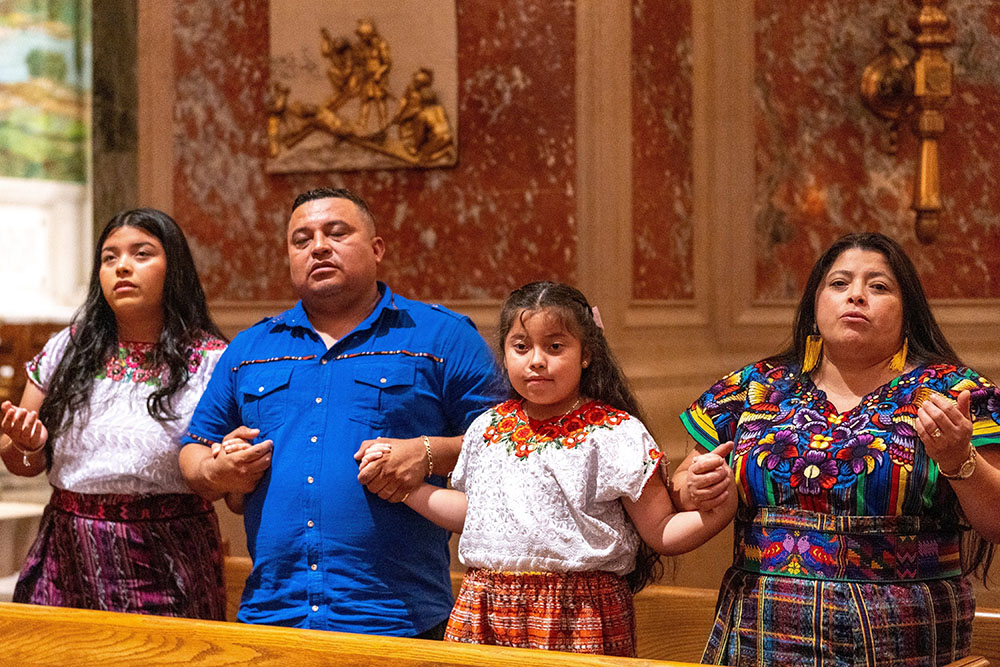
A family prays during Mass at the Cathedral of St. Matthew the Apostle in Washington Sept. 24, 2023. (OSV News/Catholic Standard/Mihoko Owada)
by Mary M. McGlone
Join the Conversation
Send your thoughts to Letters to the Editor. Learn more
The psalm we pray for the feast of the Holy Family begins: "Blest are those who fear the Lord." That's an unfortunate translation. At first glance, fear of the Lord sounds like an attitude of ongoing anxiety, a constant concern that we might do something deserving of punishment. That stage of moral development, appropriate to children between 3 and 7 years old, is ultimately a save-yourself approach to life under the rule of a God who audits our every action.
An alternative approach might translate the opening line as "Blest are those who stand in awe at the Lord." An attitude of awe follows the recognition of the immense greatness and love of God.
It's the sort of feeling one has while looking at Niagara Falls or at their spouse as they pronounce wedding vows. When we get caught up in such a feeling it's something close to fear, but it's more an experience of overwhelming goodness and beauty. It has nothing to do with disapproval or punishment.
Today, Sirach gives us advice about how to create relationships of mutual respect and love. Note his vocabulary. The prominent words are honor and revere.
A child who is afraid of parents cannot truly honor or revere. Their relationship is transactional: I do this, and you should do that. It's like a store owner and client: I provide the food, and you pay me the money. Nobody needs to give of themselves, and nobody ends up in debt to another. It might be fair, but nothing personal need happen after the exchange of goods.
In his letter to the Colossians, Paul describes an alternative to such shallow relationships. Paul calls the community to clothe themselves, with compassion, kindness, humility and more. He adds, "Most of all, put on love, that is the bond of perfection."
We might say that Paul calls for the sort of reverence and awe of others that characterizes the relationships fostered in a synodal community.
Our synod documents call for a quality of presence that attends to each person as a vessel of the Holy Spirit. One document describes it saying, "This quality of attention is an act of respecting, welcoming ... an approach that takes seriously what happens in the hearts of those who are conversing."
This is an invitation to learn how to act with attention. Joseph exhibited this virtue to an extraordinary degree. When he realized Mary was bearing a child not his own, he listened. Surely, he listened to Mary. He also listened to his tradition and then to an angel who came in a dream.
He adopted that child, creating with him and Mary a home that called forth all that each of them could be. When the innocent child was in mortal danger, Joseph gave up everything to take him and his mother to safety.
The feast of the Holy Family of Jesus, Mary, and Joseph celebrates our families and communities. It invites us to be communal centers of compassion, kindness, humility. It bears repeating: humility.
It takes humility to listen to a parent, sibling or child who is not behaving as we wish. Reverent listening becomes possible within bonds of love, the bonds that lead us to "perfection," or to the fullness of who we can become.
Advertisement
Family and community are designed to live heart-to-heart. They're webs of relationships in which we call forth one another's humanity. More than that, family and community exhibit what it means to be in the image and likeness of our Trinitarian God.
We Christians hold a unique — and to many others, strange — understanding of God as triune. We believe in the Trinity living in an eternal flow of relationship that keeps each one in being as Father, Son and Spirit. That's a family. That's the family from whom every family/community gets its name (Ephesians 3:15).
As this feast celebrates every family, every community, and every friendship that images the God of relationship, we might look to Joseph as our model. Joseph listened. In his listening, he transformed Mary the Mother of God from being a woman in great trouble to a wife. In his listening, he was the first disciple to leave tools and home (boats and nets) for the sake of the Son of God.
Why not make this a feast of thanksgiving? We can make it a day of listening to our experience and relishing our memories of God and every person — family member, friend, teacher, pastor, counselor — who has loved us into becoming who we are.
Then, from the strength of that love, let us widen our circles of relationship until we are overwhelmed by the goodness and beauty of each child of God.
We can be part of many Holy Families.